

9 TEWI Assessment of Conventional and Solar Powered Cooling Systems
151
industries such as Mitsubishi (2012), Tokyo Boeki Machineries (2019), Bry-Air
(2019), Mayekawa (2019), and SorTech (2009) are commercially manufacturing
high capacity adsorption chillers.
9.2 Cooling Systems
The refrigerant fluid changes its phase between vapour and liquid in various sections
of the cooling system due to pressure variation, which is the fundamental working
principle of any cooling system (Ahamed et al. 2010; Gill and Singh 2018; Yumruta¸ s
et al. 2002; Yang and Yeh 2015). Most common types of cooling system utilize electrical energy to achieve the desired pressure. Moreover, researchers have developed
new systems that are capable of doing the same job using thermal energy such as
(solar energy, waste heat, geothermal energy, and so forth) (Carotenuto et al. 2017;
Ghaebi et al. 2018; Ng et al. 2001, 2006; Habib et al. 2013; Choudhury et al. 2013;
Alahmer et al. 2016; Khan et al. 2007).
9.2.1 Vapor Compression Refrigeration (VCR)
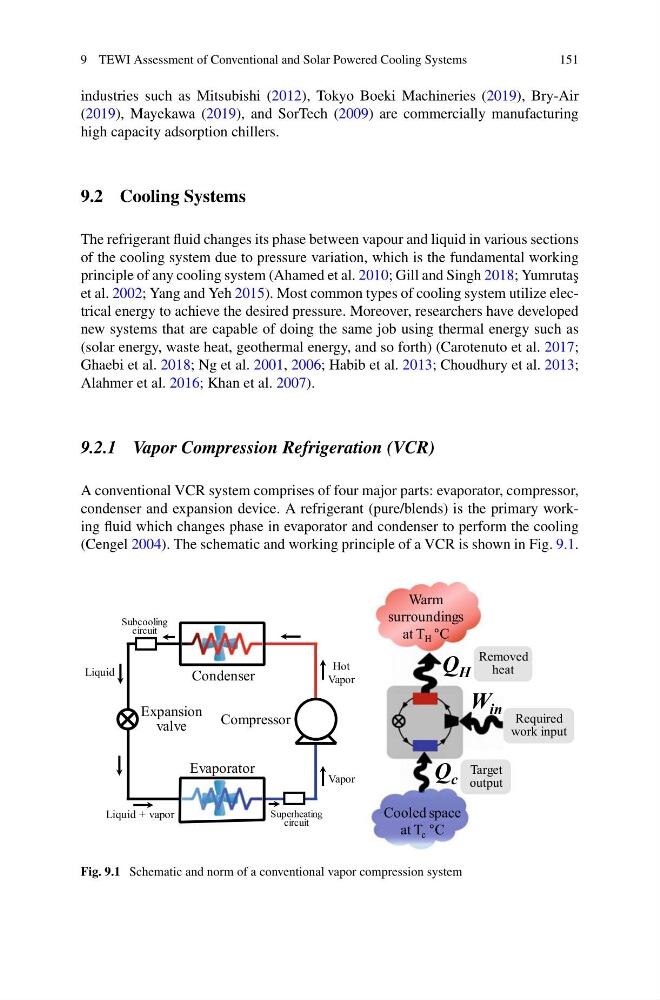
A conventional VCR system comprises of four major parts: evaporator, compressor,
condenser and expansion device. A refrigerant (pure/blends) is the primary working fluid which changes phase in evaporator and condenser to perform the cooling
(Cengel 2004). The schematic and working principle of a VCR is shown in Fig. 9.1.
Condenser
Evaporator
Compressor
Expansion
valve
Vapor
Hot
Vapor
Liquid
Liquid + vapor
W in
Q c
Q H
Cooled space
at T c °C
Warm
surroundings
at T H °C
Required
work input
Target
output
Removed
heat
Subcooling
circuit
Superheating
circuit
Fig. 9.1 Schematic and norm of a conventional vapor compression system
151
industries such as Mitsubishi (2012), Tokyo Boeki Machineries (2019), Bry-Air
(2019), Mayekawa (2019), and SorTech (2009) are commercially manufacturing
high capacity adsorption chillers.
9.2 Cooling Systems
The refrigerant fluid changes its phase between vapour and liquid in various sections
of the cooling system due to pressure variation, which is the fundamental working
principle of any cooling system (Ahamed et al. 2010; Gill and Singh 2018; Yumruta¸ s
et al. 2002; Yang and Yeh 2015). Most common types of cooling system utilize electrical energy to achieve the desired pressure. Moreover, researchers have developed
new systems that are capable of doing the same job using thermal energy such as
(solar energy, waste heat, geothermal energy, and so forth) (Carotenuto et al. 2017;
Ghaebi et al. 2018; Ng et al. 2001, 2006; Habib et al. 2013; Choudhury et al. 2013;
Alahmer et al. 2016; Khan et al. 2007).
9.2.1 Vapor Compression Refrigeration (VCR)
A conventional VCR system comprises of four major parts: evaporator, compressor,
condenser and expansion device. A refrigerant (pure/blends) is the primary working fluid which changes phase in evaporator and condenser to perform the cooling
(Cengel 2004). The schematic and working principle of a VCR is shown in Fig. 9.1.
Condenser
Evaporator
Compressor
Expansion
valve
Vapor
Hot
Vapor
Liquid
Liquid + vapor
W in
Q c
Q H
Cooled space
at T c °C
Warm
surroundings
at T H °C
Required
work input
Target
output
Removed
heat
Subcooling
circuit
Superheating
circuit
Fig. 9.1 Schematic and norm of a conventional vapor compression system