

142
M. Muttakin et al.
The rate of heat input to drive an adsorption chiller can be expressed by,
Q h =
t cycle
0
˙
m hot C p,hot
T in,hot − T out,hot
dt
t cycle
(8.65)
The COP of the chiller is defined by the ratio of useful cooling capacity produced
to the heat input to the chiller. Mathematically it can be shown as,
C O P =
Q c
Q h − Q rec
(8.66)
where Q rec is the rate of heat recovered during the heat recovery stage.
8.5.4 Typical Simulation Results
In this subsection, simulation results of a typical 10-ton capacity adsorption chiller are
shown. Let us consider the inlet temperatures of the cold water, hot water and chilled
water are 27, 80 and 13 °C respectively and their flow rates are 10, 15 and 6 m
3 /h
respectively. These values are assumed to be constant throughout the operation of the
chiller. However, they may not be such a uniform in real-life application. The chiller
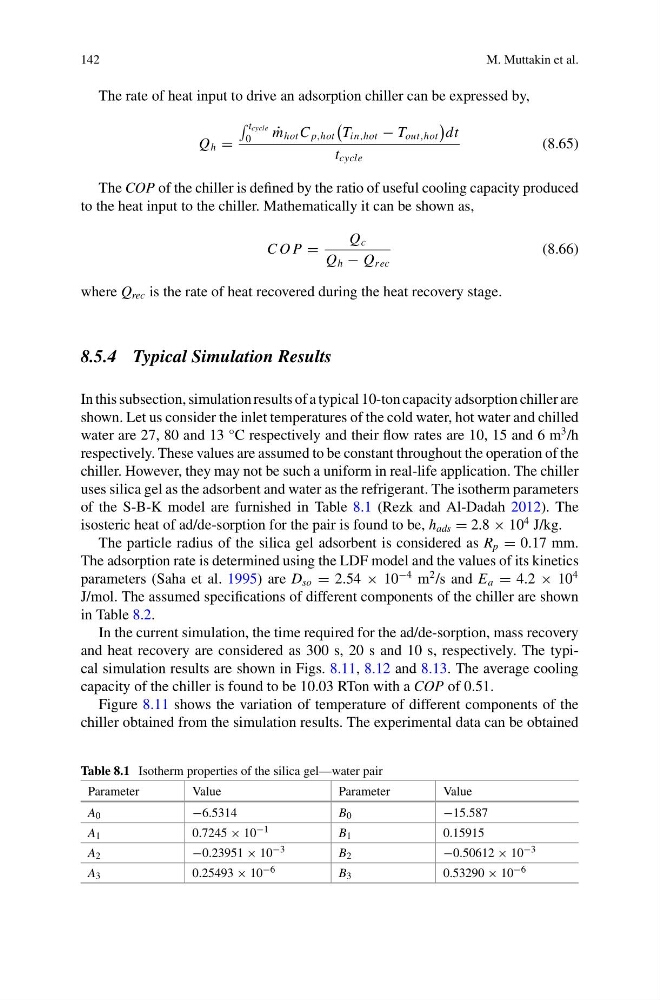
uses silica gel as the adsorbent and water as the refrigerant. The isotherm parameters
of the S-B-K model are furnished in Table 8.1 (Rezk and Al-Dadah 2012). The
isosteric heat of ad/de-sorption for the pair is found to be, h ads = 2.8 × 10
4 J/kg.
The particle radius of the silica gel adsorbent is considered as R p = 0.17 mm.
The adsorption rate is determined using the LDF model and the values of its kinetics
parameters (Saha et al. 1995) are D so = 2.54 × 10
−4 m
2 /s and E a = 4.2 × 10
4
J/mol. The assumed specifications of different components of the chiller are shown
in Table 8.2.
In the current simulation, the time required for the ad/de-sorption, mass recovery
and heat recovery are considered as 300 s, 20 s and 10 s, respectively. The typical simulation results are shown in Figs. 8.11, 8.12 and 8.13. The average cooling
capacity of the chiller is found to be 10.03 RTon with a COP of 0.51.
Figure 8.11 shows the variation of temperature of different components of the
chiller obtained from the simulation results. The experimental data can be obtained
Table 8.1 Isotherm properties of the silica gel—water pair
Parameter
Value
Parameter
Value
A 0
−6.5314
B 0
−15.587
A 1
0.7245 × 10 −1
B 1
0.15915
A 2
−0.23951 × 10 −3
B 2
−0.50612 × 10 −3
A 3
0.25493 × 10 −6
B 3
0.53290 × 10 −6
M. Muttakin et al.
The rate of heat input to drive an adsorption chiller can be expressed by,
Q h =
t cycle
0
˙
m hot C p,hot
T in,hot − T out,hot
dt
t cycle
(8.65)
The COP of the chiller is defined by the ratio of useful cooling capacity produced
to the heat input to the chiller. Mathematically it can be shown as,
C O P =
Q c
Q h − Q rec
(8.66)
where Q rec is the rate of heat recovered during the heat recovery stage.
8.5.4 Typical Simulation Results
In this subsection, simulation results of a typical 10-ton capacity adsorption chiller are
shown. Let us consider the inlet temperatures of the cold water, hot water and chilled
water are 27, 80 and 13 °C respectively and their flow rates are 10, 15 and 6 m
3 /h
respectively. These values are assumed to be constant throughout the operation of the
chiller. However, they may not be such a uniform in real-life application. The chiller
uses silica gel as the adsorbent and water as the refrigerant. The isotherm parameters
of the S-B-K model are furnished in Table 8.1 (Rezk and Al-Dadah 2012). The
isosteric heat of ad/de-sorption for the pair is found to be, h ads = 2.8 × 10
4 J/kg.
The particle radius of the silica gel adsorbent is considered as R p = 0.17 mm.
The adsorption rate is determined using the LDF model and the values of its kinetics
parameters (Saha et al. 1995) are D so = 2.54 × 10
−4 m
2 /s and E a = 4.2 × 10
4
J/mol. The assumed specifications of different components of the chiller are shown
in Table 8.2.
In the current simulation, the time required for the ad/de-sorption, mass recovery
and heat recovery are considered as 300 s, 20 s and 10 s, respectively. The typical simulation results are shown in Figs. 8.11, 8.12 and 8.13. The average cooling
capacity of the chiller is found to be 10.03 RTon with a COP of 0.51.
Figure 8.11 shows the variation of temperature of different components of the
chiller obtained from the simulation results. The experimental data can be obtained
Table 8.1 Isotherm properties of the silica gel—water pair
Parameter
Value
Parameter
Value
A 0
−6.5314
B 0
−15.587
A 1
0.7245 × 10 −1
B 1
0.15915
A 2
−0.23951 × 10 −3
B 2
−0.50612 × 10 −3
A 3
0.25493 × 10 −6
B 3
0.53290 × 10 −6