

8 Solar Thermal-Powered Adsorption Chiller
121
Solar
Radiation
Glazing
Insulation
Absorber
Hot water
out
Cold
water in
Header
tube
Copper
risers
Housing
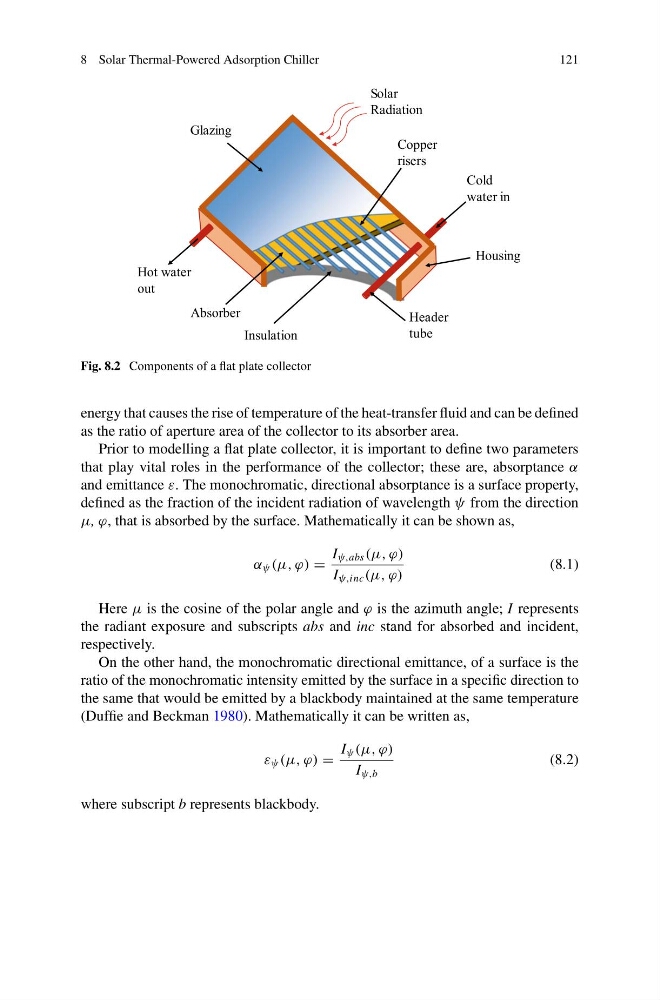
Fig. 8.2 Components of a flat plate collector
energy that causes the rise of temperature of the heat-transfer fluid and can be defined
as the ratio of aperture area of the collector to its absorber area.
Prior to modelling a flat plate collector, it is important to define two parameters
that play vital roles in the performance of the collector; these are, absorptance α
and emittance ε. The monochromatic, directional absorptance is a surface property,
defined as the fraction of the incident radiation of wavelength ψ from the direction
μ, ϕ, that is absorbed by the surface. Mathematically it can be shown as,
α ψ (μ, ϕ) =
I ψ,abs (μ, ϕ)
I ψ,inc (μ, ϕ)
(8.1)
Here μ is the cosine of the polar angle and ϕ is the azimuth angle; I represents
the radiant exposure and subscripts abs and inc stand for absorbed and incident,
respectively.
On the other hand, the monochromatic directional emittance, of a surface is the
ratio of the monochromatic intensity emitted by the surface in a specific direction to
the same that would be emitted by a blackbody maintained at the same temperature
(Duffie and Beckman 1980). Mathematically it can be written as,
ε ψ (μ, ϕ) =
I ψ (μ, ϕ)
I ψ,b
(8.2)
where subscript b represents blackbody.
121
Solar
Radiation
Glazing
Insulation
Absorber
Hot water
out
Cold
water in
Header
tube
Copper
risers
Housing
Fig. 8.2 Components of a flat plate collector
energy that causes the rise of temperature of the heat-transfer fluid and can be defined
as the ratio of aperture area of the collector to its absorber area.
Prior to modelling a flat plate collector, it is important to define two parameters
that play vital roles in the performance of the collector; these are, absorptance α
and emittance ε. The monochromatic, directional absorptance is a surface property,
defined as the fraction of the incident radiation of wavelength ψ from the direction
μ, ϕ, that is absorbed by the surface. Mathematically it can be shown as,
α ψ (μ, ϕ) =
I ψ,abs (μ, ϕ)
I ψ,inc (μ, ϕ)
(8.1)
Here μ is the cosine of the polar angle and ϕ is the azimuth angle; I represents
the radiant exposure and subscripts abs and inc stand for absorbed and incident,
respectively.
On the other hand, the monochromatic directional emittance, of a surface is the
ratio of the monochromatic intensity emitted by the surface in a specific direction to
the same that would be emitted by a blackbody maintained at the same temperature
(Duffie and Beckman 1980). Mathematically it can be written as,
ε ψ (μ, ϕ) =
I ψ (μ, ϕ)
I ψ,b
(8.2)
where subscript b represents blackbody.