

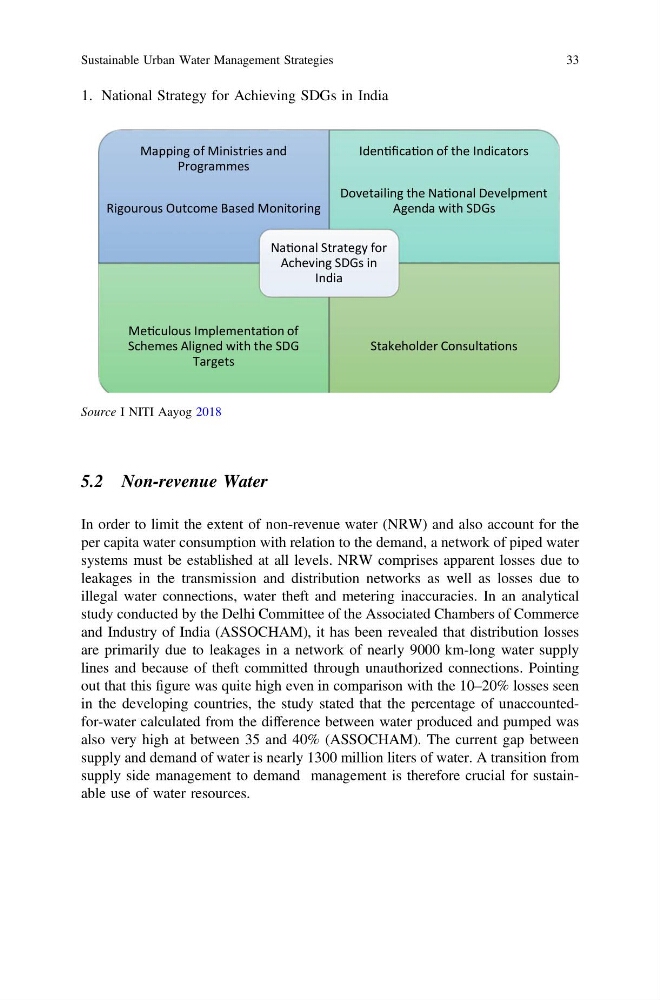
1. National Strategy for Achieving SDGs in India
5.2 Non-revenue Water
In order to limit the extent of non-revenue water (NRW) and also account for the
per capita water consumption with relation to the demand, a network of piped water
systems must be established at all levels. NRW comprises apparent losses due to
leakages in the transmission and distribution networks as well as losses due to
illegal water connections, water theft and metering inaccuracies. In an analytical
study conducted by the Delhi Committee of the Associated Chambers of Commerce
and Industry of India (ASSOCHAM), it has been revealed that distribution losses
are primarily due to leakages in a network of nearly 9000 km-long water supply
lines and because of theft committed through unauthorized connections. Pointing
out that this figure was quite high even in comparison with the 10–20% losses seen
in the developing countries, the study stated that the percentage of unaccountedfor-water calculated from the difference between water produced and pumped was
also very high at between 35 and 40% (ASSOCHAM). The current gap between
supply and demand of water is nearly 1300 million liters of water. A transition from
supply side management to demand management is therefore crucial for sustainable use of water resources.
Mapping of Ministries and
Programmes
Rigourous Outcome Based Monitoring
IdenƟficaƟon of the Indicators
Dovetailing the NaƟonal Develpment
Agenda with SDGs
MeƟculous ImplementaƟon of
Schemes Aligned with the SDG
Targets
Stakeholder ConsultaƟons
NaƟonal Strategy for
Acheving SDGs in
India
Source I NITI Aayog 2018
Sustainable Urban Water Management Strategies
33
5.2 Non-revenue Water
In order to limit the extent of non-revenue water (NRW) and also account for the
per capita water consumption with relation to the demand, a network of piped water
systems must be established at all levels. NRW comprises apparent losses due to
leakages in the transmission and distribution networks as well as losses due to
illegal water connections, water theft and metering inaccuracies. In an analytical
study conducted by the Delhi Committee of the Associated Chambers of Commerce
and Industry of India (ASSOCHAM), it has been revealed that distribution losses
are primarily due to leakages in a network of nearly 9000 km-long water supply
lines and because of theft committed through unauthorized connections. Pointing
out that this figure was quite high even in comparison with the 10–20% losses seen
in the developing countries, the study stated that the percentage of unaccountedfor-water calculated from the difference between water produced and pumped was
also very high at between 35 and 40% (ASSOCHAM). The current gap between
supply and demand of water is nearly 1300 million liters of water. A transition from
supply side management to demand management is therefore crucial for sustainable use of water resources.
Mapping of Ministries and
Programmes
Rigourous Outcome Based Monitoring
IdenƟficaƟon of the Indicators
Dovetailing the NaƟonal Develpment
Agenda with SDGs
MeƟculous ImplementaƟon of
Schemes Aligned with the SDG
Targets
Stakeholder ConsultaƟons
NaƟonal Strategy for
Acheving SDGs in
India
Source I NITI Aayog 2018
Sustainable Urban Water Management Strategies
33