

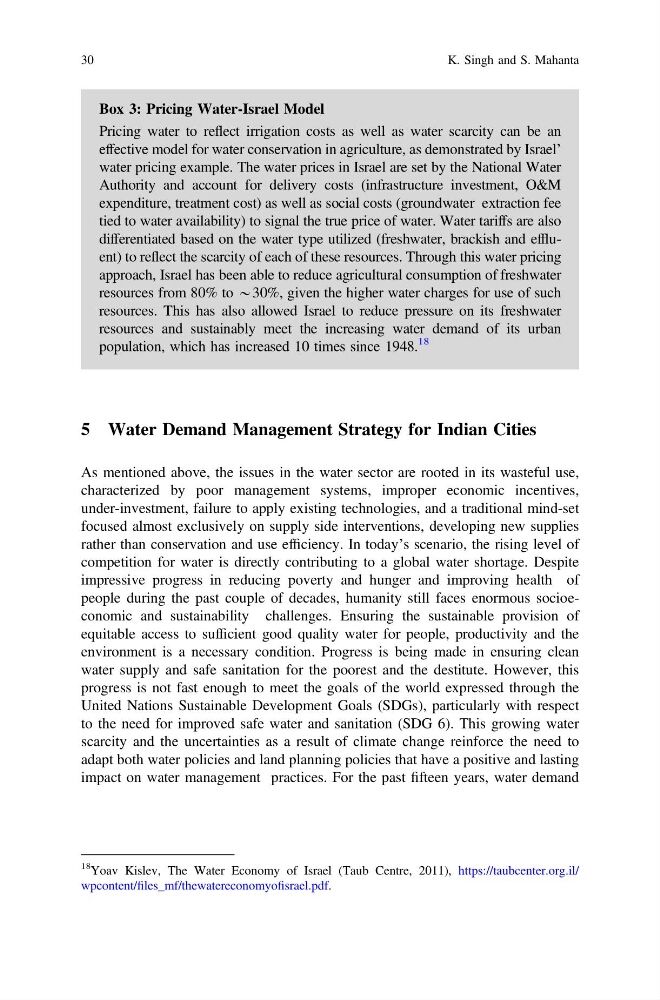
Box 3: Pricing Water-Israel Model
Pricing water to reflect irrigation costs as well as water scarcity can be an
effective model for water conservation in agriculture, as demonstrated by Israel’
water pricing example. The water prices in Israel are set by the National Water
Authority and account for delivery costs (infrastructure investment, O&M
expenditure, treatment cost) as well as social costs (groundwater extraction fee
tied to water availability) to signal the true price of water. Water tariffs are also
differentiated based on the water type utilized (freshwater, brackish and effluent) to reflect the scarcity of each of these resources. Through this water pricing
approach, Israel has been able to reduce agricultural consumption of freshwater
resources from 80% to *30%, given the higher water charges for use of such
resources. This has also allowed Israel to reduce pressure on its freshwater
resources and sustainably meet the increasing water demand of its urban
population, which has increased 10 times since 1948.
18
5 Water Demand Management Strategy for Indian Cities
As mentioned above, the issues in the water sector are rooted in its wasteful use,
characterized by poor management systems, improper economic incentives,
under-investment, failure to apply existing technologies, and a traditional mind-set
focused almost exclusively on supply side interventions, developing new supplies
rather than conservation and use efficiency. In today’s scenario, the rising level of
competition for water is directly contributing to a global water shortage. Despite
impressive progress in reducing poverty and hunger and improving health of
people during the past couple of decades, humanity still faces enormous socioeconomic and sustainability challenges. Ensuring the sustainable provision of
equitable access to sufficient good quality water for people, productivity and the
environment is a necessary condition. Progress is being made in ensuring clean
water supply and safe sanitation for the poorest and the destitute. However, this
progress is not fast enough to meet the goals of the world expressed through the
United Nations Sustainable Development Goals (SDGs), particularly with respect
to the need for improved safe water and sanitation (SDG 6). This growing water
scarcity and the uncertainties as a result of climate change reinforce the need to
adapt both water policies and land planning policies that have a positive and lasting
impact on water management practices. For the past fifteen years, water demand
18
Yoav Kislev, The Water Economy of Israel (Taub Centre, 2011), https://taubcenter.org.il/
wpcontent/files_mf/thewatereconomyofisrael.pdf.
30
K. Singh and S. Mahanta
Pricing water to reflect irrigation costs as well as water scarcity can be an
effective model for water conservation in agriculture, as demonstrated by Israel’
water pricing example. The water prices in Israel are set by the National Water
Authority and account for delivery costs (infrastructure investment, O&M
expenditure, treatment cost) as well as social costs (groundwater extraction fee
tied to water availability) to signal the true price of water. Water tariffs are also
differentiated based on the water type utilized (freshwater, brackish and effluent) to reflect the scarcity of each of these resources. Through this water pricing
approach, Israel has been able to reduce agricultural consumption of freshwater
resources from 80% to *30%, given the higher water charges for use of such
resources. This has also allowed Israel to reduce pressure on its freshwater
resources and sustainably meet the increasing water demand of its urban
population, which has increased 10 times since 1948.
18
5 Water Demand Management Strategy for Indian Cities
As mentioned above, the issues in the water sector are rooted in its wasteful use,
characterized by poor management systems, improper economic incentives,
under-investment, failure to apply existing technologies, and a traditional mind-set
focused almost exclusively on supply side interventions, developing new supplies
rather than conservation and use efficiency. In today’s scenario, the rising level of
competition for water is directly contributing to a global water shortage. Despite
impressive progress in reducing poverty and hunger and improving health of
people during the past couple of decades, humanity still faces enormous socioeconomic and sustainability challenges. Ensuring the sustainable provision of
equitable access to sufficient good quality water for people, productivity and the
environment is a necessary condition. Progress is being made in ensuring clean
water supply and safe sanitation for the poorest and the destitute. However, this
progress is not fast enough to meet the goals of the world expressed through the
United Nations Sustainable Development Goals (SDGs), particularly with respect
to the need for improved safe water and sanitation (SDG 6). This growing water
scarcity and the uncertainties as a result of climate change reinforce the need to
adapt both water policies and land planning policies that have a positive and lasting
impact on water management practices. For the past fifteen years, water demand
18
Yoav Kislev, The Water Economy of Israel (Taub Centre, 2011), https://taubcenter.org.il/
wpcontent/files_mf/thewatereconomyofisrael.pdf.
30
K. Singh and S. Mahanta