

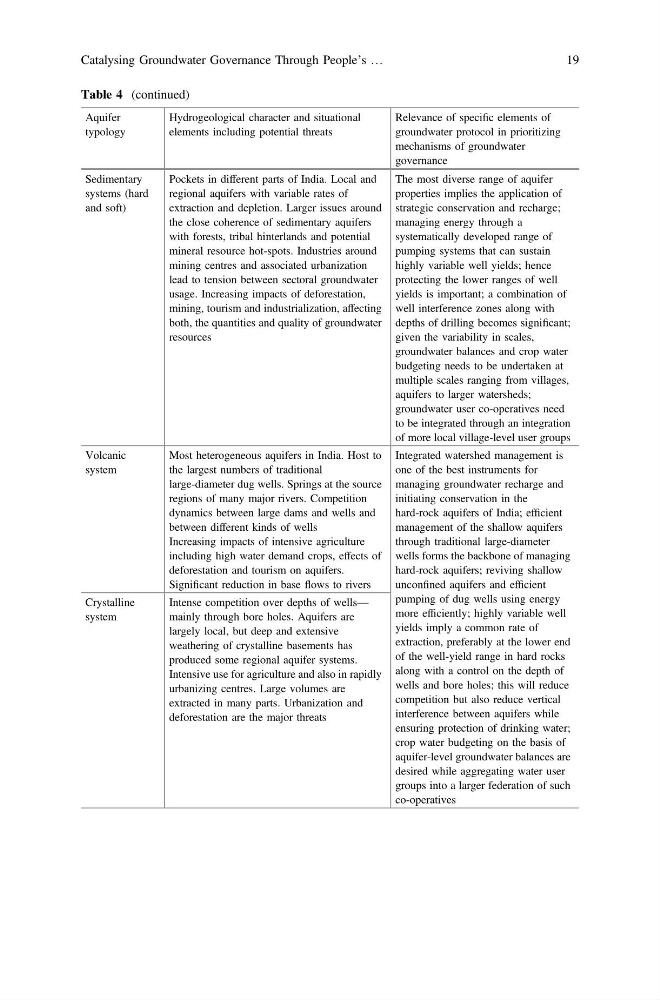
Table 4 (continued)
Aquifer
typology
Hydrogeological character and situational
elements including potential threats
Relevance of specific elements of
groundwater protocol in prioritizing
mechanisms of groundwater
governance
Sedimentary
systems (hard
and soft)
Pockets in different parts of India. Local and
regional aquifers with variable rates of
extraction and depletion. Larger issues around
the close coherence of sedimentary aquifers
with forests, tribal hinterlands and potential
mineral resource hot-spots. Industries around
mining centres and associated urbanization
lead to tension between sectoral groundwater
usage. Increasing impacts of deforestation,
mining, tourism and industrialization, affecting
both, the quantities and quality of groundwater
resources
The most diverse range of aquifer
properties implies the application of
strategic conservation and recharge;
managing energy through a
systematically developed range of
pumping systems that can sustain
highly variable well yields; hence
protecting the lower ranges of well
yields is important; a combination of
well interference zones along with
depths of drilling becomes significant;
given the variability in scales,
groundwater balances and crop water
budgeting needs to be undertaken at
multiple scales ranging from villages,
aquifers to larger watersheds;
groundwater user co-operatives need
to be integrated through an integration
of more local village-level user groups
Volcanic
system
Most heterogeneous aquifers in India. Host to
the largest numbers of traditional
large-diameter dug wells. Springs at the source
regions of many major rivers. Competition
dynamics between large dams and wells and
between different kinds of wells
Increasing impacts of intensive agriculture
including high water demand crops, effects of
deforestation and tourism on aquifers.
Significant reduction in base flows to rivers
Integrated watershed management is
one of the best instruments for
managing groundwater recharge and
initiating conservation in the
hard-rock aquifers of India; efficient
management of the shallow aquifers
through traditional large-diameter
wells forms the backbone of managing
hard-rock aquifers; reviving shallow
unconfined aquifers and efficient
pumping of dug wells using energy
more efficiently; highly variable well
yields imply a common rate of
extraction, preferably at the lower end
of the well-yield range in hard rocks
along with a control on the depth of
wells and bore holes; this will reduce
competition but also reduce vertical
interference between aquifers while
ensuring protection of drinking water;
crop water budgeting on the basis of
aquifer-level groundwater balances are
desired while aggregating water user
groups into a larger federation of such
co-operatives
Crystalline
system
Intense competition over depths of wells—
mainly through bore holes. Aquifers are
largely local, but deep and extensive
weathering of crystalline basements has
produced some regional aquifer systems.
Intensive use for agriculture and also in rapidly
urbanizing centres. Large volumes are
extracted in many parts. Urbanization and
deforestation are the major threats
Catalysing Groundwater Governance Through People’s …
19
Aquifer
typology
Hydrogeological character and situational
elements including potential threats
Relevance of specific elements of
groundwater protocol in prioritizing
mechanisms of groundwater
governance
Sedimentary
systems (hard
and soft)
Pockets in different parts of India. Local and
regional aquifers with variable rates of
extraction and depletion. Larger issues around
the close coherence of sedimentary aquifers
with forests, tribal hinterlands and potential
mineral resource hot-spots. Industries around
mining centres and associated urbanization
lead to tension between sectoral groundwater
usage. Increasing impacts of deforestation,
mining, tourism and industrialization, affecting
both, the quantities and quality of groundwater
resources
The most diverse range of aquifer
properties implies the application of
strategic conservation and recharge;
managing energy through a
systematically developed range of
pumping systems that can sustain
highly variable well yields; hence
protecting the lower ranges of well
yields is important; a combination of
well interference zones along with
depths of drilling becomes significant;
given the variability in scales,
groundwater balances and crop water
budgeting needs to be undertaken at
multiple scales ranging from villages,
aquifers to larger watersheds;
groundwater user co-operatives need
to be integrated through an integration
of more local village-level user groups
Volcanic
system
Most heterogeneous aquifers in India. Host to
the largest numbers of traditional
large-diameter dug wells. Springs at the source
regions of many major rivers. Competition
dynamics between large dams and wells and
between different kinds of wells
Increasing impacts of intensive agriculture
including high water demand crops, effects of
deforestation and tourism on aquifers.
Significant reduction in base flows to rivers
Integrated watershed management is
one of the best instruments for
managing groundwater recharge and
initiating conservation in the
hard-rock aquifers of India; efficient
management of the shallow aquifers
through traditional large-diameter
wells forms the backbone of managing
hard-rock aquifers; reviving shallow
unconfined aquifers and efficient
pumping of dug wells using energy
more efficiently; highly variable well
yields imply a common rate of
extraction, preferably at the lower end
of the well-yield range in hard rocks
along with a control on the depth of
wells and bore holes; this will reduce
competition but also reduce vertical
interference between aquifers while
ensuring protection of drinking water;
crop water budgeting on the basis of
aquifer-level groundwater balances are
desired while aggregating water user
groups into a larger federation of such
co-operatives
Crystalline
system
Intense competition over depths of wells—
mainly through bore holes. Aquifers are
largely local, but deep and extensive
weathering of crystalline basements has
produced some regional aquifer systems.
Intensive use for agriculture and also in rapidly
urbanizing centres. Large volumes are
extracted in many parts. Urbanization and
deforestation are the major threats
Catalysing Groundwater Governance Through People’s …
19