

4 The Dichotomy of Groundwater Management
and Governance
Groundwater governance is defined in multiple ways. Groundwater governance is
the art of co-ordination between administrative action and decision-making at different jurisdictional levels, at the same time being a process involving groundwater
management through the application of responsibility, participation, information,
transparency, custom and rule of law (Varady et al. 2013). On the other hand,
groundwater governance is better thought of as the governance of aquifers given
their vulnerabilities and importance in providing essential reserve supplies of water
(https://www.oecd.org/cfe/regional-policy/8-Tour-de-table-Andrew-Ross.pdf).
While defining a framework of groundwater governance in the USA, Megdal et al.
(2015) highlight three problems as priorities within this framework—water quality
and contamination, conflicts between users and declining groundwater levels.
Currently, the lack of robust groundwater governance mechanisms, mainly in the
form of institutional frameworks including legislation, limits the impacts of processes such as participatory groundwater management. In a recent publication on
the challenges and prospects of water governance in India, Singh et al. (2019)
define water governance as the set of rules, practices and processes through which
decisions for the management of water resources and services are taken and
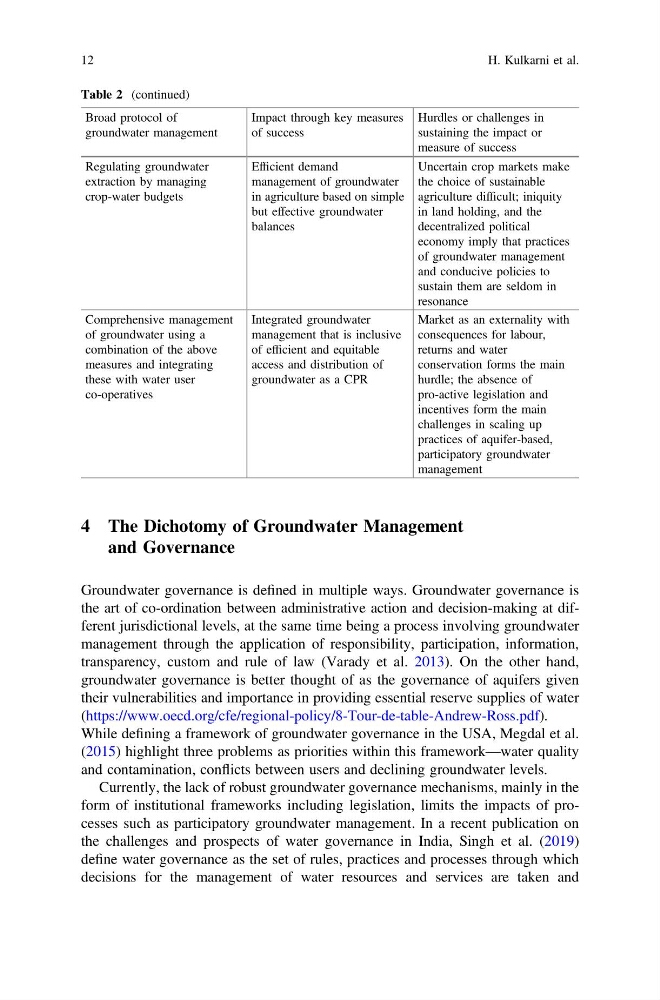
Table 2 (continued)
Broad protocol of
groundwater management
Impact through key measures
of success
Hurdles or challenges in
sustaining the impact or
measure of success
Regulating groundwater
extraction by managing
crop-water budgets
Efficient demand
management of groundwater
in agriculture based on simple
but effective groundwater
balances
Uncertain crop markets make
the choice of sustainable
agriculture difficult; iniquity
in land holding, and the
decentralized political
economy imply that practices
of groundwater management
and conducive policies to
sustain them are seldom in
resonance
Comprehensive management
of groundwater using a
combination of the above
measures and integrating
these with water user
co-operatives
Integrated groundwater
management that is inclusive
of efficient and equitable
access and distribution of
groundwater as a CPR
Market as an externality with
consequences for labour,
returns and water
conservation forms the main
hurdle; the absence of
pro-active legislation and
incentives form the main
challenges in scaling up
practices of aquifer-based,
participatory groundwater
management
12
H. Kulkarni et al.
and Governance
Groundwater governance is defined in multiple ways. Groundwater governance is
the art of co-ordination between administrative action and decision-making at different jurisdictional levels, at the same time being a process involving groundwater
management through the application of responsibility, participation, information,
transparency, custom and rule of law (Varady et al. 2013). On the other hand,
groundwater governance is better thought of as the governance of aquifers given
their vulnerabilities and importance in providing essential reserve supplies of water
(https://www.oecd.org/cfe/regional-policy/8-Tour-de-table-Andrew-Ross.pdf).
While defining a framework of groundwater governance in the USA, Megdal et al.
(2015) highlight three problems as priorities within this framework—water quality
and contamination, conflicts between users and declining groundwater levels.
Currently, the lack of robust groundwater governance mechanisms, mainly in the
form of institutional frameworks including legislation, limits the impacts of processes such as participatory groundwater management. In a recent publication on
the challenges and prospects of water governance in India, Singh et al. (2019)
define water governance as the set of rules, practices and processes through which
decisions for the management of water resources and services are taken and
Table 2 (continued)
Broad protocol of
groundwater management
Impact through key measures
of success
Hurdles or challenges in
sustaining the impact or
measure of success
Regulating groundwater
extraction by managing
crop-water budgets
Efficient demand
management of groundwater
in agriculture based on simple
but effective groundwater
balances
Uncertain crop markets make
the choice of sustainable
agriculture difficult; iniquity
in land holding, and the
decentralized political
economy imply that practices
of groundwater management
and conducive policies to
sustain them are seldom in
resonance
Comprehensive management
of groundwater using a
combination of the above
measures and integrating
these with water user
co-operatives
Integrated groundwater
management that is inclusive
of efficient and equitable
access and distribution of
groundwater as a CPR
Market as an externality with
consequences for labour,
returns and water
conservation forms the main
hurdle; the absence of
pro-active legislation and
incentives form the main
challenges in scaling up
practices of aquifer-based,
participatory groundwater
management
12
H. Kulkarni et al.