

several instances, cost-effective solutions (UNEP 2014). The ecosystem services of
wetlands can also complement human-made infrastructure to deliver water supply,
sewage treatment and energy, thereby aptly being referred to as ‘natural’ or ‘green
infrastructure’ or ‘nature-based solutions’ for water managers (UNEP 2014;
Nesshöver et al. 2017).
The hydrological functions of wetlands can be elucidated by several examples.
The high-altitude wetlands of Himalayas serve as headwaters of the 10 largest rivers
of Asia, the basins of which support nearly one-fifth of the global population (Trisal
and Kumar 2008). For several cities, wetlands were the primary source of water and
continue to be so, as reflected in the moniker ‘city of lakes’ given to Bangalore
(Nagendra 2010), Udaipur (Singh et al. 2018), Bhopal (Verma and Negandhi 2011)
and many others. In some instances this water store can be highly significant, such
as the water storage in Yamuna floodplains has been estimated to be equivalent to
three-fourths of Delhi’s water supply (Soni et al. 2009).
Wetlands have traditionally been the backbone of agriculture practised in the
Ganga–Brahmaputra floodplains. The waste treatment capability of wetlands has
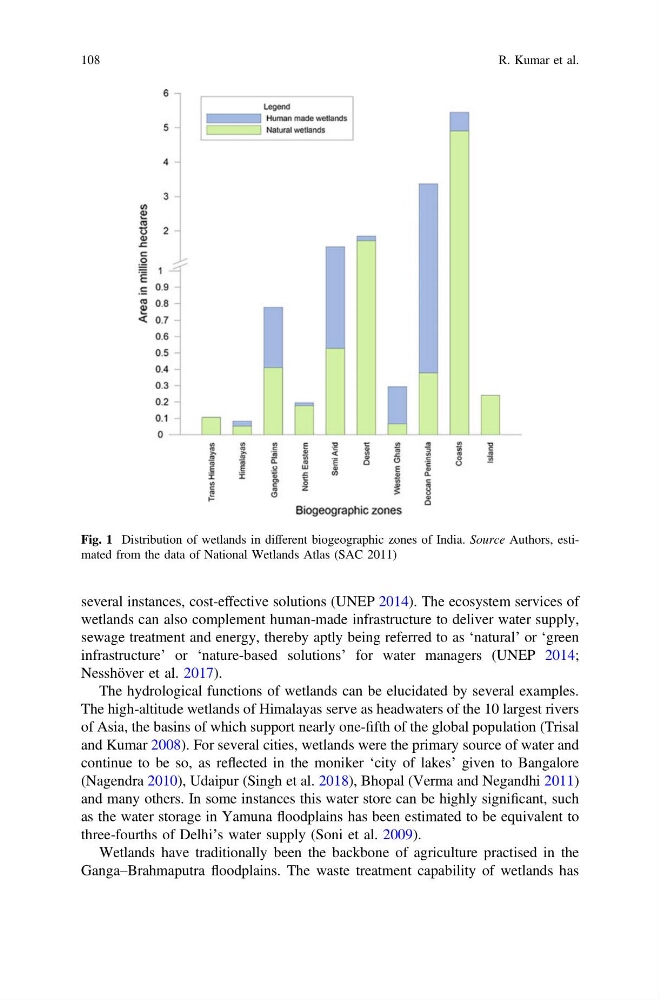
Fig. 1 Distribution of wetlands in different biogeographic zones of India. Source Authors, estimated from the data of National Wetlands Atlas (SAC 2011)
108
R. Kumar et al.
wetlands can also complement human-made infrastructure to deliver water supply,
sewage treatment and energy, thereby aptly being referred to as ‘natural’ or ‘green
infrastructure’ or ‘nature-based solutions’ for water managers (UNEP 2014;
Nesshöver et al. 2017).
The hydrological functions of wetlands can be elucidated by several examples.
The high-altitude wetlands of Himalayas serve as headwaters of the 10 largest rivers
of Asia, the basins of which support nearly one-fifth of the global population (Trisal
and Kumar 2008). For several cities, wetlands were the primary source of water and
continue to be so, as reflected in the moniker ‘city of lakes’ given to Bangalore
(Nagendra 2010), Udaipur (Singh et al. 2018), Bhopal (Verma and Negandhi 2011)
and many others. In some instances this water store can be highly significant, such
as the water storage in Yamuna floodplains has been estimated to be equivalent to
three-fourths of Delhi’s water supply (Soni et al. 2009).
Wetlands have traditionally been the backbone of agriculture practised in the
Ganga–Brahmaputra floodplains. The waste treatment capability of wetlands has
Fig. 1 Distribution of wetlands in different biogeographic zones of India. Source Authors, estimated from the data of National Wetlands Atlas (SAC 2011)
108
R. Kumar et al.