

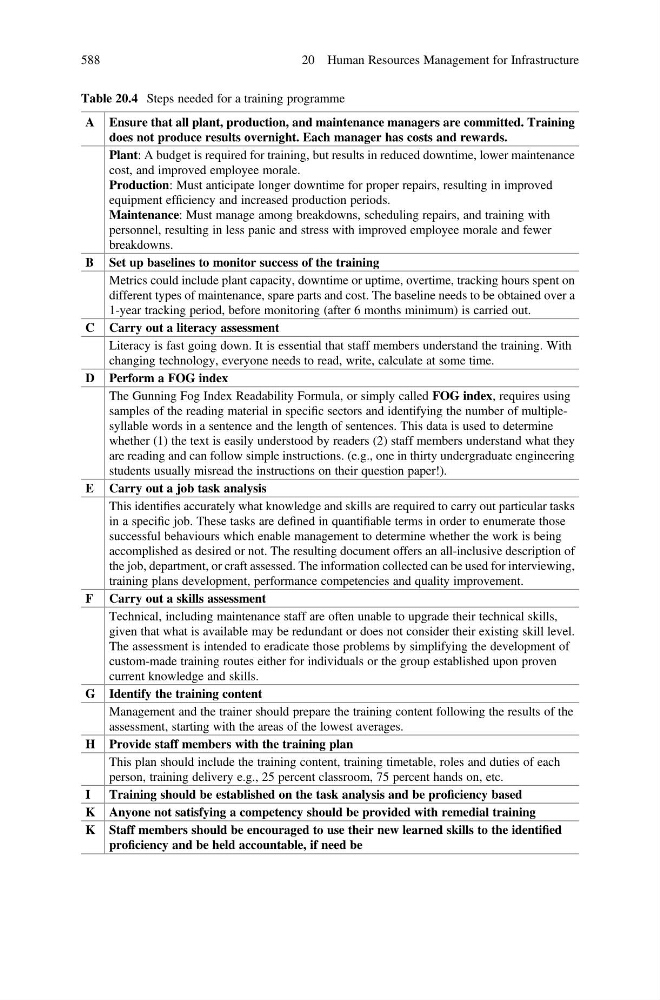
Table 20.4 Steps needed for a training programme
A Ensure that all plant, production, and maintenance managers are committed. Training
does not produce results overnight. Each manager has costs and rewards.
Plant: A budget is required for training, but results in reduced downtime, lower maintenance
cost, and improved employee morale.
Production: Must anticipate longer downtime for proper repairs, resulting in improved
equipment efficiency and increased production periods.
Maintenance: Must manage among breakdowns, scheduling repairs, and training with
personnel, resulting in less panic and stress with improved employee morale and fewer
breakdowns.
B Set up baselines to monitor success of the training
Metrics could include plant capacity, downtime or uptime, overtime, tracking hours spent on
different types of maintenance, spare parts and cost. The baseline needs to be obtained over a
1-year tracking period, before monitoring (after 6 months minimum) is carried out.
C Carry out a literacy assessment
Literacy is fast going down. It is essential that staff members understand the training. With
changing technology, everyone needs to read, write, calculate at some time.
D Perform a FOG index
The Gunning Fog Index Readability Formula, or simply called FOG index, requires using
samples of the reading material in specific sectors and identifying the number of multiplesyllable words in a sentence and the length of sentences. This data is used to determine
whether (1) the text is easily understood by readers (2) staff members understand what they
are reading and can follow simple instructions. (e.g., one in thirty undergraduate engineering
students usually misread the instructions on their question paper!).
E Carry out a job task analysis
This identifies accurately what knowledge and skills are required to carry out particular tasks
in a specific job. These tasks are defined in quantifiable terms in order to enumerate those
successful behaviours which enable management to determine whether the work is being
accomplished as desired or not. The resulting document offers an all-inclusive description of
the job, department, or craft assessed. The information collected can be used for interviewing,
training plans development, performance competencies and quality improvement.
F Carry out a skills assessment
Technical, including maintenance staff are often unable to upgrade their technical skills,
given that what is available may be redundant or does not consider their existing skill level.
The assessment is intended to eradicate those problems by simplifying the development of
custom-made training routes either for individuals or the group established upon proven
current knowledge and skills.
G Identify the training content
Management and the trainer should prepare the training content following the results of the
assessment, starting with the areas of the lowest averages.
H Provide staff members with the training plan
This plan should include the training content, training timetable, roles and duties of each
person, training delivery e.g., 25 percent classroom, 75 percent hands on, etc.
I Training should be established on the task analysis and be proficiency based
K Anyone not satisfying a competency should be provided with remedial training
K Staff members should be encouraged to use their new learned skills to the identified
proficiency and be held accountable, if need be
588
20 Human Resources Management for Infrastructure