

Critical infrastructures consist of those physical and information technology facilities,
networks, services and assets which, if disrupted or destroyed, would have a serious impact
on the health, safety, security or economic well-being of citizens or the effective functioning
of governments in the Member States. Critical infrastructures extend across many sectors of
the economy, including banking and finance, transport and distribution, energy, utilities,
health, food supply and communications, as well as key government services. Some critical
elements in these sectors are not strictly speaking ‘infrastructure’, but are in fact, networks
or supply chains that support the delivery of an essential product or service. For example the
supply of food or water to our major urban areas is dependent on some key facilities, but
also a complex network of producers, processors, manufacturers, distributors and retailers.
(https://eur-lex.europa.eu/legal-content/EN/ALL/?uri¼CELEX:52004DC0702).
Accessed 22 January 2020
The UK government’s official definition of Critical National Infrastructure
(CNI) is: “Those critical elements of infrastructure (namely assets, facilities, systems, networks or processes and the essential workers that operate and facilitate
them), the loss or compromise of which could result in:
(a) Major detrimental impact on the availability, integrity or delivery of essential
services – including those services whose integrity, if compromised, could result
in significant loss of life or casualties – taking into account significant economic
or social impacts; and/or
(b) Significant impact on national security, national defence, or the functioning of
the state.”
(https://www.cpni.gov.uk/critical-national-infrastructure-0). Accessed 22
January 2020
L
l
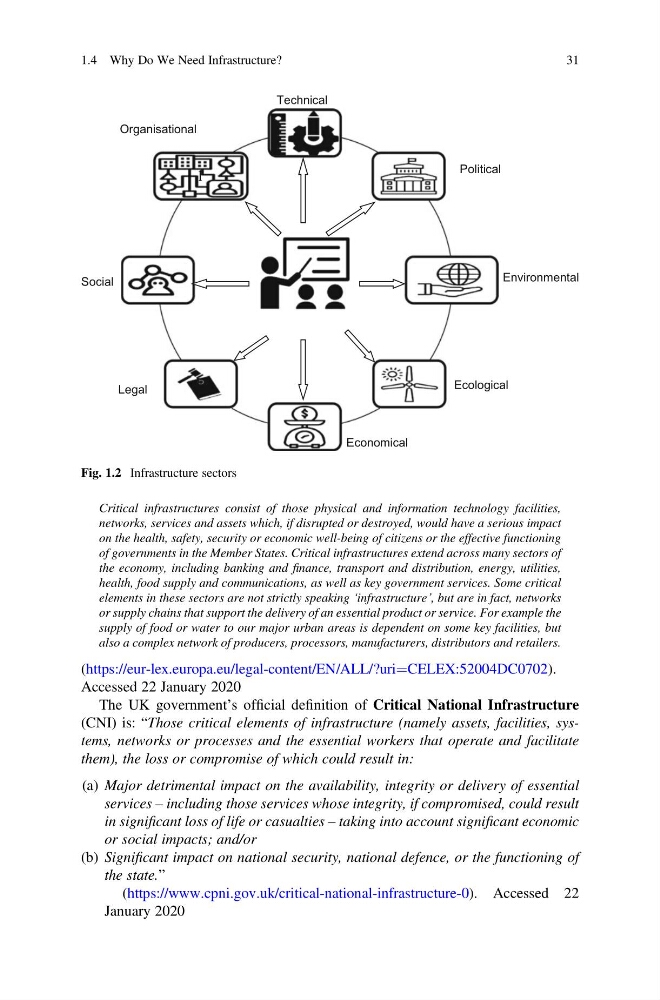
Political
Environmental
Organisational
Technical
Ecological
Social
Legal
Economical
Fig. 1.2 Infrastructure sectors
1.4 Why Do We Need Infrastructure?
31
networks, services and assets which, if disrupted or destroyed, would have a serious impact
on the health, safety, security or economic well-being of citizens or the effective functioning
of governments in the Member States. Critical infrastructures extend across many sectors of
the economy, including banking and finance, transport and distribution, energy, utilities,
health, food supply and communications, as well as key government services. Some critical
elements in these sectors are not strictly speaking ‘infrastructure’, but are in fact, networks
or supply chains that support the delivery of an essential product or service. For example the
supply of food or water to our major urban areas is dependent on some key facilities, but
also a complex network of producers, processors, manufacturers, distributors and retailers.
(https://eur-lex.europa.eu/legal-content/EN/ALL/?uri¼CELEX:52004DC0702).
Accessed 22 January 2020
The UK government’s official definition of Critical National Infrastructure
(CNI) is: “Those critical elements of infrastructure (namely assets, facilities, systems, networks or processes and the essential workers that operate and facilitate
them), the loss or compromise of which could result in:
(a) Major detrimental impact on the availability, integrity or delivery of essential
services – including those services whose integrity, if compromised, could result
in significant loss of life or casualties – taking into account significant economic
or social impacts; and/or
(b) Significant impact on national security, national defence, or the functioning of
the state.”
(https://www.cpni.gov.uk/critical-national-infrastructure-0). Accessed 22
January 2020
L
l
Political
Environmental
Organisational
Technical
Ecological
Social
Legal
Economical
Fig. 1.2 Infrastructure sectors
1.4 Why Do We Need Infrastructure?
31