

The Resnikoff’s conundrum (Resnikoff 1978) highlights that while information
is required about critical failures to ascertain the correct maintenance work, (with the
very purpose of avoiding the same failures), it will be difficult to obtain such data, if
we are able to have perfect maintenance, with no such critical failures taking place!
20.2.4 Capability and Expectation
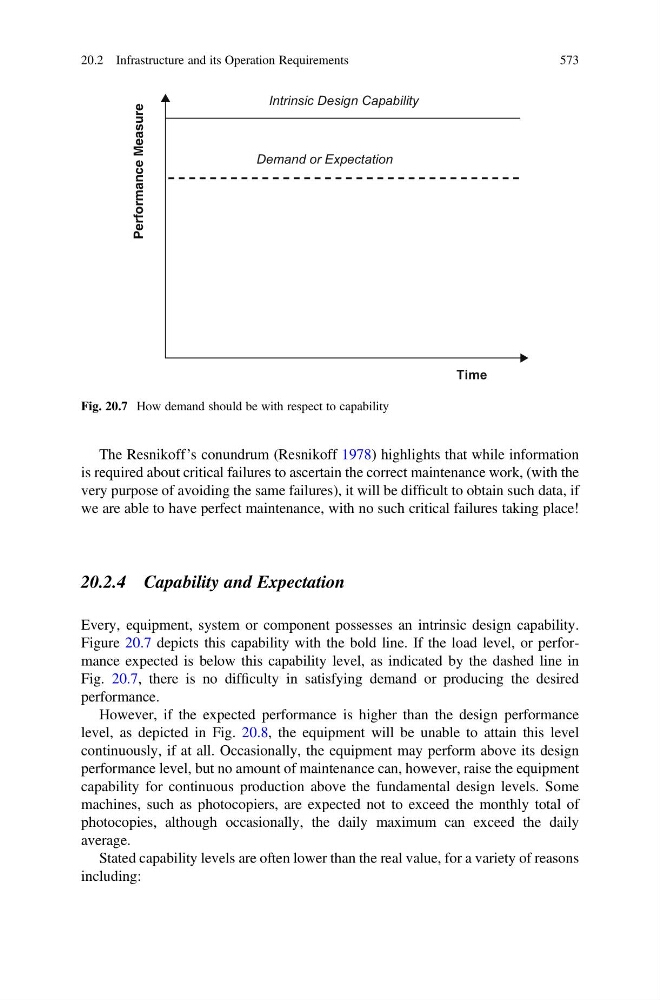
Every, equipment, system or component possesses an intrinsic design capability.
Figure 20.7 depicts this capability with the bold line. If the load level, or performance expected is below this capability level, as indicated by the dashed line in
Fig. 20.7, there is no difficulty in satisfying demand or producing the desired
performance.
However, if the expected performance is higher than the design performance
level, as depicted in Fig. 20.8, the equipment will be unable to attain this level
continuously, if at all. Occasionally, the equipment may perform above its design
performance level, but no amount of maintenance can, however, raise the equipment
capability for continuous production above the fundamental design levels. Some
machines, such as photocopiers, are expected not to exceed the monthly total of
photocopies, although occasionally, the daily maximum can exceed the daily
average.
Stated capability levels are often lower than the real value, for a variety of reasons
including:
Time
Performance Measure
Demand or Expectation
Intrinsic Design Capability
Fig. 20.7 How demand should be with respect to capability
20.2 Infrastructure and its Operation Requirements
573