

20.1.3 Evident Failures
When a car driver notices that his car takes a longer time to stop when he applies the
brakes, he can check the tyre threads. As he sees a partially worn out tyre, he can see
the change in tyre wear, knows the deterioration. He can therefore notice an evident
failure condition. Similarly, an equipment operator can notice the condition of the
equipment through performance, the dashboard equipment or his senses, and therefore of evident failure conditions.
20.1.4 Hidden Failures
In contrast, hidden failures cannot be seen or noticed by the operators during normal
operation. For example, car brake lights, smoke detectors do not indicate their
working condition at any point in time.
When equipment increases in complexity, the designer will often include various
warning or protective devices to warn the operator, such as alarms, or trips to either
stop it or bring it to a safer level. However, as these protection devices are rarely
required to work, their operating condition is unknown to the operator. They are,
thus, subject to hidden failures.
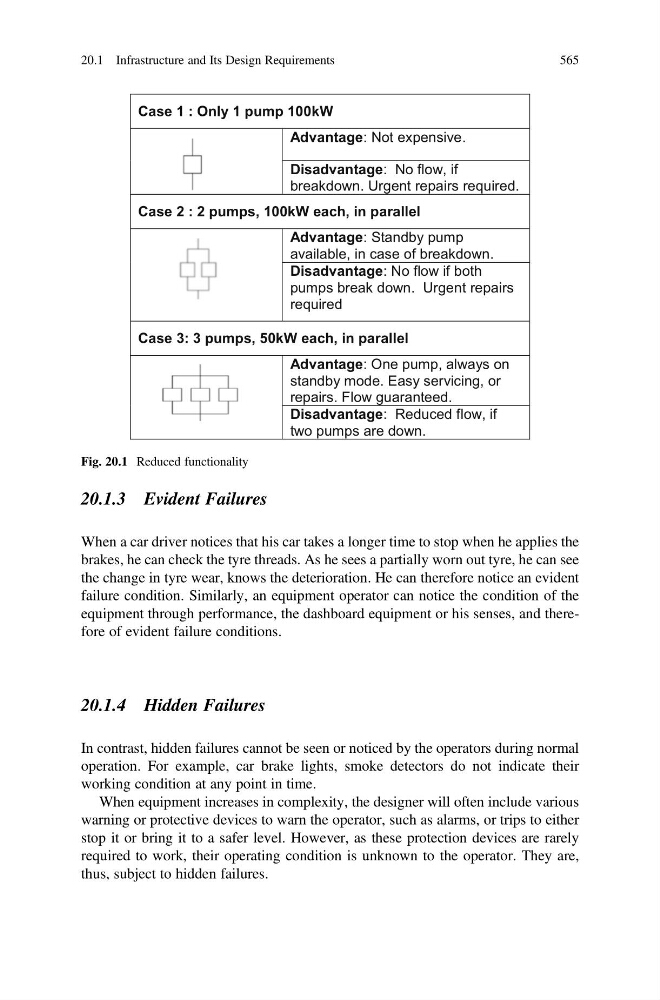
Case 1 : Only 1 pump 100kW
Advantage: Not expensive.
Disadvantage: No flow, if
breakdown. Urgent repairs required.
Case 2 : 2 pumps, 100kW each, in parallel
Advantage: Standby pump
available, in case of breakdown.
Disadvantage: No flow if both
pumps break down. Urgent repairs
required
Case 3: 3 pumps, 50kW each, in parallel
Advantage: One pump, always on
standby mode. Easy servicing, or
repairs. Flow guaranteed.
Disadvantage: Reduced flow, if
two pumps are down.
Fig. 20.1 Reduced functionality
20.1 Infrastructure and Its Design Requirements
565