

“value for money” service with respect to their financial contribution for the services
rendered.
Even if the resource is limited, customers perceive a service as being good only if
the supply is available on a regular, predictable and efficient basis. This can be
ensured only if the systems for supply and for delivery are being properly
maintained. It is important that the operation and maintenance (O&M) budget is
provided with an adequate funding level, equitably allocated among the users.
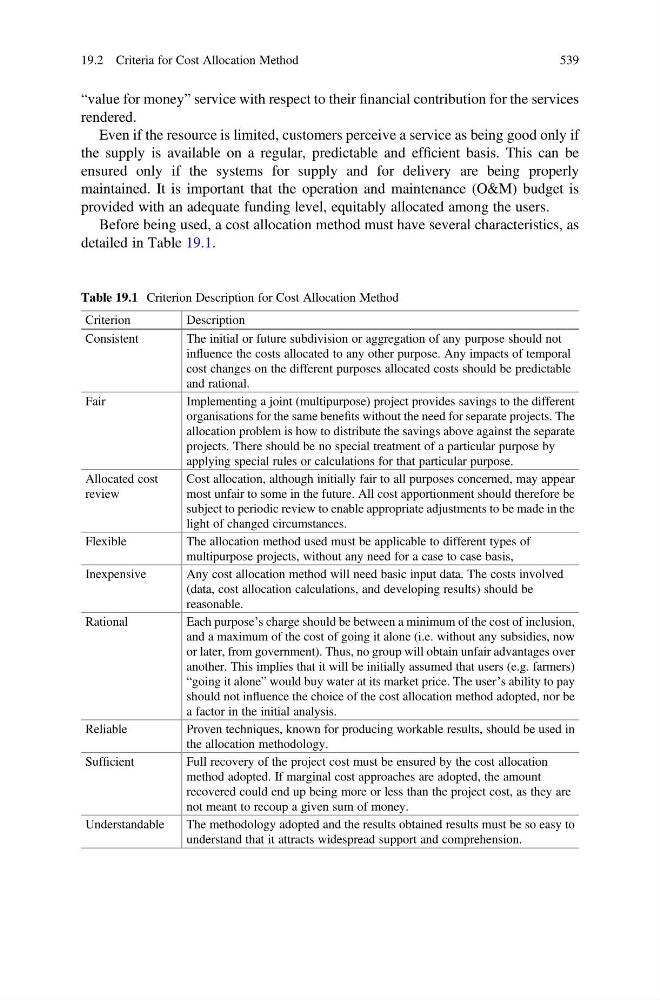
Before being used, a cost allocation method must have several characteristics, as
detailed in Table 19.1.
Table 19.1 Criterion Description for Cost Allocation Method
Criterion
Description
Consistent
The initial or future subdivision or aggregation of any purpose should not
influence the costs allocated to any other purpose. Any impacts of temporal
cost changes on the different purposes allocated costs should be predictable
and rational.
Fair
Implementing a joint (multipurpose) project provides savings to the different
organisations for the same benefits without the need for separate projects. The
allocation problem is how to distribute the savings above against the separate
projects. There should be no special treatment of a particular purpose by
applying special rules or calculations for that particular purpose.
Allocated cost
review
Cost allocation, although initially fair to all purposes concerned, may appear
most unfair to some in the future. All cost apportionment should therefore be
subject to periodic review to enable appropriate adjustments to be made in the
light of changed circumstances.
Flexible
The allocation method used must be applicable to different types of
multipurpose projects, without any need for a case to case basis,
Inexpensive
Any cost allocation method will need basic input data. The costs involved
(data, cost allocation calculations, and developing results) should be
reasonable.
Rational
Each purpose’s charge should be between a minimum of the cost of inclusion,
and a maximum of the cost of going it alone (i.e. without any subsidies, now
or later, from government). Thus, no group will obtain unfair advantages over
another. This implies that it will be initially assumed that users (e.g. farmers)
“going it alone” would buy water at its market price. The user’s ability to pay
should not influence the choice of the cost allocation method adopted, nor be
a factor in the initial analysis.
Reliable
Proven techniques, known for producing workable results, should be used in
the allocation methodology.
Sufficient
Full recovery of the project cost must be ensured by the cost allocation
method adopted. If marginal cost approaches are adopted, the amount
recovered could end up being more or less than the project cost, as they are
not meant to recoup a given sum of money.
Understandable
The methodology adopted and the results obtained results must be so easy to
understand that it attracts widespread support and comprehension.
19.2 Criteria for Cost Allocation Method
539