

(iii) Utilisation of a properly balanced basket of currencies for debt service.
(iv) Provision of output tariff adjustments as a function of exchange rate fluctuation.
(v) Overseas commercial insurance, albeit usually very expensive.
(vi) Provision of Escrow Accounts
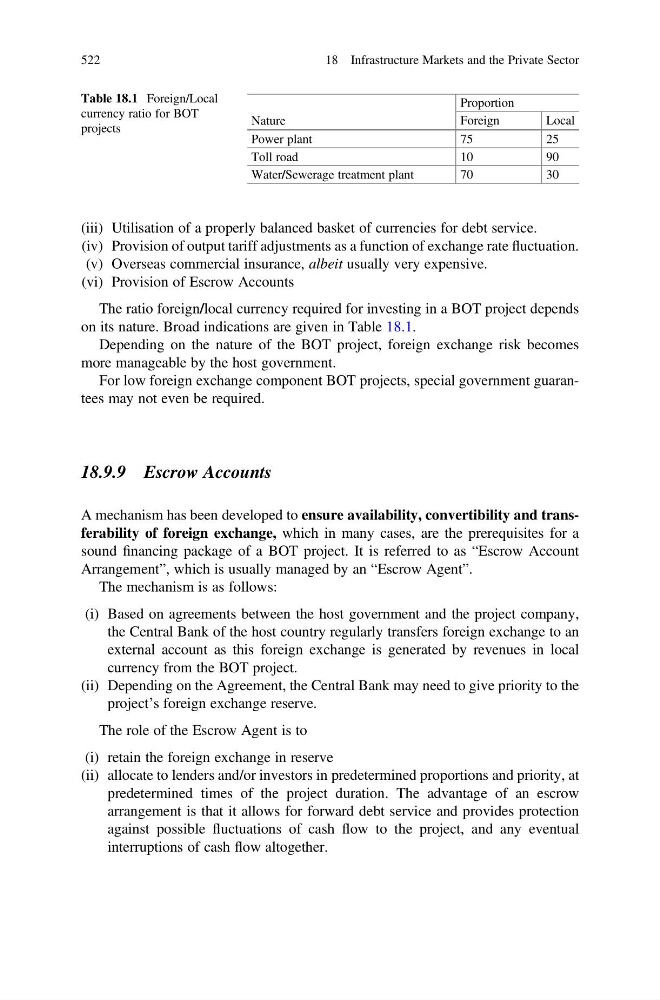
The ratio foreign/local currency required for investing in a BOT project depends
on its nature. Broad indications are given in Table 18.1.
Depending on the nature of the BOT project, foreign exchange risk becomes
more manageable by the host government.
For low foreign exchange component BOT projects, special government guarantees may not even be required.
18.9.9 Escrow Accounts
A mechanism has been developed to ensure availability, convertibility and transferability of foreign exchange, which in many cases, are the prerequisites for a
sound financing package of a BOT project. It is referred to as “Escrow Account
Arrangement”, which is usually managed by an “Escrow Agent”.
The mechanism is as follows:
(i) Based on agreements between the host government and the project company,
the Central Bank of the host country regularly transfers foreign exchange to an
external account as this foreign exchange is generated by revenues in local
currency from the BOT project.
(ii) Depending on the Agreement, the Central Bank may need to give priority to the
project’s foreign exchange reserve.
The role of the Escrow Agent is to
(i) retain the foreign exchange in reserve
(ii) allocate to lenders and/or investors in predetermined proportions and priority, at
predetermined times of the project duration. The advantage of an escrow
arrangement is that it allows for forward debt service and provides protection
against possible fluctuations of cash flow to the project, and any eventual
interruptions of cash flow altogether.
Table 18.1 Foreign/Local
currency ratio for BOT
projects
Nature
Proportion
Foreign
Local
Power plant
75
25
Toll road
10
90
Water/Sewerage treatment plant
70
30
522
18 Infrastructure Markets and the Private Sector