

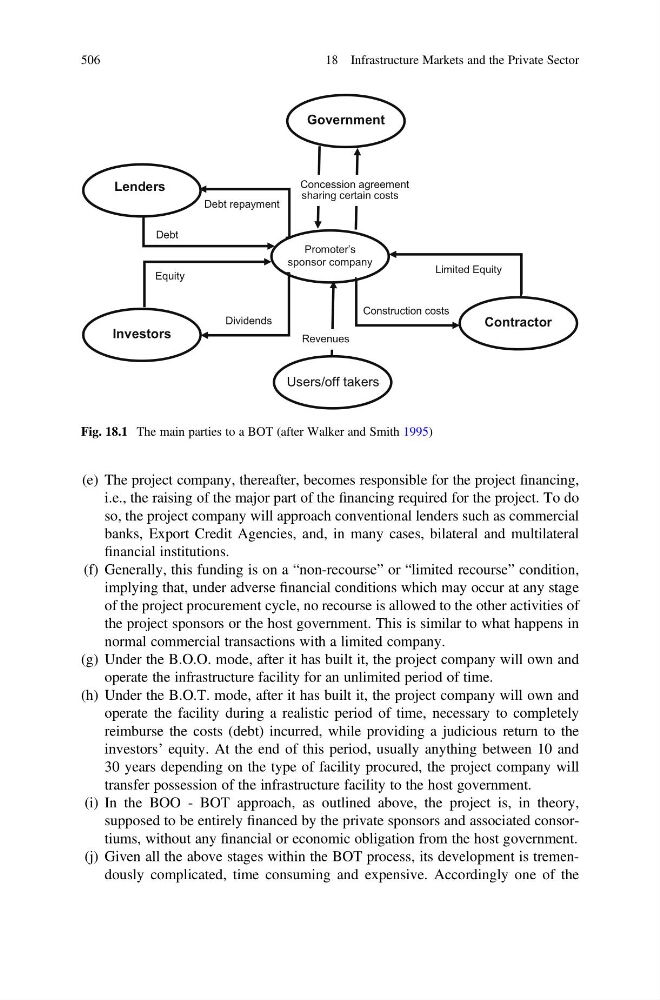
(e) The project company, thereafter, becomes responsible for the project financing,
i.e., the raising of the major part of the financing required for the project. To do
so, the project company will approach conventional lenders such as commercial
banks, Export Credit Agencies, and, in many cases, bilateral and multilateral
financial institutions.
(f) Generally, this funding is on a “non-recourse” or “limited recourse” condition,
implying that, under adverse financial conditions which may occur at any stage
of the project procurement cycle, no recourse is allowed to the other activities of
the project sponsors or the host government. This is similar to what happens in
normal commercial transactions with a limited company.
(g) Under the B.O.O. mode, after it has built it, the project company will own and
operate the infrastructure facility for an unlimited period of time.
(h) Under the B.O.T. mode, after it has built it, the project company will own and
operate the facility during a realistic period of time, necessary to completely
reimburse the costs (debt) incurred, while providing a judicious return to the
investors’ equity. At the end of this period, usually anything between 10 and
30 years depending on the type of facility procured, the project company will
transfer possession of the infrastructure facility to the host government.
(i) In the BOO - BOT approach, as outlined above, the project is, in theory,
supposed to be entirely financed by the private sponsors and associated consortiums, without any financial or economic obligation from the host government.
(j) Given all the above stages within the BOT process, its development is tremendously complicated, time consuming and expensive. Accordingly one of the
Government
Promoter’s
sponsor company
Lenders
Investors
Contractor
Users/off takers
Revenues
Limited Equity
Construction costs
Debt repayment
Debt
Equity
Dividends
Concession agreement
sharing certain costs
Fig. 18.1 The main parties to a BOT (after Walker and Smith 1995)
506
18 Infrastructure Markets and the Private Sector
i.e., the raising of the major part of the financing required for the project. To do
so, the project company will approach conventional lenders such as commercial
banks, Export Credit Agencies, and, in many cases, bilateral and multilateral
financial institutions.
(f) Generally, this funding is on a “non-recourse” or “limited recourse” condition,
implying that, under adverse financial conditions which may occur at any stage
of the project procurement cycle, no recourse is allowed to the other activities of
the project sponsors or the host government. This is similar to what happens in
normal commercial transactions with a limited company.
(g) Under the B.O.O. mode, after it has built it, the project company will own and
operate the infrastructure facility for an unlimited period of time.
(h) Under the B.O.T. mode, after it has built it, the project company will own and
operate the facility during a realistic period of time, necessary to completely
reimburse the costs (debt) incurred, while providing a judicious return to the
investors’ equity. At the end of this period, usually anything between 10 and
30 years depending on the type of facility procured, the project company will
transfer possession of the infrastructure facility to the host government.
(i) In the BOO - BOT approach, as outlined above, the project is, in theory,
supposed to be entirely financed by the private sponsors and associated consortiums, without any financial or economic obligation from the host government.
(j) Given all the above stages within the BOT process, its development is tremendously complicated, time consuming and expensive. Accordingly one of the
Government
Promoter’s
sponsor company
Lenders
Investors
Contractor
Users/off takers
Revenues
Limited Equity
Construction costs
Debt repayment
Debt
Equity
Dividends
Concession agreement
sharing certain costs
Fig. 18.1 The main parties to a BOT (after Walker and Smith 1995)
506
18 Infrastructure Markets and the Private Sector