

supplied by a few other methods, previously, probably, unacceptable. This chapter
explains the different concepts, along with the externalities involved, and provides
examples of same. In some cases, infrastructure may also present the symptoms of
the Tragedy of the Commons. Infrastructural resources obey the following criteria:
(a) the resource is often used nonrivalrously over an appreciable demand range,
(b) downstream productive activities requiring the resource (e.g. electricity, roads) as
an input drive the social demand for the resource, (c) a wide range of goods and
services, such as private, public, and social goods often use the resource as an input.
17.1 The Different Kinds of Goods
17.1.1 Characteristics
Two characteristics may be used to define or distinguish goods:
(1) Excludability: A person selling potatoes or apples can prevent (or exclude) nonpayers from using them. Thus, such goods (or services) are considered excludable. Conversely, a service provider cannot prevent (or exclude) non payers
from using traffic lights, or television broadcast. Therefore, these goods are
called non excludable.
(2) Rivalrousness: If only one person can use the good (apple, ice cream cone), it is
considered as rival while it is called non rival if the good (or service) can be
enjoyed by more than one at same time (fireworks, street lights).
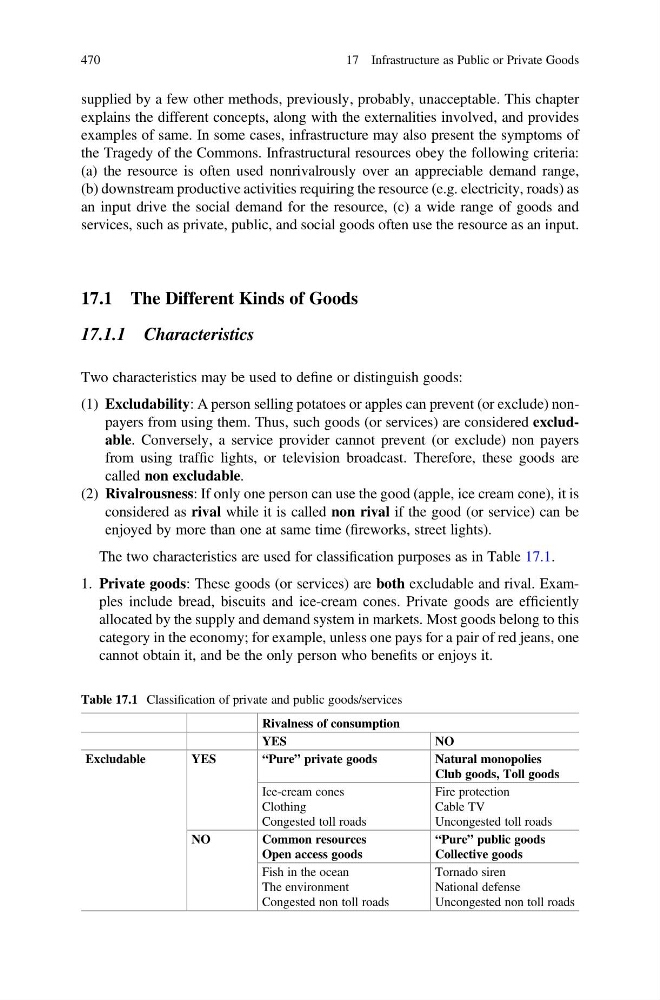
The two characteristics are used for classification purposes as in Table 17.1.
1. Private goods: These goods (or services) are both excludable and rival. Examples include bread, biscuits and ice-cream cones. Private goods are efficiently
allocated by the supply and demand system in markets. Most goods belong to this
category in the economy; for example, unless one pays for a pair of red jeans, one
cannot obtain it, and be the only person who benefits or enjoys it.
Table 17.1 Classification of private and public goods/services
Rivalness of consumption
YES
NO
Excludable
YES
“Pure” private goods
Natural monopolies
Club goods, Toll goods
Ice-cream cones
Clothing
Congested toll roads
Fire protection
Cable TV
Uncongested toll roads
NO
Common resources
Open access goods
“Pure” public goods
Collective goods
Fish in the ocean
The environment
Congested non toll roads
Tornado siren
National defense
Uncongested non toll roads
470
17 Infrastructure as Public or Private Goods
explains the different concepts, along with the externalities involved, and provides
examples of same. In some cases, infrastructure may also present the symptoms of
the Tragedy of the Commons. Infrastructural resources obey the following criteria:
(a) the resource is often used nonrivalrously over an appreciable demand range,
(b) downstream productive activities requiring the resource (e.g. electricity, roads) as
an input drive the social demand for the resource, (c) a wide range of goods and
services, such as private, public, and social goods often use the resource as an input.
17.1 The Different Kinds of Goods
17.1.1 Characteristics
Two characteristics may be used to define or distinguish goods:
(1) Excludability: A person selling potatoes or apples can prevent (or exclude) nonpayers from using them. Thus, such goods (or services) are considered excludable. Conversely, a service provider cannot prevent (or exclude) non payers
from using traffic lights, or television broadcast. Therefore, these goods are
called non excludable.
(2) Rivalrousness: If only one person can use the good (apple, ice cream cone), it is
considered as rival while it is called non rival if the good (or service) can be
enjoyed by more than one at same time (fireworks, street lights).
The two characteristics are used for classification purposes as in Table 17.1.
1. Private goods: These goods (or services) are both excludable and rival. Examples include bread, biscuits and ice-cream cones. Private goods are efficiently
allocated by the supply and demand system in markets. Most goods belong to this
category in the economy; for example, unless one pays for a pair of red jeans, one
cannot obtain it, and be the only person who benefits or enjoys it.
Table 17.1 Classification of private and public goods/services
Rivalness of consumption
YES
NO
Excludable
YES
“Pure” private goods
Natural monopolies
Club goods, Toll goods
Ice-cream cones
Clothing
Congested toll roads
Fire protection
Cable TV
Uncongested toll roads
NO
Common resources
Open access goods
“Pure” public goods
Collective goods
Fish in the ocean
The environment
Congested non toll roads
Tornado siren
National defense
Uncongested non toll roads
470
17 Infrastructure as Public or Private Goods