

3. Decision making under conditions of risk
Here also, there are more than one states of nature. However, in this case, the
decision maker possesses enough information to permit him assign probabilities to
any of possible states of nature.
16.4 Decision Making Under Conditions of Certainty
Under this environment, there is only one state of nature. The payoff matrix consists
of two columns (1) the feasible alternatives and (2) the different payoffs. The
decision maker simply selects the best payoff in the second column and picks up
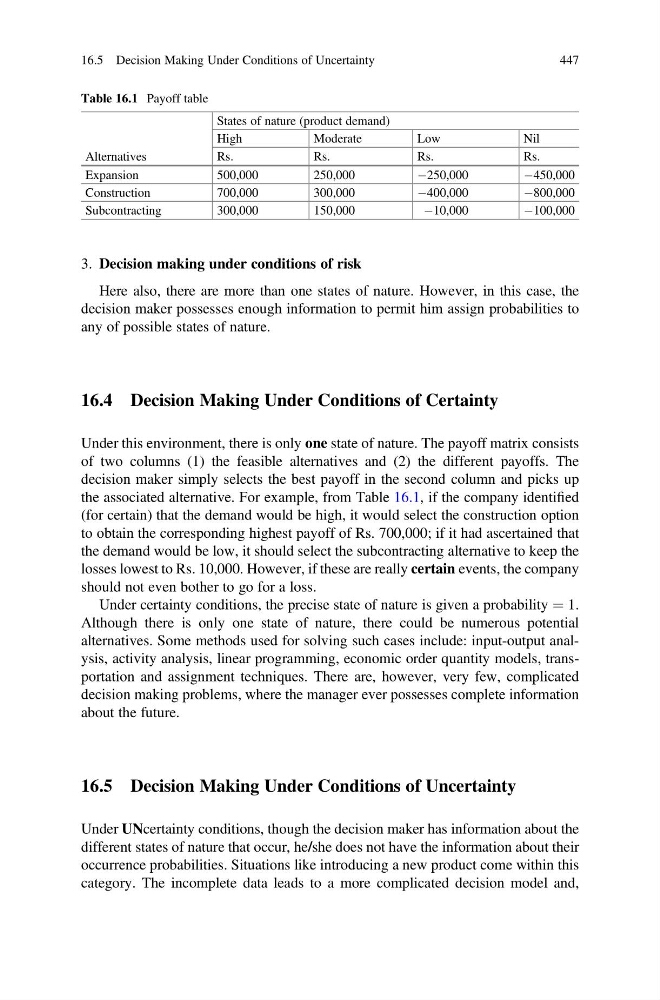
the associated alternative. For example, from Table 16.1, if the company identified
(for certain) that the demand would be high, it would select the construction option
to obtain the corresponding highest payoff of Rs. 700,000; if it had ascertained that
the demand would be low, it should select the subcontracting alternative to keep the
losses lowest to Rs. 10,000. However, if these are really certain events, the company
should not even bother to go for a loss.
Under certainty conditions, the precise state of nature is given a probability ¼ 1.
Although there is only one state of nature, there could be numerous potential
alternatives. Some methods used for solving such cases include: input-output analysis, activity analysis, linear programming, economic order quantity models, transportation and assignment techniques. There are, however, very few, complicated
decision making problems, where the manager ever possesses complete information
about the future.
16.5 Decision Making Under Conditions of Uncertainty
Under UNcertainty conditions, though the decision maker has information about the
different states of nature that occur, he/she does not have the information about their
occurrence probabilities. Situations like introducing a new product come within this
category. The incomplete data leads to a more complicated decision model and,
Table 16.1 Payoff table
Alternatives
States of nature (product demand)
High
Moderate
Low
Nil
Rs.
Rs.
Rs.
Rs.
Expansion
500,000
250,000
À250,000
À450,000
Construction
700,000
300,000
À400,000
À800,000
Subcontracting
300,000
150,000
À10,000
À100,000
16.5 Decision Making Under Conditions of Uncertainty
447
Here also, there are more than one states of nature. However, in this case, the
decision maker possesses enough information to permit him assign probabilities to
any of possible states of nature.
16.4 Decision Making Under Conditions of Certainty
Under this environment, there is only one state of nature. The payoff matrix consists
of two columns (1) the feasible alternatives and (2) the different payoffs. The
decision maker simply selects the best payoff in the second column and picks up
the associated alternative. For example, from Table 16.1, if the company identified
(for certain) that the demand would be high, it would select the construction option
to obtain the corresponding highest payoff of Rs. 700,000; if it had ascertained that
the demand would be low, it should select the subcontracting alternative to keep the
losses lowest to Rs. 10,000. However, if these are really certain events, the company
should not even bother to go for a loss.
Under certainty conditions, the precise state of nature is given a probability ¼ 1.
Although there is only one state of nature, there could be numerous potential
alternatives. Some methods used for solving such cases include: input-output analysis, activity analysis, linear programming, economic order quantity models, transportation and assignment techniques. There are, however, very few, complicated
decision making problems, where the manager ever possesses complete information
about the future.
16.5 Decision Making Under Conditions of Uncertainty
Under UNcertainty conditions, though the decision maker has information about the
different states of nature that occur, he/she does not have the information about their
occurrence probabilities. Situations like introducing a new product come within this
category. The incomplete data leads to a more complicated decision model and,
Table 16.1 Payoff table
Alternatives
States of nature (product demand)
High
Moderate
Low
Nil
Rs.
Rs.
Rs.
Rs.
Expansion
500,000
250,000
À250,000
À450,000
Construction
700,000
300,000
À400,000
À800,000
Subcontracting
300,000
150,000
À10,000
À100,000
16.5 Decision Making Under Conditions of Uncertainty
447