

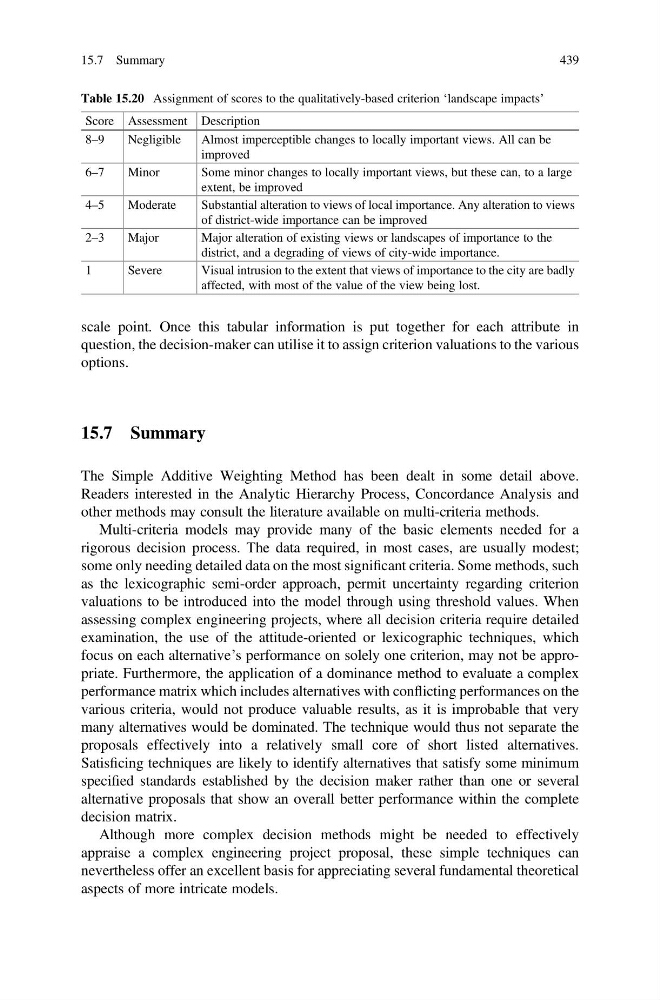
scale point. Once this tabular information is put together for each attribute in
question, the decision-maker can utilise it to assign criterion valuations to the various
options.
15.7 Summary
The Simple Additive Weighting Method has been dealt in some detail above.
Readers interested in the Analytic Hierarchy Process, Concordance Analysis and
other methods may consult the literature available on multi-criteria methods.
Multi-criteria models may provide many of the basic elements needed for a
rigorous decision process. The data required, in most cases, are usually modest;
some only needing detailed data on the most significant criteria. Some methods, such
as the lexicographic semi-order approach, permit uncertainty regarding criterion
valuations to be introduced into the model through using threshold values. When
assessing complex engineering projects, where all decision criteria require detailed
examination, the use of the attitude-oriented or lexicographic techniques, which
focus on each alternative’s performance on solely one criterion, may not be appropriate. Furthermore, the application of a dominance method to evaluate a complex
performance matrix which includes alternatives with conflicting performances on the
various criteria, would not produce valuable results, as it is improbable that very
many alternatives would be dominated. The technique would thus not separate the
proposals effectively into a relatively small core of short listed alternatives.
Satisficing techniques are likely to identify alternatives that satisfy some minimum
specified standards established by the decision maker rather than one or several
alternative proposals that show an overall better performance within the complete
decision matrix.
Although more complex decision methods might be needed to effectively
appraise a complex engineering project proposal, these simple techniques can
nevertheless offer an excellent basis for appreciating several fundamental theoretical
aspects of more intricate models.
Table 15.20 Assignment of scores to the qualitatively-based criterion ‘landscape impacts’
Score Assessment Description
8–9
Negligible
Almost imperceptible changes to locally important views. All can be
improved
6–7
Minor
Some minor changes to locally important views, but these can, to a large
extent, be improved
4–5
Moderate
Substantial alteration to views of local importance. Any alteration to views
of district-wide importance can be improved
2–3
Major
Major alteration of existing views or landscapes of importance to the
district, and a degrading of views of city-wide importance.
1
Severe
Visual intrusion to the extent that views of importance to the city are badly
affected, with most of the value of the view being lost.
15.7 Summary
439
question, the decision-maker can utilise it to assign criterion valuations to the various
options.
15.7 Summary
The Simple Additive Weighting Method has been dealt in some detail above.
Readers interested in the Analytic Hierarchy Process, Concordance Analysis and
other methods may consult the literature available on multi-criteria methods.
Multi-criteria models may provide many of the basic elements needed for a
rigorous decision process. The data required, in most cases, are usually modest;
some only needing detailed data on the most significant criteria. Some methods, such
as the lexicographic semi-order approach, permit uncertainty regarding criterion
valuations to be introduced into the model through using threshold values. When
assessing complex engineering projects, where all decision criteria require detailed
examination, the use of the attitude-oriented or lexicographic techniques, which
focus on each alternative’s performance on solely one criterion, may not be appropriate. Furthermore, the application of a dominance method to evaluate a complex
performance matrix which includes alternatives with conflicting performances on the
various criteria, would not produce valuable results, as it is improbable that very
many alternatives would be dominated. The technique would thus not separate the
proposals effectively into a relatively small core of short listed alternatives.
Satisficing techniques are likely to identify alternatives that satisfy some minimum
specified standards established by the decision maker rather than one or several
alternative proposals that show an overall better performance within the complete
decision matrix.
Although more complex decision methods might be needed to effectively
appraise a complex engineering project proposal, these simple techniques can
nevertheless offer an excellent basis for appreciating several fundamental theoretical
aspects of more intricate models.
Table 15.20 Assignment of scores to the qualitatively-based criterion ‘landscape impacts’
Score Assessment Description
8–9
Negligible
Almost imperceptible changes to locally important views. All can be
improved
6–7
Minor
Some minor changes to locally important views, but these can, to a large
extent, be improved
4–5
Moderate
Substantial alteration to views of local importance. Any alteration to views
of district-wide importance can be improved
2–3
Major
Major alteration of existing views or landscapes of importance to the
district, and a degrading of views of city-wide importance.
1
Severe
Visual intrusion to the extent that views of importance to the city are badly
affected, with most of the value of the view being lost.
15.7 Summary
439