

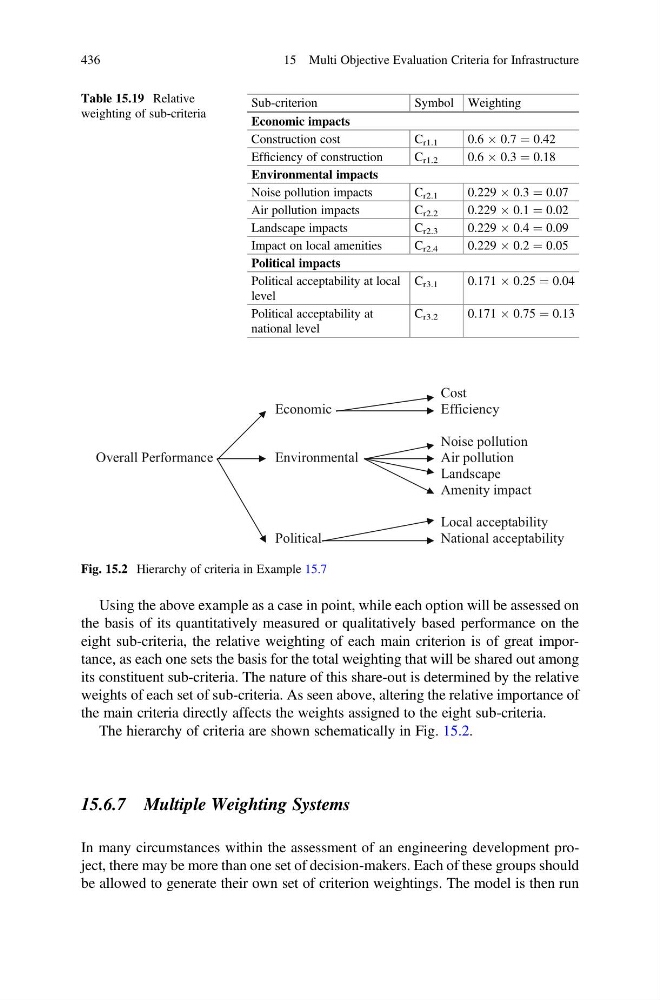
Using the above example as a case in point, while each option will be assessed on
the basis of its quantitatively measured or qualitatively based performance on the
eight sub-criteria, the relative weighting of each main criterion is of great importance, as each one sets the basis for the total weighting that will be shared out among
its constituent sub-criteria. The nature of this share-out is determined by the relative
weights of each set of sub-criteria. As seen above, altering the relative importance of
the main criteria directly affects the weights assigned to the eight sub-criteria.
The hierarchy of criteria are shown schematically in Fig. 15.2.
15.6.7 Multiple Weighting Systems
In many circumstances within the assessment of an engineering development project, there may be more than one set of decision-makers. Each of these groups should
be allowed to generate their own set of criterion weightings. The model is then run
Table 15.19 Relative
weighting of sub-criteria
Sub-criterion
Symbol Weighting
Economic impacts
Construction cost
C r1.1
0.6 Â 0.7 ¼ 0.42
Efficiency of construction
C r1.2
0.6 Â 0.3 ¼ 0.18
Environmental impacts
Noise pollution impacts
C r2.1
0.229 Â 0.3 ¼ 0.07
Air pollution impacts
C r2.2
0.229 Â 0.1 ¼ 0.02
Landscape impacts
C r2.3
0.229 Â 0.4 ¼ 0.09
Impact on local amenities
C r2.4
0.229 Â 0.2 ¼ 0.05
Political impacts
Political acceptability at local
level
C r3.1
0.171 Â 0.25 ¼ 0.04
Political acceptability at
national level
C r3.2
0.171 Â 0.75 ¼ 0.13
Cost
Economic
Efficiency
Noise pollution
Overall Performance
Environmental
Air pollution
Landscape
Amenity impact
Local acceptability
Political
National acceptability
Fig. 15.2 Hierarchy of criteria in Example 15.7
436
15 Multi Objective Evaluation Criteria for Infrastructure
the basis of its quantitatively measured or qualitatively based performance on the
eight sub-criteria, the relative weighting of each main criterion is of great importance, as each one sets the basis for the total weighting that will be shared out among
its constituent sub-criteria. The nature of this share-out is determined by the relative
weights of each set of sub-criteria. As seen above, altering the relative importance of
the main criteria directly affects the weights assigned to the eight sub-criteria.
The hierarchy of criteria are shown schematically in Fig. 15.2.
15.6.7 Multiple Weighting Systems
In many circumstances within the assessment of an engineering development project, there may be more than one set of decision-makers. Each of these groups should
be allowed to generate their own set of criterion weightings. The model is then run
Table 15.19 Relative
weighting of sub-criteria
Sub-criterion
Symbol Weighting
Economic impacts
Construction cost
C r1.1
0.6 Â 0.7 ¼ 0.42
Efficiency of construction
C r1.2
0.6 Â 0.3 ¼ 0.18
Environmental impacts
Noise pollution impacts
C r2.1
0.229 Â 0.3 ¼ 0.07
Air pollution impacts
C r2.2
0.229 Â 0.1 ¼ 0.02
Landscape impacts
C r2.3
0.229 Â 0.4 ¼ 0.09
Impact on local amenities
C r2.4
0.229 Â 0.2 ¼ 0.05
Political impacts
Political acceptability at local
level
C r3.1
0.171 Â 0.25 ¼ 0.04
Political acceptability at
national level
C r3.2
0.171 Â 0.75 ¼ 0.13
Cost
Economic
Efficiency
Noise pollution
Overall Performance
Environmental
Air pollution
Landscape
Amenity impact
Local acceptability
Political
National acceptability
Fig. 15.2 Hierarchy of criteria in Example 15.7
436
15 Multi Objective Evaluation Criteria for Infrastructure