

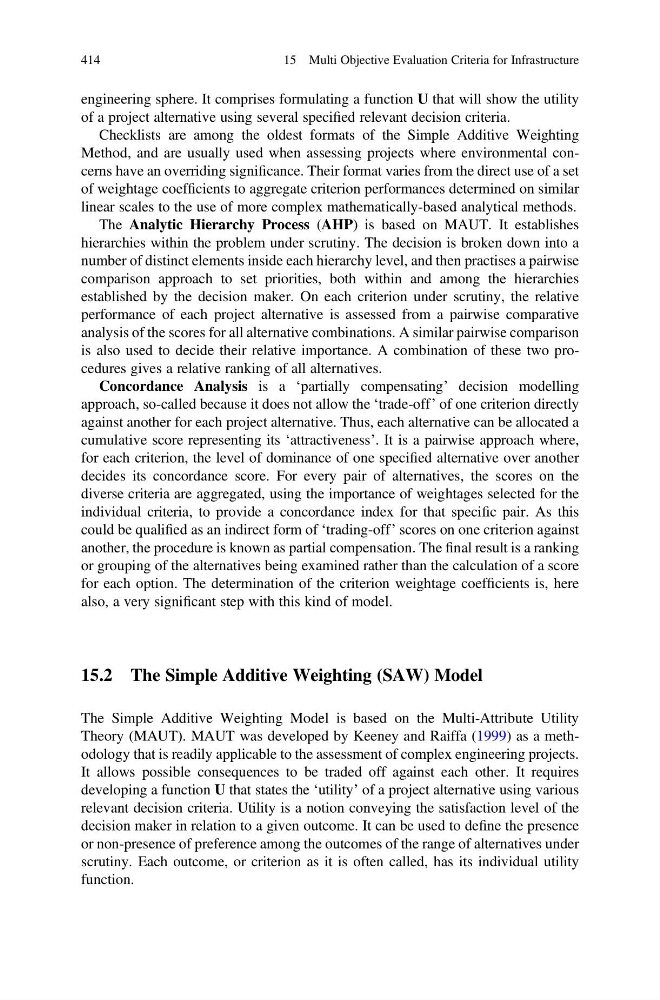
engineering sphere. It comprises formulating a function U that will show the utility
of a project alternative using several specified relevant decision criteria.
Checklists are among the oldest formats of the Simple Additive Weighting
Method, and are usually used when assessing projects where environmental concerns have an overriding significance. Their format varies from the direct use of a set
of weightage coefficients to aggregate criterion performances determined on similar
linear scales to the use of more complex mathematically-based analytical methods.
The Analytic Hierarchy Process (AHP) is based on MAUT. It establishes
hierarchies within the problem under scrutiny. The decision is broken down into a
number of distinct elements inside each hierarchy level, and then practises a pairwise
comparison approach to set priorities, both within and among the hierarchies
established by the decision maker. On each criterion under scrutiny, the relative
performance of each project alternative is assessed from a pairwise comparative
analysis of the scores for all alternative combinations. A similar pairwise comparison
is also used to decide their relative importance. A combination of these two procedures gives a relative ranking of all alternatives.
Concordance Analysis is a ‘partially compensating’ decision modelling
approach, so-called because it does not allow the ‘trade-off’ of one criterion directly
against another for each project alternative. Thus, each alternative can be allocated a
cumulative score representing its ‘attractiveness’. It is a pairwise approach where,
for each criterion, the level of dominance of one specified alternative over another
decides its concordance score. For every pair of alternatives, the scores on the
diverse criteria are aggregated, using the importance of weightages selected for the
individual criteria, to provide a concordance index for that specific pair. As this
could be qualified as an indirect form of ‘trading-off’ scores on one criterion against
another, the procedure is known as partial compensation. The final result is a ranking
or grouping of the alternatives being examined rather than the calculation of a score
for each option. The determination of the criterion weightage coefficients is, here
also, a very significant step with this kind of model.
15.2 The Simple Additive Weighting (SAW) Model
The Simple Additive Weighting Model is based on the Multi-Attribute Utility
Theory (MAUT). MAUT was developed by Keeney and Raiffa (1999) as a methodology that is readily applicable to the assessment of complex engineering projects.
It allows possible consequences to be traded off against each other. It requires
developing a function U that states the ‘utility’ of a project alternative using various
relevant decision criteria. Utility is a notion conveying the satisfaction level of the
decision maker in relation to a given outcome. It can be used to define the presence
or non-presence of preference among the outcomes of the range of alternatives under
scrutiny. Each outcome, or criterion as it is often called, has its individual utility
function.
414
15 Multi Objective Evaluation Criteria for Infrastructure
of a project alternative using several specified relevant decision criteria.
Checklists are among the oldest formats of the Simple Additive Weighting
Method, and are usually used when assessing projects where environmental concerns have an overriding significance. Their format varies from the direct use of a set
of weightage coefficients to aggregate criterion performances determined on similar
linear scales to the use of more complex mathematically-based analytical methods.
The Analytic Hierarchy Process (AHP) is based on MAUT. It establishes
hierarchies within the problem under scrutiny. The decision is broken down into a
number of distinct elements inside each hierarchy level, and then practises a pairwise
comparison approach to set priorities, both within and among the hierarchies
established by the decision maker. On each criterion under scrutiny, the relative
performance of each project alternative is assessed from a pairwise comparative
analysis of the scores for all alternative combinations. A similar pairwise comparison
is also used to decide their relative importance. A combination of these two procedures gives a relative ranking of all alternatives.
Concordance Analysis is a ‘partially compensating’ decision modelling
approach, so-called because it does not allow the ‘trade-off’ of one criterion directly
against another for each project alternative. Thus, each alternative can be allocated a
cumulative score representing its ‘attractiveness’. It is a pairwise approach where,
for each criterion, the level of dominance of one specified alternative over another
decides its concordance score. For every pair of alternatives, the scores on the
diverse criteria are aggregated, using the importance of weightages selected for the
individual criteria, to provide a concordance index for that specific pair. As this
could be qualified as an indirect form of ‘trading-off’ scores on one criterion against
another, the procedure is known as partial compensation. The final result is a ranking
or grouping of the alternatives being examined rather than the calculation of a score
for each option. The determination of the criterion weightage coefficients is, here
also, a very significant step with this kind of model.
15.2 The Simple Additive Weighting (SAW) Model
The Simple Additive Weighting Model is based on the Multi-Attribute Utility
Theory (MAUT). MAUT was developed by Keeney and Raiffa (1999) as a methodology that is readily applicable to the assessment of complex engineering projects.
It allows possible consequences to be traded off against each other. It requires
developing a function U that states the ‘utility’ of a project alternative using various
relevant decision criteria. Utility is a notion conveying the satisfaction level of the
decision maker in relation to a given outcome. It can be used to define the presence
or non-presence of preference among the outcomes of the range of alternatives under
scrutiny. Each outcome, or criterion as it is often called, has its individual utility
function.
414
15 Multi Objective Evaluation Criteria for Infrastructure