

(8) it tries to achieve profit maximisation by reducing cost and time in the different
methods outlined above.
(9) it chooses the best alternative when it is not very easy to select the best through
conventional approaches. Its techniques enable ranking the various alternatives
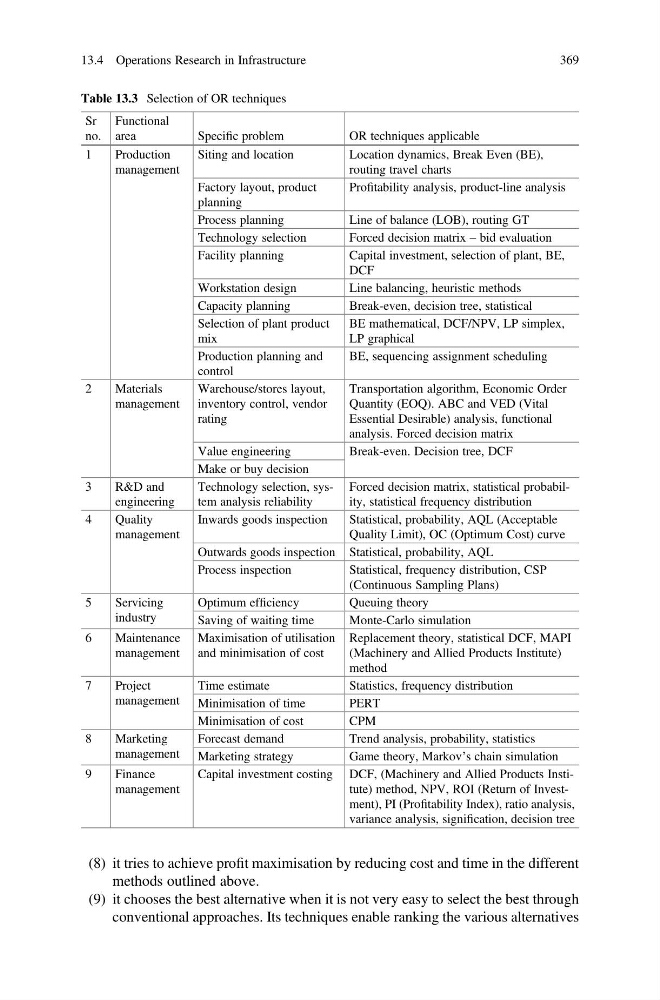
Table 13.3 Selection of OR techniques
Sr
no.
Functional
area
Specific problem
OR techniques applicable
1
Production
management
Siting and location
Location dynamics, Break Even (BE),
routing travel charts
Factory layout, product
planning
Profitability analysis, product-line analysis
Process planning
Line of balance (LOB), routing GT
Technology selection
Forced decision matrix – bid evaluation
Facility planning
Capital investment, selection of plant, BE,
DCF
Workstation design
Line balancing, heuristic methods
Capacity planning
Break-even, decision tree, statistical
Selection of plant product
mix
BE mathematical, DCF/NPV, LP simplex,
LP graphical
Production planning and
control
BE, sequencing assignment scheduling
2
Materials
management
Warehouse/stores layout,
inventory control, vendor
rating
Transportation algorithm, Economic Order
Quantity (EOQ). ABC and VED (Vital
Essential Desirable) analysis, functional
analysis. Forced decision matrix
Value engineering
Break-even. Decision tree, DCF
Make or buy decision
3
R&D and
engineering
Technology selection, system analysis reliability
Forced decision matrix, statistical probability, statistical frequency distribution
4
Quality
management
Inwards goods inspection
Statistical, probability, AQL (Acceptable
Quality Limit), OC (Optimum Cost) curve
Outwards goods inspection Statistical, probability, AQL
Process inspection
Statistical, frequency distribution, CSP
(Continuous Sampling Plans)
5
Servicing
industry
Optimum efficiency
Queuing theory
Saving of waiting time
Monte-Carlo simulation
6
Maintenance
management
Maximisation of utilisation
and minimisation of cost
Replacement theory, statistical DCF, MAPI
(Machinery and Allied Products Institute)
method
7
Project
management
Time estimate
Statistics, frequency distribution
Minimisation of time
PERT
Minimisation of cost
CPM
8
Marketing
management
Forecast demand
Trend analysis, probability, statistics
Marketing strategy
Game theory, Markov’s chain simulation
9
Finance
management
Capital investment costing DCF, (Machinery and Allied Products Institute) method, NPV, ROI (Return of Investment), PI (Profitability Index), ratio analysis,
variance analysis, signification, decision tree
13.4 Operations Research in Infrastructure
369
methods outlined above.
(9) it chooses the best alternative when it is not very easy to select the best through
conventional approaches. Its techniques enable ranking the various alternatives
Table 13.3 Selection of OR techniques
Sr
no.
Functional
area
Specific problem
OR techniques applicable
1
Production
management
Siting and location
Location dynamics, Break Even (BE),
routing travel charts
Factory layout, product
planning
Profitability analysis, product-line analysis
Process planning
Line of balance (LOB), routing GT
Technology selection
Forced decision matrix – bid evaluation
Facility planning
Capital investment, selection of plant, BE,
DCF
Workstation design
Line balancing, heuristic methods
Capacity planning
Break-even, decision tree, statistical
Selection of plant product
mix
BE mathematical, DCF/NPV, LP simplex,
LP graphical
Production planning and
control
BE, sequencing assignment scheduling
2
Materials
management
Warehouse/stores layout,
inventory control, vendor
rating
Transportation algorithm, Economic Order
Quantity (EOQ). ABC and VED (Vital
Essential Desirable) analysis, functional
analysis. Forced decision matrix
Value engineering
Break-even. Decision tree, DCF
Make or buy decision
3
R&D and
engineering
Technology selection, system analysis reliability
Forced decision matrix, statistical probability, statistical frequency distribution
4
Quality
management
Inwards goods inspection
Statistical, probability, AQL (Acceptable
Quality Limit), OC (Optimum Cost) curve
Outwards goods inspection Statistical, probability, AQL
Process inspection
Statistical, frequency distribution, CSP
(Continuous Sampling Plans)
5
Servicing
industry
Optimum efficiency
Queuing theory
Saving of waiting time
Monte-Carlo simulation
6
Maintenance
management
Maximisation of utilisation
and minimisation of cost
Replacement theory, statistical DCF, MAPI
(Machinery and Allied Products Institute)
method
7
Project
management
Time estimate
Statistics, frequency distribution
Minimisation of time
PERT
Minimisation of cost
CPM
8
Marketing
management
Forecast demand
Trend analysis, probability, statistics
Marketing strategy
Game theory, Markov’s chain simulation
9
Finance
management
Capital investment costing DCF, (Machinery and Allied Products Institute) method, NPV, ROI (Return of Investment), PI (Profitability Index), ratio analysis,
variance analysis, signification, decision tree
13.4 Operations Research in Infrastructure
369