

new parameters may materialise and the basic function between the variables may
change.
A solution obtained from a model remains valid as long as the uncontrollable
variables keep their values and the basic function between the variables remains
the same.
However, if one or several decision variable values change, or if the basic
function between the variables changes, the solution is no longer valid. Thus, the
limits of reliability for the model and its solution must be established in order to
indicate when modifications are required.
13.2.6 Implementing the Solution from the Model
After obtaining the solution from the model, it remains to be implemented through
operating procedures which are easily understood and can be applied by the control
operators. If need be, necessary changes in prevailing procedures and resources must
also be indicated.
The actual performance of the system will need to be monitored to indicate any
additional modifications required. Sometimes, OR solutions, though theoretically
feasible cannot be implemented because they are unworkable in practice.
Of course, as mentioned in Table 13.1, getting management as an active participant in all phases of the model construction and testing is one way of obtaining
co-operation for implementing the solution.
13.3 Types of Mathematical Models
Many OR models have been developed and applied to problems in business and
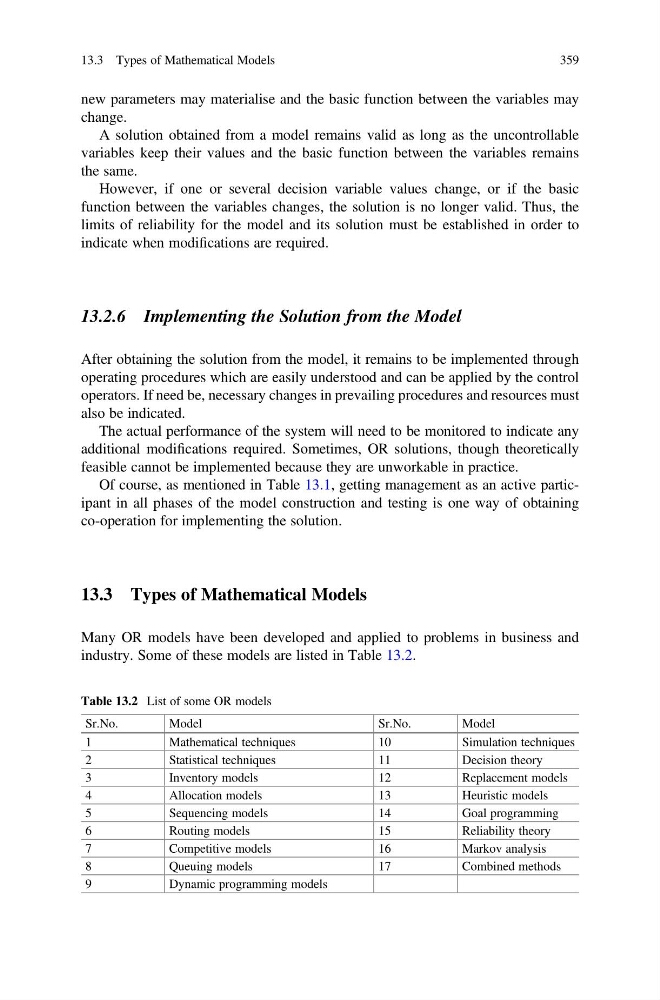
industry. Some of these models are listed in Table 13.2.
Table 13.2 List of some OR models
Sr.No.
Model
Sr.No.
Model
1
Mathematical techniques
10
Simulation techniques
2
Statistical techniques
11
Decision theory
3
Inventory models
12
Replacement models
4
Allocation models
13
Heuristic models
5
Sequencing models
14
Goal programming
6
Routing models
15
Reliability theory
7
Competitive models
16
Markov analysis
8
Queuing models
17
Combined methods
9
Dynamic programming models
13.3 Types of Mathematical Models
359
change.
A solution obtained from a model remains valid as long as the uncontrollable
variables keep their values and the basic function between the variables remains
the same.
However, if one or several decision variable values change, or if the basic
function between the variables changes, the solution is no longer valid. Thus, the
limits of reliability for the model and its solution must be established in order to
indicate when modifications are required.
13.2.6 Implementing the Solution from the Model
After obtaining the solution from the model, it remains to be implemented through
operating procedures which are easily understood and can be applied by the control
operators. If need be, necessary changes in prevailing procedures and resources must
also be indicated.
The actual performance of the system will need to be monitored to indicate any
additional modifications required. Sometimes, OR solutions, though theoretically
feasible cannot be implemented because they are unworkable in practice.
Of course, as mentioned in Table 13.1, getting management as an active participant in all phases of the model construction and testing is one way of obtaining
co-operation for implementing the solution.
13.3 Types of Mathematical Models
Many OR models have been developed and applied to problems in business and
industry. Some of these models are listed in Table 13.2.
Table 13.2 List of some OR models
Sr.No.
Model
Sr.No.
Model
1
Mathematical techniques
10
Simulation techniques
2
Statistical techniques
11
Decision theory
3
Inventory models
12
Replacement models
4
Allocation models
13
Heuristic models
5
Sequencing models
14
Goal programming
6
Routing models
15
Reliability theory
7
Competitive models
16
Markov analysis
8
Queuing models
17
Combined methods
9
Dynamic programming models
13.3 Types of Mathematical Models
359