

13.1.2 Basic Rules of Modelling
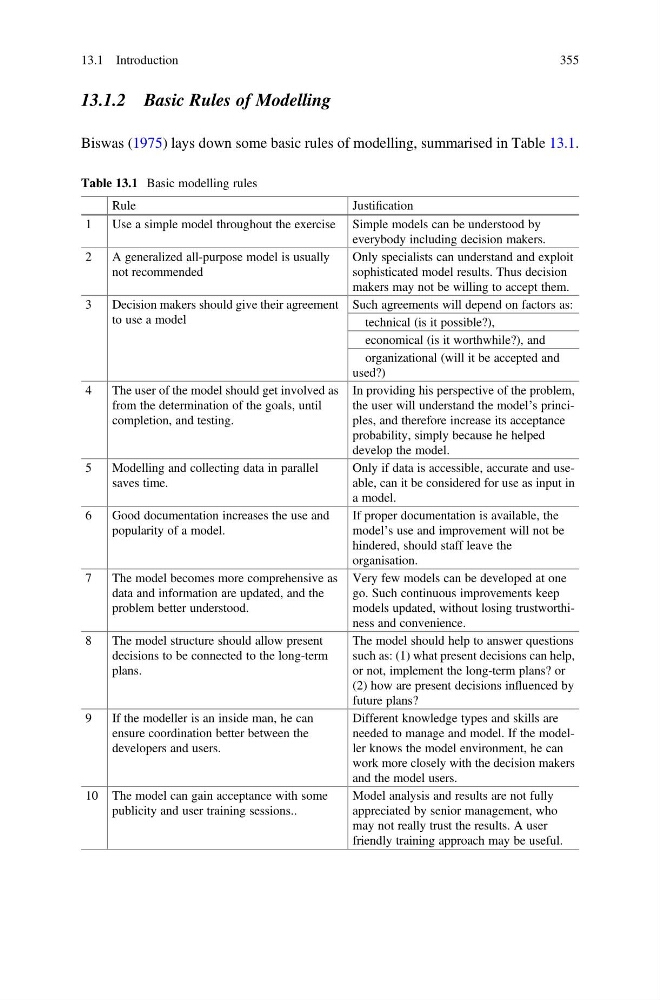
Biswas (1975) lays down some basic rules of modelling, summarised in Table 13.1.
Table 13.1 Basic modelling rules
Rule
Justification
1
Use a simple model throughout the exercise Simple models can be understood by
everybody including decision makers.
2
A generalized all-purpose model is usually
not recommended
Only specialists can understand and exploit
sophisticated model results. Thus decision
makers may not be willing to accept them.
3
Decision makers should give their agreement
to use a model
Such agreements will depend on factors as:
technical (is it possible?),
economical (is it worthwhile?), and
organizational (will it be accepted and
used?)
4
The user of the model should get involved as
from the determination of the goals, until
completion, and testing.
In providing his perspective of the problem,
the user will understand the model’s principles, and therefore increase its acceptance
probability, simply because he helped
develop the model.
5
Modelling and collecting data in parallel
saves time.
Only if data is accessible, accurate and useable, can it be considered for use as input in
a model.
6
Good documentation increases the use and
popularity of a model.
If proper documentation is available, the
model’s use and improvement will not be
hindered, should staff leave the
organisation.
7
The model becomes more comprehensive as
data and information are updated, and the
problem better understood.
Very few models can be developed at one
go. Such continuous improvements keep
models updated, without losing trustworthiness and convenience.
8
The model structure should allow present
decisions to be connected to the long-term
plans.
The model should help to answer questions
such as: (1) what present decisions can help,
or not, implement the long-term plans? or
(2) how are present decisions influenced by
future plans?
9
If the modeller is an inside man, he can
ensure coordination better between the
developers and users.
Different knowledge types and skills are
needed to manage and model. If the modeller knows the model environment, he can
work more closely with the decision makers
and the model users.
10 The model can gain acceptance with some
publicity and user training sessions..
Model analysis and results are not fully
appreciated by senior management, who
may not really trust the results. A user
friendly training approach may be useful.
13.1 Introduction
355
Biswas (1975) lays down some basic rules of modelling, summarised in Table 13.1.
Table 13.1 Basic modelling rules
Rule
Justification
1
Use a simple model throughout the exercise Simple models can be understood by
everybody including decision makers.
2
A generalized all-purpose model is usually
not recommended
Only specialists can understand and exploit
sophisticated model results. Thus decision
makers may not be willing to accept them.
3
Decision makers should give their agreement
to use a model
Such agreements will depend on factors as:
technical (is it possible?),
economical (is it worthwhile?), and
organizational (will it be accepted and
used?)
4
The user of the model should get involved as
from the determination of the goals, until
completion, and testing.
In providing his perspective of the problem,
the user will understand the model’s principles, and therefore increase its acceptance
probability, simply because he helped
develop the model.
5
Modelling and collecting data in parallel
saves time.
Only if data is accessible, accurate and useable, can it be considered for use as input in
a model.
6
Good documentation increases the use and
popularity of a model.
If proper documentation is available, the
model’s use and improvement will not be
hindered, should staff leave the
organisation.
7
The model becomes more comprehensive as
data and information are updated, and the
problem better understood.
Very few models can be developed at one
go. Such continuous improvements keep
models updated, without losing trustworthiness and convenience.
8
The model structure should allow present
decisions to be connected to the long-term
plans.
The model should help to answer questions
such as: (1) what present decisions can help,
or not, implement the long-term plans? or
(2) how are present decisions influenced by
future plans?
9
If the modeller is an inside man, he can
ensure coordination better between the
developers and users.
Different knowledge types and skills are
needed to manage and model. If the modeller knows the model environment, he can
work more closely with the decision makers
and the model users.
10 The model can gain acceptance with some
publicity and user training sessions..
Model analysis and results are not fully
appreciated by senior management, who
may not really trust the results. A user
friendly training approach may be useful.
13.1 Introduction
355