

11.6 Case Study: Resilience in a Water Supply Network
11.6.1 Vulnerability in the System
A water network is an important infrastructure service provided to consumers.
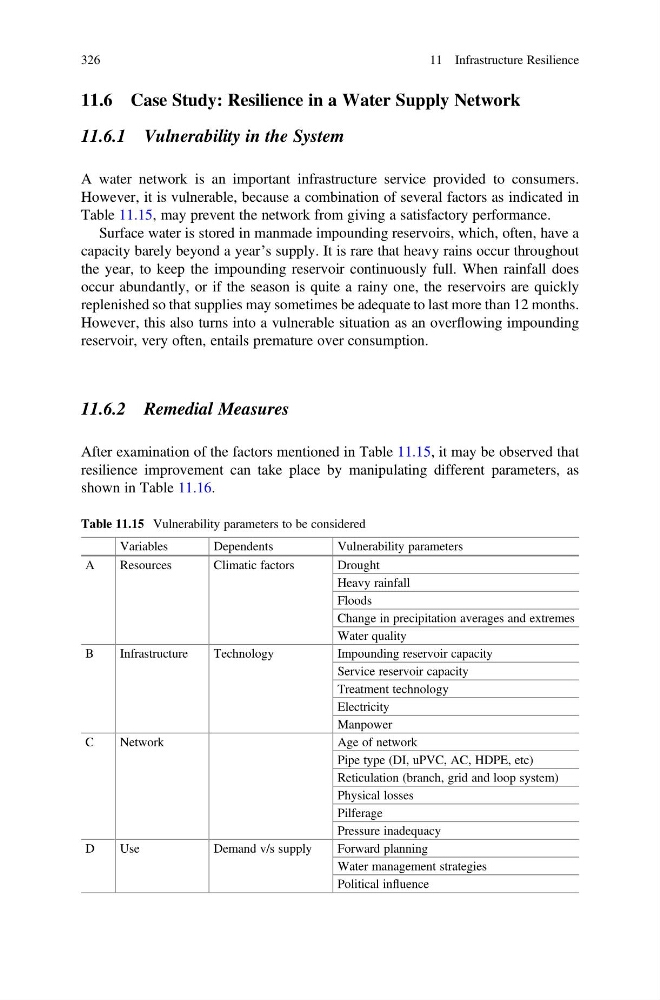
However, it is vulnerable, because a combination of several factors as indicated in
Table 11.15, may prevent the network from giving a satisfactory performance.
Surface water is stored in manmade impounding reservoirs, which, often, have a
capacity barely beyond a year’s supply. It is rare that heavy rains occur throughout
the year, to keep the impounding reservoir continuously full. When rainfall does
occur abundantly, or if the season is quite a rainy one, the reservoirs are quickly
replenished so that supplies may sometimes be adequate to last more than 12 months.
However, this also turns into a vulnerable situation as an overflowing impounding
reservoir, very often, entails premature over consumption.
11.6.2 Remedial Measures
After examination of the factors mentioned in Table 11.15, it may be observed that
resilience improvement can take place by manipulating different parameters, as
shown in Table 11.16.
Table 11.15 Vulnerability parameters to be considered
Variables
Dependents
Vulnerability parameters
A
Resources
Climatic factors
Drought
Heavy rainfall
Floods
Change in precipitation averages and extremes
Water quality
B
Infrastructure
Technology
Impounding reservoir capacity
Service reservoir capacity
Treatment technology
Electricity
Manpower
C
Network
Age of network
Pipe type (DI, uPVC, AC, HDPE, etc)
Reticulation (branch, grid and loop system)
Physical losses
Pilferage
Pressure inadequacy
D
Use
Demand v/s supply
Forward planning
Water management strategies
Political influence
326
11 Infrastructure Resilience
11.6.1 Vulnerability in the System
A water network is an important infrastructure service provided to consumers.
However, it is vulnerable, because a combination of several factors as indicated in
Table 11.15, may prevent the network from giving a satisfactory performance.
Surface water is stored in manmade impounding reservoirs, which, often, have a
capacity barely beyond a year’s supply. It is rare that heavy rains occur throughout
the year, to keep the impounding reservoir continuously full. When rainfall does
occur abundantly, or if the season is quite a rainy one, the reservoirs are quickly
replenished so that supplies may sometimes be adequate to last more than 12 months.
However, this also turns into a vulnerable situation as an overflowing impounding
reservoir, very often, entails premature over consumption.
11.6.2 Remedial Measures
After examination of the factors mentioned in Table 11.15, it may be observed that
resilience improvement can take place by manipulating different parameters, as
shown in Table 11.16.
Table 11.15 Vulnerability parameters to be considered
Variables
Dependents
Vulnerability parameters
A
Resources
Climatic factors
Drought
Heavy rainfall
Floods
Change in precipitation averages and extremes
Water quality
B
Infrastructure
Technology
Impounding reservoir capacity
Service reservoir capacity
Treatment technology
Electricity
Manpower
C
Network
Age of network
Pipe type (DI, uPVC, AC, HDPE, etc)
Reticulation (branch, grid and loop system)
Physical losses
Pilferage
Pressure inadequacy
D
Use
Demand v/s supply
Forward planning
Water management strategies
Political influence
326
11 Infrastructure Resilience