

10.4.4 Suggested Policies to Increase Infrastructure
Resilience
In practical terms, policies can be organised in five main categories:
1. Information-based policies: infrastructure resilience can be increased only if
stakeholders have the information related to natural risks, and how climate
change is affecting these natural risks. Since such information is a public good
(see Chap. 17), there is a need for the governments to produce this information –
for example, climate data should be freely disseminated, instead of being kept as a
national secret by a few, impossible to access and use by many.
2. Regulation-based policies: although, infrastructure stakeholders (design, construction, or operation) follow regulations strictly, natural risks are not considered
directly, except if the regulations have included this aspect. Thus, regulations may
provide an important role to improve infrastructure resilience, if they adapted to
consider climate change, and the resulting changes in natural risks. Such regulations deal with technical aspects of the infrastructure.
It might also be necessary to examine procedural aspects, for example, to
consider requesting applicants for public and private civil engineering works for a
mandatory vulnerability (or robustness) study with respect to possible climate
change impacts.
Other standards, not directly related to climate change and risks, but, which
have an impact on adaptability, may also be modified. For example, architectural
INPUTS
Factors/dimensions
Population growth rate
Temperature rise magnitude
Rainfall fluctuations
Magnitude of extreme events
POLICY
OUTPUTS
Impacts
ASSESSMENT CRITERIA
Public financing needs
Implementation barriers
ASSESSMENT CRITERIA
Environmental dimension
Economic dimension
Social component
Political dimension
Institutional dimension
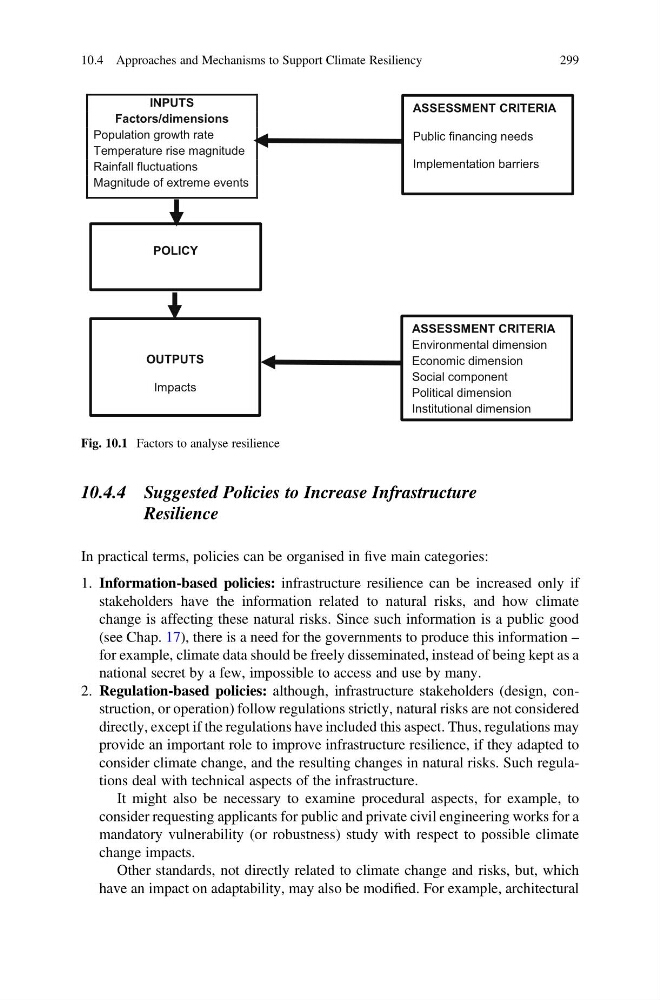
Fig. 10.1 Factors to analyse resilience
10.4 Approaches and Mechanisms to Support Climate Resiliency
299
Resilience
In practical terms, policies can be organised in five main categories:
1. Information-based policies: infrastructure resilience can be increased only if
stakeholders have the information related to natural risks, and how climate
change is affecting these natural risks. Since such information is a public good
(see Chap. 17), there is a need for the governments to produce this information –
for example, climate data should be freely disseminated, instead of being kept as a
national secret by a few, impossible to access and use by many.
2. Regulation-based policies: although, infrastructure stakeholders (design, construction, or operation) follow regulations strictly, natural risks are not considered
directly, except if the regulations have included this aspect. Thus, regulations may
provide an important role to improve infrastructure resilience, if they adapted to
consider climate change, and the resulting changes in natural risks. Such regulations deal with technical aspects of the infrastructure.
It might also be necessary to examine procedural aspects, for example, to
consider requesting applicants for public and private civil engineering works for a
mandatory vulnerability (or robustness) study with respect to possible climate
change impacts.
Other standards, not directly related to climate change and risks, but, which
have an impact on adaptability, may also be modified. For example, architectural
INPUTS
Factors/dimensions
Population growth rate
Temperature rise magnitude
Rainfall fluctuations
Magnitude of extreme events
POLICY
OUTPUTS
Impacts
ASSESSMENT CRITERIA
Public financing needs
Implementation barriers
ASSESSMENT CRITERIA
Environmental dimension
Economic dimension
Social component
Political dimension
Institutional dimension
Fig. 10.1 Factors to analyse resilience
10.4 Approaches and Mechanisms to Support Climate Resiliency
299