

(5) for water supply, by the timely delivery of promised amounts of water and its
quality for drinking, irrigation, or other uses.
There are several ways how reliability or risk of failure may be measured,
namely:
1. Factor of Safety
2. Safety Margin
3. Reliability Index
4. Performance Function and Limiting State
5. Resilience
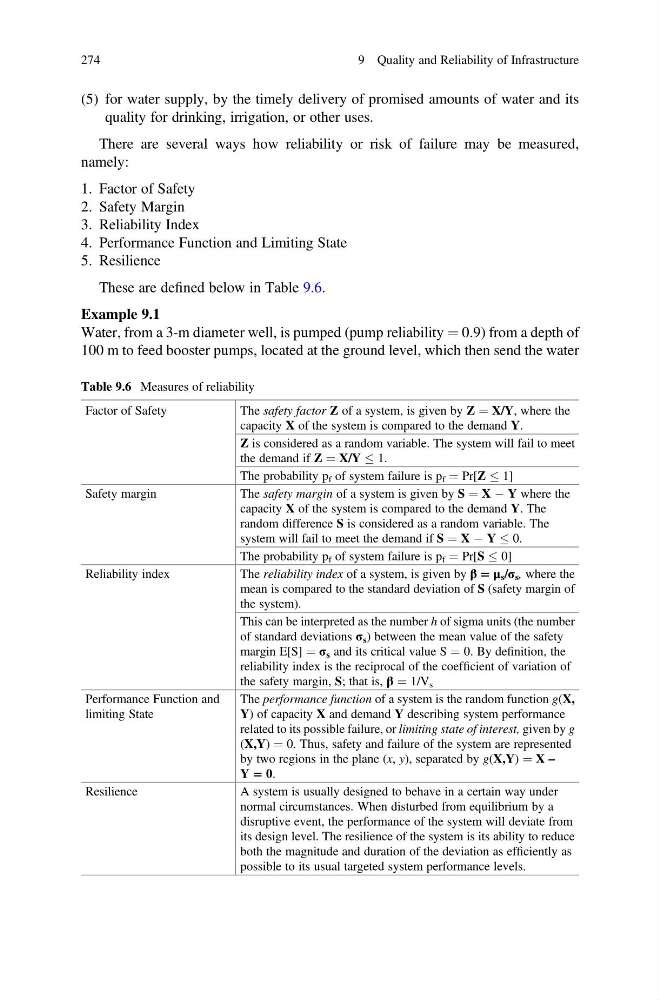
These are defined below in Table 9.6.
Example 9.1
Water, from a 3-m diameter well, is pumped (pump reliability ¼ 0.9) from a depth of
100 m to feed booster pumps, located at the ground level, which then send the water
Table 9.6 Measures of reliability
Factor of Safety
The safety factor Z of a system, is given by Z ¼ X/Y, where the
capacity X of the system is compared to the demand Y.
Z is considered as a random variable. The system will fail to meet
the demand if Z ¼ X/Y 1.
The probability p f of system failure is p f ¼ Pr[Z 1]
Safety margin
The safety margin of a system is given by S ¼ X À Y where the
capacity X of the system is compared to the demand Y. The
random difference S is considered as a random variable. The
system will fail to meet the demand if S ¼ X À Y 0.
The probability p f of system failure is p f ¼ Pr[S 0]
Reliability index
The reliability index of a system, is given by β = μ s /σ s , where the
mean is compared to the standard deviation of S (safety margin of
the system).
This can be interpreted as the number h of sigma units (the number
of standard deviations σ s ) between the mean value of the safety
margin E[S] ¼ σ s and its critical value S ¼ 0. By definition, the
reliability index is the reciprocal of the coefficient of variation of
the safety margin, S; that is, β ¼ 1/V s
Performance Function and
limiting State
The performance function of a system is the random function g(X,
Y) of capacity X and demand Y describing system performance
related to its possible failure, or limiting state of interest, given by g
(X,Y) ¼ 0. Thus, safety and failure of the system are represented
by two regions in the plane (x, y), separated by g(X,Y) ¼ X –
Y = 0.
Resilience
A system is usually designed to behave in a certain way under
normal circumstances. When disturbed from equilibrium by a
disruptive event, the performance of the system will deviate from
its design level. The resilience of the system is its ability to reduce
both the magnitude and duration of the deviation as efficiently as
possible to its usual targeted system performance levels.
274
9 Quality and Reliability of Infrastructure
quality for drinking, irrigation, or other uses.
There are several ways how reliability or risk of failure may be measured,
namely:
1. Factor of Safety
2. Safety Margin
3. Reliability Index
4. Performance Function and Limiting State
5. Resilience
These are defined below in Table 9.6.
Example 9.1
Water, from a 3-m diameter well, is pumped (pump reliability ¼ 0.9) from a depth of
100 m to feed booster pumps, located at the ground level, which then send the water
Table 9.6 Measures of reliability
Factor of Safety
The safety factor Z of a system, is given by Z ¼ X/Y, where the
capacity X of the system is compared to the demand Y.
Z is considered as a random variable. The system will fail to meet
the demand if Z ¼ X/Y 1.
The probability p f of system failure is p f ¼ Pr[Z 1]
Safety margin
The safety margin of a system is given by S ¼ X À Y where the
capacity X of the system is compared to the demand Y. The
random difference S is considered as a random variable. The
system will fail to meet the demand if S ¼ X À Y 0.
The probability p f of system failure is p f ¼ Pr[S 0]
Reliability index
The reliability index of a system, is given by β = μ s /σ s , where the
mean is compared to the standard deviation of S (safety margin of
the system).
This can be interpreted as the number h of sigma units (the number
of standard deviations σ s ) between the mean value of the safety
margin E[S] ¼ σ s and its critical value S ¼ 0. By definition, the
reliability index is the reciprocal of the coefficient of variation of
the safety margin, S; that is, β ¼ 1/V s
Performance Function and
limiting State
The performance function of a system is the random function g(X,
Y) of capacity X and demand Y describing system performance
related to its possible failure, or limiting state of interest, given by g
(X,Y) ¼ 0. Thus, safety and failure of the system are represented
by two regions in the plane (x, y), separated by g(X,Y) ¼ X –
Y = 0.
Resilience
A system is usually designed to behave in a certain way under
normal circumstances. When disturbed from equilibrium by a
disruptive event, the performance of the system will deviate from
its design level. The resilience of the system is its ability to reduce
both the magnitude and duration of the deviation as efficiently as
possible to its usual targeted system performance levels.
274
9 Quality and Reliability of Infrastructure