

9.6.3 Parallel Systems
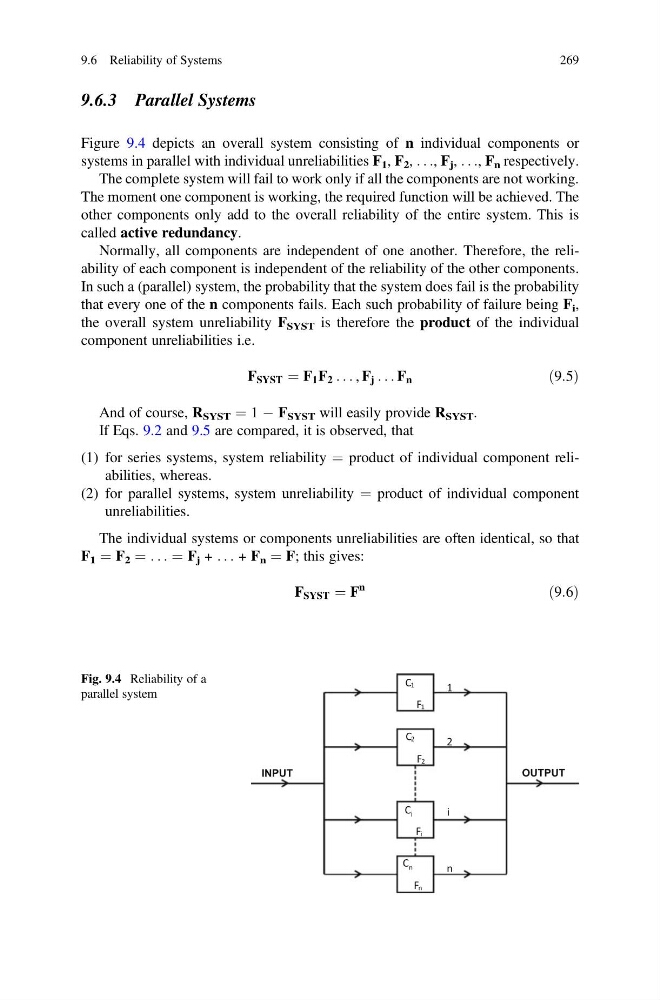
Figure 9.4 depicts an overall system consisting of n individual components or
systems in parallel with individual unreliabilities F 1 , F 2 , . . ., F j , . . ., F n respectively.
The complete system will fail to work only if all the components are not working.
The moment one component is working, the required function will be achieved. The
other components only add to the overall reliability of the entire system. This is
called active redundancy.
Normally, all components are independent of one another. Therefore, the reliability of each component is independent of the reliability of the other components.
In such a (parallel) system, the probability that the system does fail is the probability
that every one of the n components fails. Each such probability of failure being F i ,
the overall system unreliability F SYST is therefore the product of the individual
component unreliabilities i.e.
F SYST ¼ F 1 F 2 . . . , F j . . . F n
ð9:5Þ
And of course, R SYST ¼ 1 À F SYST will easily provide R SYST .
If Eqs. 9.2 and 9.5 are compared, it is observed, that
(1) for series systems, system reliability ¼ product of individual component reliabilities, whereas.
(2) for parallel systems, system unreliability ¼ product of individual component
unreliabilities.
The individual systems or components unreliabilities are often identical, so that
F 1 ¼ F 2 ¼ . . . ¼ F j + . . . + F n ¼ F; this gives:
F SYST ¼ F
n
ð9:6Þ
OUTPUT
INPUT
C1
F1
1
2
i
n
C2
F2
C i
Fi
C n
Fn
Fig. 9.4 Reliability of a
parallel system
9.6 Reliability of Systems
269
Figure 9.4 depicts an overall system consisting of n individual components or
systems in parallel with individual unreliabilities F 1 , F 2 , . . ., F j , . . ., F n respectively.
The complete system will fail to work only if all the components are not working.
The moment one component is working, the required function will be achieved. The
other components only add to the overall reliability of the entire system. This is
called active redundancy.
Normally, all components are independent of one another. Therefore, the reliability of each component is independent of the reliability of the other components.
In such a (parallel) system, the probability that the system does fail is the probability
that every one of the n components fails. Each such probability of failure being F i ,
the overall system unreliability F SYST is therefore the product of the individual
component unreliabilities i.e.
F SYST ¼ F 1 F 2 . . . , F j . . . F n
ð9:5Þ
And of course, R SYST ¼ 1 À F SYST will easily provide R SYST .
If Eqs. 9.2 and 9.5 are compared, it is observed, that
(1) for series systems, system reliability ¼ product of individual component reliabilities, whereas.
(2) for parallel systems, system unreliability ¼ product of individual component
unreliabilities.
The individual systems or components unreliabilities are often identical, so that
F 1 ¼ F 2 ¼ . . . ¼ F j + . . . + F n ¼ F; this gives:
F SYST ¼ F
n
ð9:6Þ
OUTPUT
INPUT
C1
F1
1
2
i
n
C2
F2
C i
Fi
C n
Fn
Fig. 9.4 Reliability of a
parallel system
9.6 Reliability of Systems
269