

Before analyzing the risk of failure of a system, it is necessary to identify the
system’s input and the consequential response. For a building, the structural safety
depends on the maximum load the building will be subjected to during its lifetime,
on the strength or load-carrying capacity of the structural members. As maximum
(including wind) loads and actual strength of structural members are subject to
uncertainties, exact calculations for its absolute safety cannot be carried out. The
engineer then relies on some probabilistic concept (factor of safety) to indicate the
likelihood that the available strength of the structure will be adequate to withstand
the maximum load over the lifetime of the building. In a water supply system, the
engineer compares the water demand by different users against the available
resources. As both, the demand fluctuates, and water resources undergo natural
variability, the probability of available supply relative to demand provides the
adequacy of the system’s design or operation.
9.2 Introduction to Quality and Reliability
9.2.1 The Meaning of Quality
People talk about the quality of a service or product to mean its ability to ensure user
satisfaction completely. However, for any given service or product, the customer
uses more than one feature to establish his satisfaction. Thus the quality of an air
flight will be judged on the comfort of the seat, on leg room available, choice of
entertainment (films) available, choice offered by the meal menu, the quality of the
meal itself as well as efficiency of the service. Thus, it is probably more appropriate
to define quality as: “the totality of features and characteristics of a product, process
or service that bear on its ability to satisfy stated or implied needs”.
Therefore the quality of an infrastructure (or engineering product) can be determined or assessed through several performance characteristics that contribute to
an overall performance satisfying a customer’s requirements.
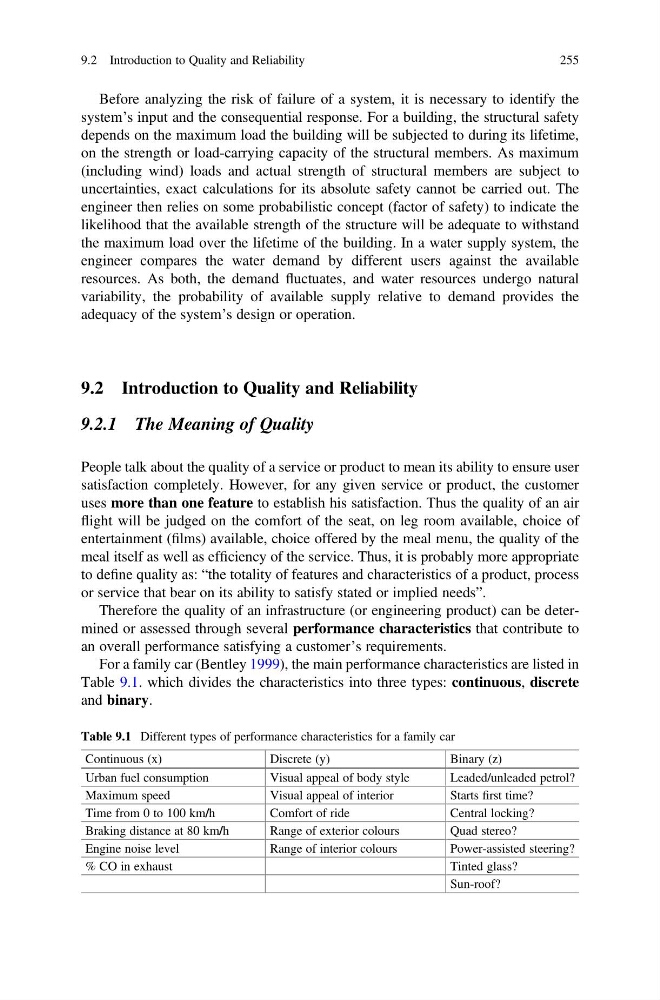
For a family car (Bentley 1999), the main performance characteristics are listed in
Table 9.1. which divides the characteristics into three types: continuous, discrete
and binary.
Table 9.1 Different types of performance characteristics for a family car
Continuous (x)
Discrete (y)
Binary (z)
Urban fuel consumption
Visual appeal of body style
Leaded/unleaded petrol?
Maximum speed
Visual appeal of interior
Starts first time?
Time from 0 to 100 km/h
Comfort of ride
Central locking?
Braking distance at 80 km/h
Range of exterior colours
Quad stereo?
Engine noise level
Range of interior colours
Power-assisted steering?
% CO in exhaust
Tinted glass?
Sun-roof?
9.2 Introduction to Quality and Reliability
255
system’s input and the consequential response. For a building, the structural safety
depends on the maximum load the building will be subjected to during its lifetime,
on the strength or load-carrying capacity of the structural members. As maximum
(including wind) loads and actual strength of structural members are subject to
uncertainties, exact calculations for its absolute safety cannot be carried out. The
engineer then relies on some probabilistic concept (factor of safety) to indicate the
likelihood that the available strength of the structure will be adequate to withstand
the maximum load over the lifetime of the building. In a water supply system, the
engineer compares the water demand by different users against the available
resources. As both, the demand fluctuates, and water resources undergo natural
variability, the probability of available supply relative to demand provides the
adequacy of the system’s design or operation.
9.2 Introduction to Quality and Reliability
9.2.1 The Meaning of Quality
People talk about the quality of a service or product to mean its ability to ensure user
satisfaction completely. However, for any given service or product, the customer
uses more than one feature to establish his satisfaction. Thus the quality of an air
flight will be judged on the comfort of the seat, on leg room available, choice of
entertainment (films) available, choice offered by the meal menu, the quality of the
meal itself as well as efficiency of the service. Thus, it is probably more appropriate
to define quality as: “the totality of features and characteristics of a product, process
or service that bear on its ability to satisfy stated or implied needs”.
Therefore the quality of an infrastructure (or engineering product) can be determined or assessed through several performance characteristics that contribute to
an overall performance satisfying a customer’s requirements.
For a family car (Bentley 1999), the main performance characteristics are listed in
Table 9.1. which divides the characteristics into three types: continuous, discrete
and binary.
Table 9.1 Different types of performance characteristics for a family car
Continuous (x)
Discrete (y)
Binary (z)
Urban fuel consumption
Visual appeal of body style
Leaded/unleaded petrol?
Maximum speed
Visual appeal of interior
Starts first time?
Time from 0 to 100 km/h
Comfort of ride
Central locking?
Braking distance at 80 km/h
Range of exterior colours
Quad stereo?
Engine noise level
Range of interior colours
Power-assisted steering?
% CO in exhaust
Tinted glass?
Sun-roof?
9.2 Introduction to Quality and Reliability
255