

be subject to uncertainty. For soil-conservation projects, both the with-project and
without-project rates of erosion and/or their effects on productivity may be
unknown. Natural events such as drought, windstorms, hail, and plant and animal
diseases may seriously affect projects.
All projects face some degree of uncertainty. The most common way of dealing
with this is to use “expected values” for prices, quantities and other variables whose
precise values cannot be known in advance. Essentially, this involves transforming
uncertainty (where the probabilities of different outcomes are not known) into risk
(where the probabilities of various outcomes are weighted according to their likelihood of occurrence). Each potential outcome is weighted by the probability of its
occurrence, and the weighted outcomes are then summed to arrive at a mean, or
expected, value. These probabilities may be estimated by using past trends, subjective judgements or through a variety of advanced techniques.
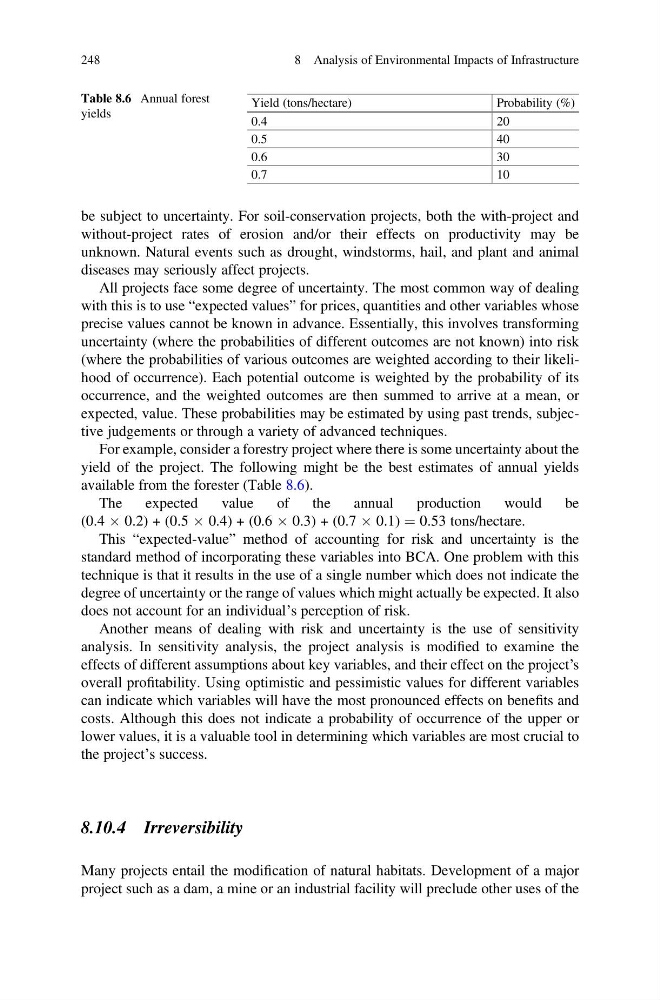
For example, consider a forestry project where there is some uncertainty about the
yield of the project. The following might be the best estimates of annual yields
available from the forester (Table 8.6).
The
expected
value
of
the
annual
production
would
be
(0.4 Â 0.2) + (0.5 Â 0.4) + (0.6 Â 0.3) + (0.7 Â 0.1) ¼ 0.53 tons/hectare.
This “expected-value” method of accounting for risk and uncertainty is the
standard method of incorporating these variables into BCA. One problem with this
technique is that it results in the use of a single number which does not indicate the
degree of uncertainty or the range of values which might actually be expected. It also
does not account for an individual’s perception of risk.
Another means of dealing with risk and uncertainty is the use of sensitivity
analysis. In sensitivity analysis, the project analysis is modified to examine the
effects of different assumptions about key variables, and their effect on the project’s
overall profitability. Using optimistic and pessimistic values for different variables
can indicate which variables will have the most pronounced effects on benefits and
costs. Although this does not indicate a probability of occurrence of the upper or
lower values, it is a valuable tool in determining which variables are most crucial to
the project’s success.
8.10.4 Irreversibility
Many projects entail the modification of natural habitats. Development of a major
project such as a dam, a mine or an industrial facility will preclude other uses of the
Table 8.6 Annual forest
yields
Yield (tons/hectare)
Probability (%)
0.4
20
0.5
40
0.6
30
0.7
10
248
8 Analysis of Environmental Impacts of Infrastructure
without-project rates of erosion and/or their effects on productivity may be
unknown. Natural events such as drought, windstorms, hail, and plant and animal
diseases may seriously affect projects.
All projects face some degree of uncertainty. The most common way of dealing
with this is to use “expected values” for prices, quantities and other variables whose
precise values cannot be known in advance. Essentially, this involves transforming
uncertainty (where the probabilities of different outcomes are not known) into risk
(where the probabilities of various outcomes are weighted according to their likelihood of occurrence). Each potential outcome is weighted by the probability of its
occurrence, and the weighted outcomes are then summed to arrive at a mean, or
expected, value. These probabilities may be estimated by using past trends, subjective judgements or through a variety of advanced techniques.
For example, consider a forestry project where there is some uncertainty about the
yield of the project. The following might be the best estimates of annual yields
available from the forester (Table 8.6).
The
expected
value
of
the
annual
production
would
be
(0.4 Â 0.2) + (0.5 Â 0.4) + (0.6 Â 0.3) + (0.7 Â 0.1) ¼ 0.53 tons/hectare.
This “expected-value” method of accounting for risk and uncertainty is the
standard method of incorporating these variables into BCA. One problem with this
technique is that it results in the use of a single number which does not indicate the
degree of uncertainty or the range of values which might actually be expected. It also
does not account for an individual’s perception of risk.
Another means of dealing with risk and uncertainty is the use of sensitivity
analysis. In sensitivity analysis, the project analysis is modified to examine the
effects of different assumptions about key variables, and their effect on the project’s
overall profitability. Using optimistic and pessimistic values for different variables
can indicate which variables will have the most pronounced effects on benefits and
costs. Although this does not indicate a probability of occurrence of the upper or
lower values, it is a valuable tool in determining which variables are most crucial to
the project’s success.
8.10.4 Irreversibility
Many projects entail the modification of natural habitats. Development of a major
project such as a dam, a mine or an industrial facility will preclude other uses of the
Table 8.6 Annual forest
yields
Yield (tons/hectare)
Probability (%)
0.4
20
0.5
40
0.6
30
0.7
10
248
8 Analysis of Environmental Impacts of Infrastructure