

suitable adjustments will be needed. Such adjusted prices are commonly known as
shadow prices.
8.3 Using Market Prices to Value a Change in Production
The methods presented are straightforward ones from benefit-cost analysis. The
stress is, however, on the economic assessment of the environmental effects of
infrastructure projects. The effects on environmental quality or on the sustainability
of renewable resources are often mirrored in productivity changes from the systems
involved, which, in turn, are used to allocate values. Many of the valuation methods
depend on the market prices to define values.
Infrastructure projects may affect both natural and human systems. While the
former comprise fisheries, agriculture and forests; human systems consist of
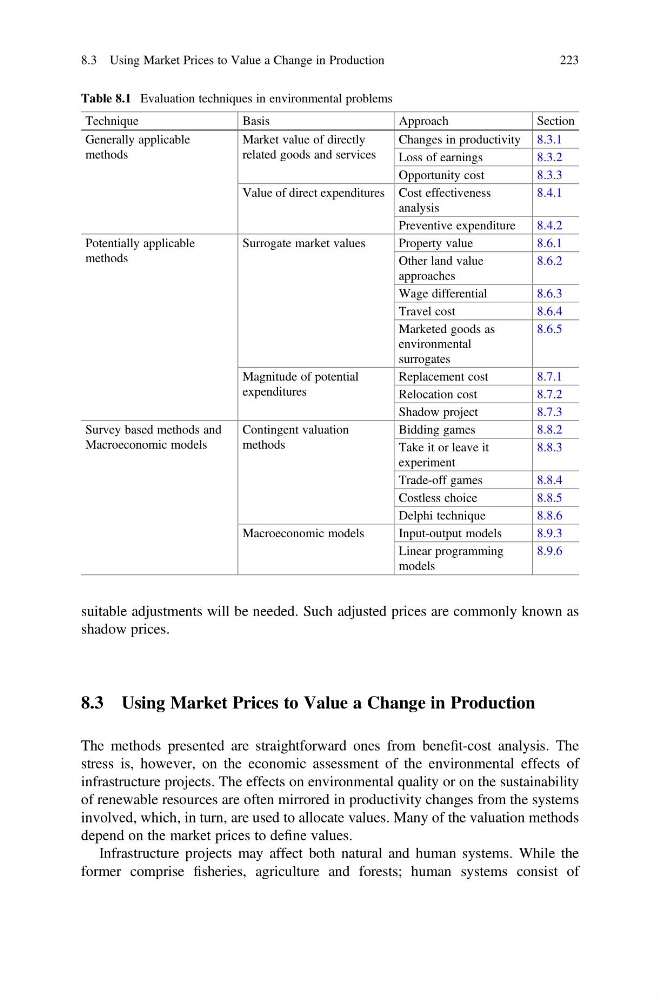
Table 8.1 Evaluation techniques in environmental problems
Technique
Basis
Approach
Section
Generally applicable
methods
Market value of directly
related goods and services
Changes in productivity 8.3.1
Loss of earnings
8.3.2
Opportunity cost
8.3.3
Value of direct expenditures Cost effectiveness
analysis
8.4.1
Preventive expenditure
8.4.2
Potentially applicable
methods
Surrogate market values
Property value
8.6.1
Other land value
approaches
8.6.2
Wage differential
8.6.3
Travel cost
8.6.4
Marketed goods as
environmental
surrogates
8.6.5
Magnitude of potential
expenditures
Replacement cost
8.7.1
Relocation cost
8.7.2
Shadow project
8.7.3
Survey based methods and
Macroeconomic models
Contingent valuation
methods
Bidding games
8.8.2
Take it or leave it
experiment
8.8.3
Trade-off games
8.8.4
Costless choice
8.8.5
Delphi technique
8.8.6
Macroeconomic models
Input-output models
8.9.3
Linear programming
models
8.9.6
8.3 Using Market Prices to Value a Change in Production
223
shadow prices.
8.3 Using Market Prices to Value a Change in Production
The methods presented are straightforward ones from benefit-cost analysis. The
stress is, however, on the economic assessment of the environmental effects of
infrastructure projects. The effects on environmental quality or on the sustainability
of renewable resources are often mirrored in productivity changes from the systems
involved, which, in turn, are used to allocate values. Many of the valuation methods
depend on the market prices to define values.
Infrastructure projects may affect both natural and human systems. While the
former comprise fisheries, agriculture and forests; human systems consist of
Table 8.1 Evaluation techniques in environmental problems
Technique
Basis
Approach
Section
Generally applicable
methods
Market value of directly
related goods and services
Changes in productivity 8.3.1
Loss of earnings
8.3.2
Opportunity cost
8.3.3
Value of direct expenditures Cost effectiveness
analysis
8.4.1
Preventive expenditure
8.4.2
Potentially applicable
methods
Surrogate market values
Property value
8.6.1
Other land value
approaches
8.6.2
Wage differential
8.6.3
Travel cost
8.6.4
Marketed goods as
environmental
surrogates
8.6.5
Magnitude of potential
expenditures
Replacement cost
8.7.1
Relocation cost
8.7.2
Shadow project
8.7.3
Survey based methods and
Macroeconomic models
Contingent valuation
methods
Bidding games
8.8.2
Take it or leave it
experiment
8.8.3
Trade-off games
8.8.4
Costless choice
8.8.5
Delphi technique
8.8.6
Macroeconomic models
Input-output models
8.9.3
Linear programming
models
8.9.6
8.3 Using Market Prices to Value a Change in Production
223