

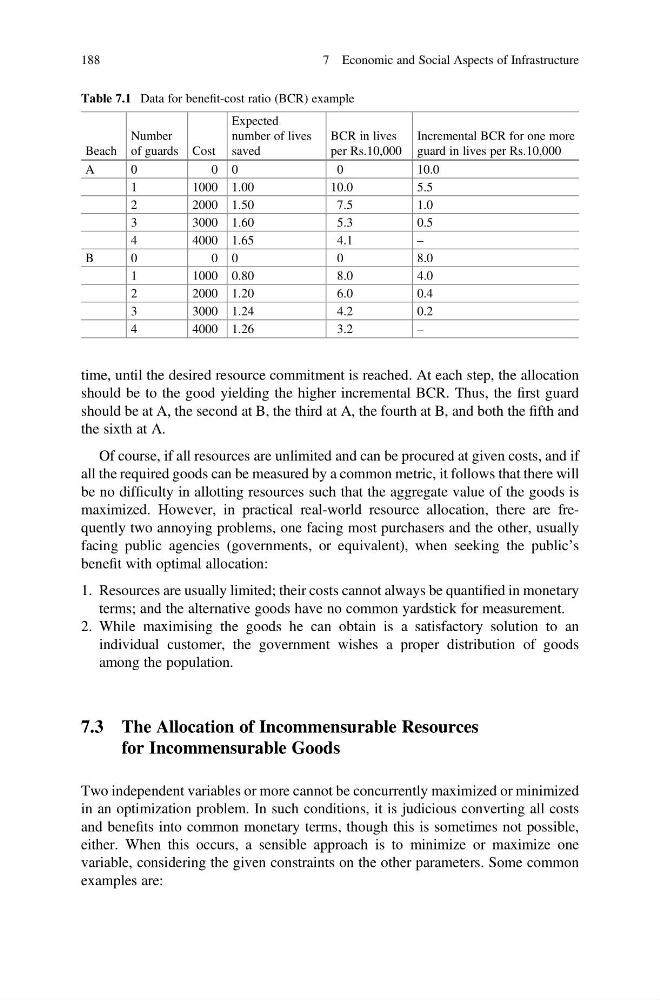
time, until the desired resource commitment is reached. At each step, the allocation
should be to the good yielding the higher incremental BCR. Thus, the first guard
should be at A, the second at B, the third at A, the fourth at B, and both the fifth and
the sixth at A.
Of course, if all resources are unlimited and can be procured at given costs, and if
all the required goods can be measured by a common metric, it follows that there will
be no difficulty in allotting resources such that the aggregate value of the goods is
maximized. However, in practical real-world resource allocation, there are frequently two annoying problems, one facing most purchasers and the other, usually
facing public agencies (governments, or equivalent), when seeking the public’s
benefit with optimal allocation:
1. Resources are usually limited; their costs cannot always be quantified in monetary
terms; and the alternative goods have no common yardstick for measurement.
2. While maximising the goods he can obtain is a satisfactory solution to an
individual customer, the government wishes a proper distribution of goods
among the population.
7.3 The Allocation of Incommensurable Resources
for Incommensurable Goods
Two independent variables or more cannot be concurrently maximized or minimized
in an optimization problem. In such conditions, it is judicious converting all costs
and benefits into common monetary terms, though this is sometimes not possible,
either. When this occurs, a sensible approach is to minimize or maximize one
variable, considering the given constraints on the other parameters. Some common
examples are:
Table 7.1 Data for benefit-cost ratio (BCR) example
Beach
Number
of guards Cost
Expected
number of lives
saved
BCR in lives
per Rs.10,000
Incremental BCR for one more
guard in lives per Rs.10,000
A
0
0 0
0
10.0
1
1000 1.00
10.0
5.5
2
2000 1.50
7.5
1.0
3
3000 1.60
5.3
0.5
4
4000 1.65
4.1
–
B
0
0 0
0
8.0
1
1000 0.80
8.0
4.0
2
2000 1.20
6.0
0.4
3
3000 1.24
4.2
0.2
4
4000 1.26
3.2
–
188
7 Economic and Social Aspects of Infrastructure
should be to the good yielding the higher incremental BCR. Thus, the first guard
should be at A, the second at B, the third at A, the fourth at B, and both the fifth and
the sixth at A.
Of course, if all resources are unlimited and can be procured at given costs, and if
all the required goods can be measured by a common metric, it follows that there will
be no difficulty in allotting resources such that the aggregate value of the goods is
maximized. However, in practical real-world resource allocation, there are frequently two annoying problems, one facing most purchasers and the other, usually
facing public agencies (governments, or equivalent), when seeking the public’s
benefit with optimal allocation:
1. Resources are usually limited; their costs cannot always be quantified in monetary
terms; and the alternative goods have no common yardstick for measurement.
2. While maximising the goods he can obtain is a satisfactory solution to an
individual customer, the government wishes a proper distribution of goods
among the population.
7.3 The Allocation of Incommensurable Resources
for Incommensurable Goods
Two independent variables or more cannot be concurrently maximized or minimized
in an optimization problem. In such conditions, it is judicious converting all costs
and benefits into common monetary terms, though this is sometimes not possible,
either. When this occurs, a sensible approach is to minimize or maximize one
variable, considering the given constraints on the other parameters. Some common
examples are:
Table 7.1 Data for benefit-cost ratio (BCR) example
Beach
Number
of guards Cost
Expected
number of lives
saved
BCR in lives
per Rs.10,000
Incremental BCR for one more
guard in lives per Rs.10,000
A
0
0 0
0
10.0
1
1000 1.00
10.0
5.5
2
2000 1.50
7.5
1.0
3
3000 1.60
5.3
0.5
4
4000 1.65
4.1
–
B
0
0 0
0
8.0
1
1000 0.80
8.0
4.0
2
2000 1.20
6.0
0.4
3
3000 1.24
4.2
0.2
4
4000 1.26
3.2
–
188
7 Economic and Social Aspects of Infrastructure