

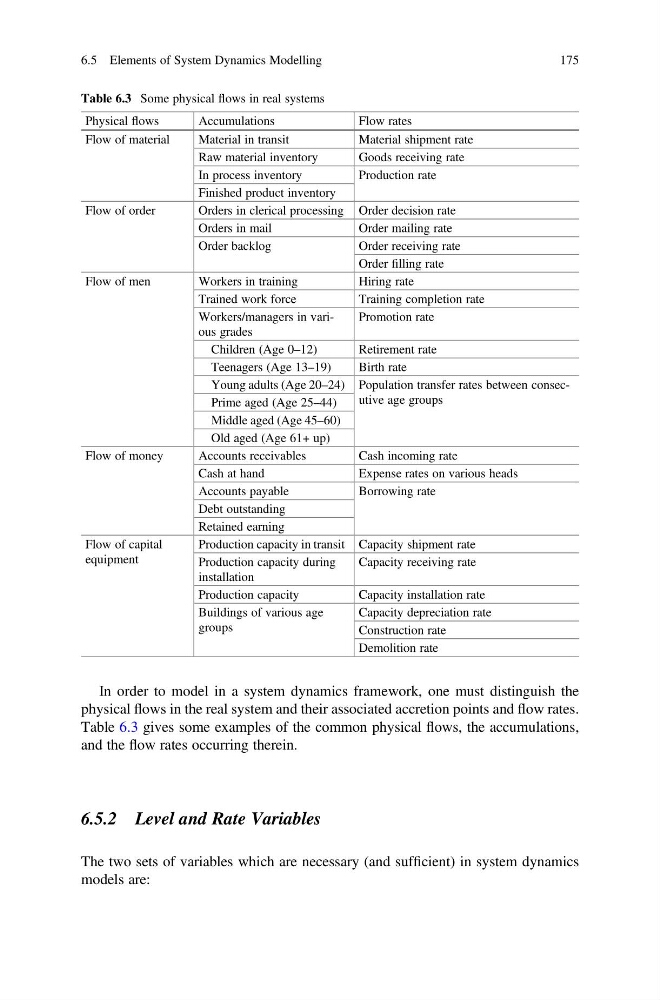
In order to model in a system dynamics framework, one must distinguish the
physical flows in the real system and their associated accretion points and flow rates.
Table 6.3 gives some examples of the common physical flows, the accumulations,
and the flow rates occurring therein.
6.5.2 Level and Rate Variables
The two sets of variables which are necessary (and sufficient) in system dynamics
models are:
Table 6.3 Some physical flows in real systems
Physical flows
Accumulations
Flow rates
Flow of material
Material in transit
Material shipment rate
Raw material inventory
Goods receiving rate
In process inventory
Production rate
Finished product inventory
Flow of order
Orders in clerical processing Order decision rate
Orders in mail
Order mailing rate
Order backlog
Order receiving rate
Order filling rate
Flow of men
Workers in training
Hiring rate
Trained work force
Training completion rate
Workers/managers in various grades
Promotion rate
Children (Age 0–12)
Retirement rate
Teenagers (Age 13–19)
Birth rate
Young adults (Age 20–24) Population transfer rates between consecutive age groups
Prime aged (Age 25–44)
Middle aged (Age 45–60)
Old aged (Age 61+ up)
Flow of money
Accounts receivables
Cash incoming rate
Cash at hand
Expense rates on various heads
Accounts payable
Borrowing rate
Debt outstanding
Retained earning
Flow of capital
equipment
Production capacity in transit Capacity shipment rate
Production capacity during
installation
Capacity receiving rate
Production capacity
Capacity installation rate
Buildings of various age
groups
Capacity depreciation rate
Construction rate
Demolition rate
6.5 Elements of System Dynamics Modelling
175
physical flows in the real system and their associated accretion points and flow rates.
Table 6.3 gives some examples of the common physical flows, the accumulations,
and the flow rates occurring therein.
6.5.2 Level and Rate Variables
The two sets of variables which are necessary (and sufficient) in system dynamics
models are:
Table 6.3 Some physical flows in real systems
Physical flows
Accumulations
Flow rates
Flow of material
Material in transit
Material shipment rate
Raw material inventory
Goods receiving rate
In process inventory
Production rate
Finished product inventory
Flow of order
Orders in clerical processing Order decision rate
Orders in mail
Order mailing rate
Order backlog
Order receiving rate
Order filling rate
Flow of men
Workers in training
Hiring rate
Trained work force
Training completion rate
Workers/managers in various grades
Promotion rate
Children (Age 0–12)
Retirement rate
Teenagers (Age 13–19)
Birth rate
Young adults (Age 20–24) Population transfer rates between consecutive age groups
Prime aged (Age 25–44)
Middle aged (Age 45–60)
Old aged (Age 61+ up)
Flow of money
Accounts receivables
Cash incoming rate
Cash at hand
Expense rates on various heads
Accounts payable
Borrowing rate
Debt outstanding
Retained earning
Flow of capital
equipment
Production capacity in transit Capacity shipment rate
Production capacity during
installation
Capacity receiving rate
Production capacity
Capacity installation rate
Buildings of various age
groups
Capacity depreciation rate
Construction rate
Demolition rate
6.5 Elements of System Dynamics Modelling
175