

consensus agreement of all stakeholders, rather than voting, to ensure active support
later on. During these discussions, it will be useful to consider using the Ws! (see
Fig. 5.9).
Some useful questions, among others, would be
1. What changes are necessary (C, S, T)? C ¼ Culture, S ¼ Structure
T ¼ Technology
2. How can these changes be achieved?
3. Who (which stakeholders) are needed?
4. What are drivers and barriers for this pathway?
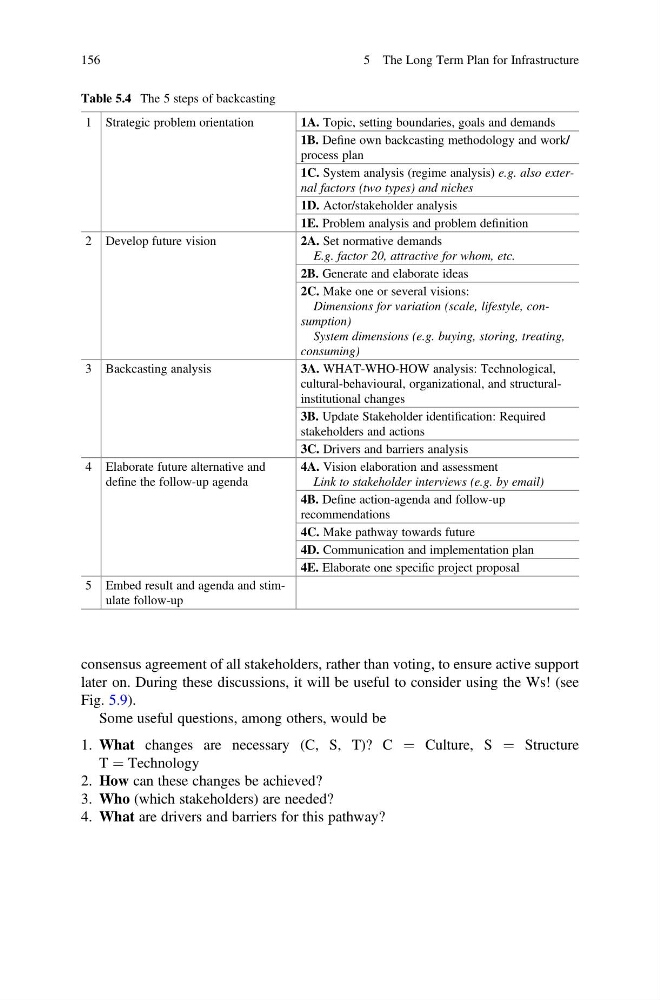
Table 5.4 The 5 steps of backcasting
1 Strategic problem orientation
1A. Topic, setting boundaries, goals and demands
1B. Define own backcasting methodology and work/
process plan
1C. System analysis (regime analysis) e.g. also external factors (two types) and niches
1D. Actor/stakeholder analysis
1E. Problem analysis and problem definition
2 Develop future vision
2A. Set normative demands
E.g. factor 20, attractive for whom, etc.
2B. Generate and elaborate ideas
2C. Make one or several visions:
Dimensions for variation (scale, lifestyle, consumption)
System dimensions (e.g. buying, storing, treating,
consuming)
3 Backcasting analysis
3A. WHAT-WHO-HOW analysis: Technological,
cultural-behavioural, organizational, and structuralinstitutional changes
3B. Update Stakeholder identification: Required
stakeholders and actions
3C. Drivers and barriers analysis
4 Elaborate future alternative and
define the follow-up agenda
4A. Vision elaboration and assessment
Link to stakeholder interviews (e.g. by email)
4B. Define action-agenda and follow-up
recommendations
4C. Make pathway towards future
4D. Communication and implementation plan
4E. Elaborate one specific project proposal
5 Embed result and agenda and stimulate follow-up
156
5 The Long Term Plan for Infrastructure
later on. During these discussions, it will be useful to consider using the Ws! (see
Fig. 5.9).
Some useful questions, among others, would be
1. What changes are necessary (C, S, T)? C ¼ Culture, S ¼ Structure
T ¼ Technology
2. How can these changes be achieved?
3. Who (which stakeholders) are needed?
4. What are drivers and barriers for this pathway?
Table 5.4 The 5 steps of backcasting
1 Strategic problem orientation
1A. Topic, setting boundaries, goals and demands
1B. Define own backcasting methodology and work/
process plan
1C. System analysis (regime analysis) e.g. also external factors (two types) and niches
1D. Actor/stakeholder analysis
1E. Problem analysis and problem definition
2 Develop future vision
2A. Set normative demands
E.g. factor 20, attractive for whom, etc.
2B. Generate and elaborate ideas
2C. Make one or several visions:
Dimensions for variation (scale, lifestyle, consumption)
System dimensions (e.g. buying, storing, treating,
consuming)
3 Backcasting analysis
3A. WHAT-WHO-HOW analysis: Technological,
cultural-behavioural, organizational, and structuralinstitutional changes
3B. Update Stakeholder identification: Required
stakeholders and actions
3C. Drivers and barriers analysis
4 Elaborate future alternative and
define the follow-up agenda
4A. Vision elaboration and assessment
Link to stakeholder interviews (e.g. by email)
4B. Define action-agenda and follow-up
recommendations
4C. Make pathway towards future
4D. Communication and implementation plan
4E. Elaborate one specific project proposal
5 Embed result and agenda and stimulate follow-up
156
5 The Long Term Plan for Infrastructure