

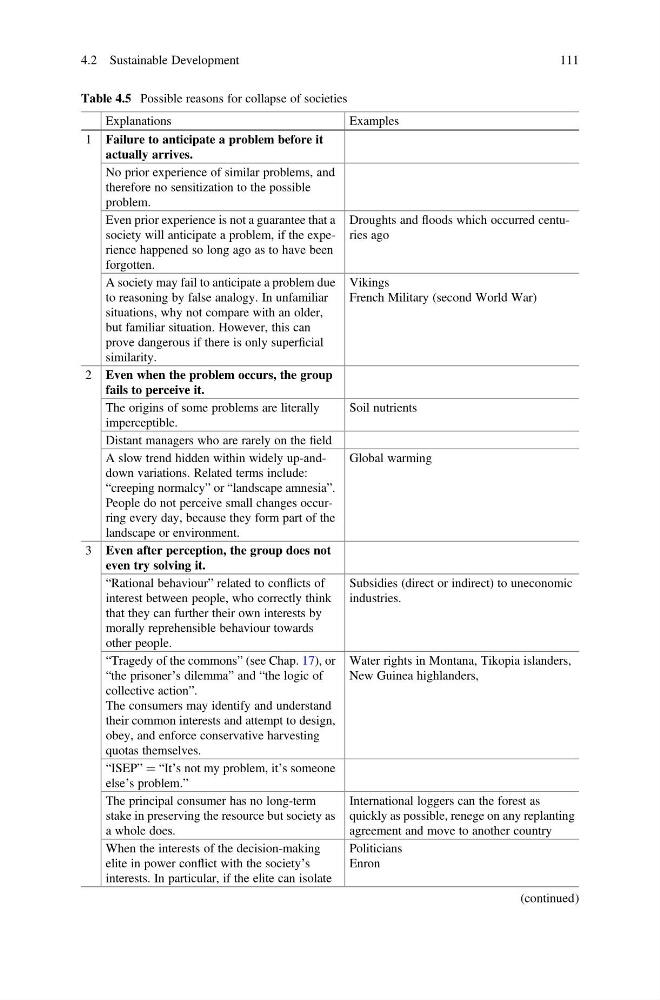
Table 4.5 Possible reasons for collapse of societies
Explanations
Examples
1 Failure to anticipate a problem before it
actually arrives.
No prior experience of similar problems, and
therefore no sensitization to the possible
problem.
Even prior experience is not a guarantee that a
society will anticipate a problem, if the experience happened so long ago as to have been
forgotten.
Droughts and floods which occurred centuries ago
A society may fail to anticipate a problem due
to reasoning by false analogy. In unfamiliar
situations, why not compare with an older,
but familiar situation. However, this can
prove dangerous if there is only superficial
similarity.
Vikings
French Military (second World War)
2 Even when the problem occurs, the group
fails to perceive it.
The origins of some problems are literally
imperceptible.
Soil nutrients
Distant managers who are rarely on the field
A slow trend hidden within widely up-anddown variations. Related terms include:
“creeping normalcy” or “landscape amnesia”.
People do not perceive small changes occurring every day, because they form part of the
landscape or environment.
Global warming
3 Even after perception, the group does not
even try solving it.
“Rational behaviour” related to conflicts of
interest between people, who correctly think
that they can further their own interests by
morally reprehensible behaviour towards
other people.
Subsidies (direct or indirect) to uneconomic
industries.
“Tragedy of the commons” (see Chap. 17), or
“the prisoner’s dilemma” and “the logic of
collective action”.
The consumers may identify and understand
their common interests and attempt to design,
obey, and enforce conservative harvesting
quotas themselves.
Water rights in Montana, Tikopia islanders,
New Guinea highlanders,
“ISEP” ¼ “It’s not my problem, it’s someone
else’s problem.”
The principal consumer has no long-term
stake in preserving the resource but society as
a whole does.
International loggers can the forest as
quickly as possible, renege on any replanting
agreement and move to another country
When the interests of the decision-making
elite in power conflict with the society’s
interests. In particular, if the elite can isolate
Politicians
Enron
(continued)
4.2 Sustainable Development
111
Explanations
Examples
1 Failure to anticipate a problem before it
actually arrives.
No prior experience of similar problems, and
therefore no sensitization to the possible
problem.
Even prior experience is not a guarantee that a
society will anticipate a problem, if the experience happened so long ago as to have been
forgotten.
Droughts and floods which occurred centuries ago
A society may fail to anticipate a problem due
to reasoning by false analogy. In unfamiliar
situations, why not compare with an older,
but familiar situation. However, this can
prove dangerous if there is only superficial
similarity.
Vikings
French Military (second World War)
2 Even when the problem occurs, the group
fails to perceive it.
The origins of some problems are literally
imperceptible.
Soil nutrients
Distant managers who are rarely on the field
A slow trend hidden within widely up-anddown variations. Related terms include:
“creeping normalcy” or “landscape amnesia”.
People do not perceive small changes occurring every day, because they form part of the
landscape or environment.
Global warming
3 Even after perception, the group does not
even try solving it.
“Rational behaviour” related to conflicts of
interest between people, who correctly think
that they can further their own interests by
morally reprehensible behaviour towards
other people.
Subsidies (direct or indirect) to uneconomic
industries.
“Tragedy of the commons” (see Chap. 17), or
“the prisoner’s dilemma” and “the logic of
collective action”.
The consumers may identify and understand
their common interests and attempt to design,
obey, and enforce conservative harvesting
quotas themselves.
Water rights in Montana, Tikopia islanders,
New Guinea highlanders,
“ISEP” ¼ “It’s not my problem, it’s someone
else’s problem.”
The principal consumer has no long-term
stake in preserving the resource but society as
a whole does.
International loggers can the forest as
quickly as possible, renege on any replanting
agreement and move to another country
When the interests of the decision-making
elite in power conflict with the society’s
interests. In particular, if the elite can isolate
Politicians
Enron
(continued)
4.2 Sustainable Development
111