

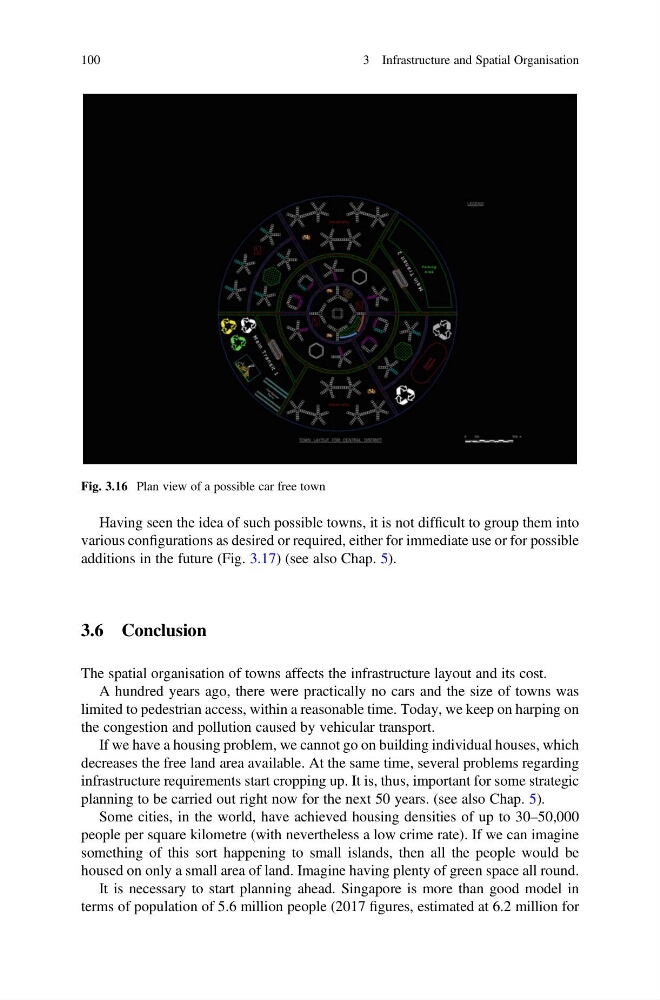
Having seen the idea of such possible towns, it is not difficult to group them into
various configurations as desired or required, either for immediate use or for possible
additions in the future (Fig. 3.17) (see also Chap. 5).
3.6 Conclusion
The spatial organisation of towns affects the infrastructure layout and its cost.
A hundred years ago, there were practically no cars and the size of towns was
limited to pedestrian access, within a reasonable time. Today, we keep on harping on
the congestion and pollution caused by vehicular transport.
If we have a housing problem, we cannot go on building individual houses, which
decreases the free land area available. At the same time, several problems regarding
infrastructure requirements start cropping up. It is, thus, important for some strategic
planning to be carried out right now for the next 50 years. (see also Chap. 5).
Some cities, in the world, have achieved housing densities of up to 30–50,000
people per square kilometre (with nevertheless a low crime rate). If we can imagine
something of this sort happening to small islands, then all the people would be
housed on only a small area of land. Imagine having plenty of green space all round.
It is necessary to start planning ahead. Singapore is more than good model in
terms of population of 5.6 million people (2017 figures, estimated at 6.2 million for
Fig. 3.16 Plan view of a possible car free town
100
3 Infrastructure and Spatial Organisation
various configurations as desired or required, either for immediate use or for possible
additions in the future (Fig. 3.17) (see also Chap. 5).
3.6 Conclusion
The spatial organisation of towns affects the infrastructure layout and its cost.
A hundred years ago, there were practically no cars and the size of towns was
limited to pedestrian access, within a reasonable time. Today, we keep on harping on
the congestion and pollution caused by vehicular transport.
If we have a housing problem, we cannot go on building individual houses, which
decreases the free land area available. At the same time, several problems regarding
infrastructure requirements start cropping up. It is, thus, important for some strategic
planning to be carried out right now for the next 50 years. (see also Chap. 5).
Some cities, in the world, have achieved housing densities of up to 30–50,000
people per square kilometre (with nevertheless a low crime rate). If we can imagine
something of this sort happening to small islands, then all the people would be
housed on only a small area of land. Imagine having plenty of green space all round.
It is necessary to start planning ahead. Singapore is more than good model in
terms of population of 5.6 million people (2017 figures, estimated at 6.2 million for
Fig. 3.16 Plan view of a possible car free town
100
3 Infrastructure and Spatial Organisation