

4 Solar Cells: Optical and Recombination Losses
75
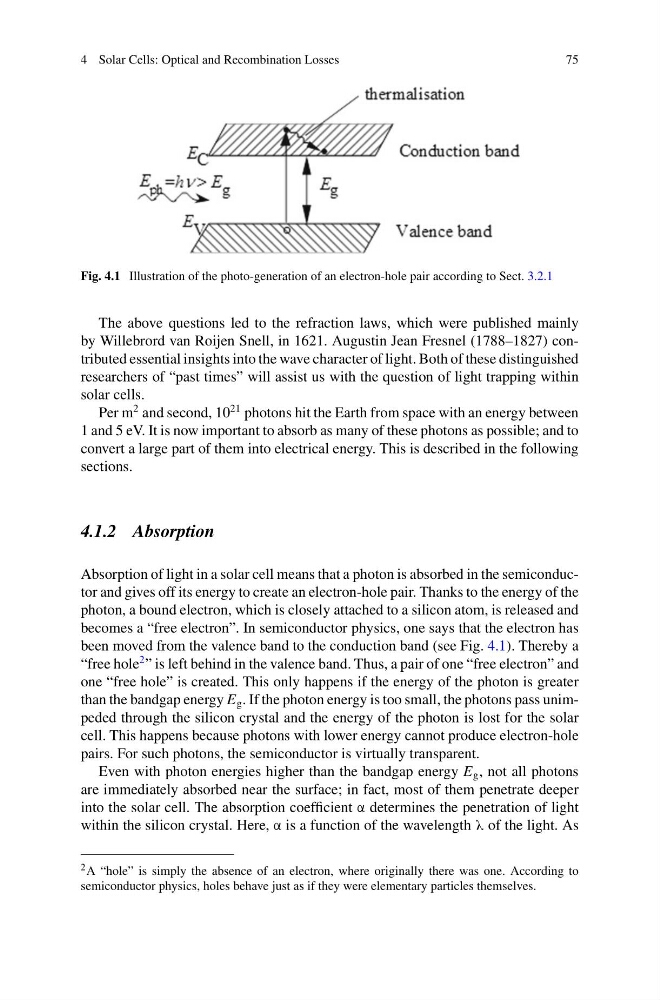
Fig. 4.1 Illustration of the photo-generation of an electron-hole pair according to Sect. 3.2.1
The above questions led to the refraction laws, which were published mainly
by Willebrord van Roijen Snell, in 1621. Augustin Jean Fresnel (1788–1827) contributed essential insights into the wave character of light. Both of these distinguished
researchers of “past times” will assist us with the question of light trapping within
solar cells.
Per m
2 and second, 10
21 photons hit the Earth from space with an energy between
1 and 5 eV. It is now important to absorb as many of these photons as possible; and to
convert a large part of them into electrical energy. This is described in the following
sections.
4.1.2 Absorption
Absorption of light in a solar cell means that a photon is absorbed in the semiconductor and gives off its energy to create an electron-hole pair. Thanks to the energy of the
photon, a bound electron, which is closely attached to a silicon atom, is released and
becomes a “free electron”. In semiconductor physics, one says that the electron has
been moved from the valence band to the conduction band (see Fig. 4.1). Thereby a
“free hole
2 ” is left behind in the valence band. Thus, a pair of one “free electron” and
one “free hole” is created. This only happens if the energy of the photon is greater
than the bandgap energy E g . If the photon energy is too small, the photons pass unimpeded through the silicon crystal and the energy of the photon is lost for the solar
cell. This happens because photons with lower energy cannot produce electron-hole
pairs. For such photons, the semiconductor is virtually transparent.
Even with photon energies higher than the bandgap energy E g , not all photons
are immediately absorbed near the surface; in fact, most of them penetrate deeper
into the solar cell. The absorption coefficient α determines the penetration of light
within the silicon crystal. Here, α is a function of the wavelength λ of the light. As
2 A “hole” is simply the absence of an electron, where originally there was one. According to
semiconductor physics, holes behave just as if they were elementary particles themselves.
75
Fig. 4.1 Illustration of the photo-generation of an electron-hole pair according to Sect. 3.2.1
The above questions led to the refraction laws, which were published mainly
by Willebrord van Roijen Snell, in 1621. Augustin Jean Fresnel (1788–1827) contributed essential insights into the wave character of light. Both of these distinguished
researchers of “past times” will assist us with the question of light trapping within
solar cells.
Per m
2 and second, 10
21 photons hit the Earth from space with an energy between
1 and 5 eV. It is now important to absorb as many of these photons as possible; and to
convert a large part of them into electrical energy. This is described in the following
sections.
4.1.2 Absorption
Absorption of light in a solar cell means that a photon is absorbed in the semiconductor and gives off its energy to create an electron-hole pair. Thanks to the energy of the
photon, a bound electron, which is closely attached to a silicon atom, is released and
becomes a “free electron”. In semiconductor physics, one says that the electron has
been moved from the valence band to the conduction band (see Fig. 4.1). Thereby a
“free hole
2 ” is left behind in the valence band. Thus, a pair of one “free electron” and
one “free hole” is created. This only happens if the energy of the photon is greater
than the bandgap energy E g . If the photon energy is too small, the photons pass unimpeded through the silicon crystal and the energy of the photon is lost for the solar
cell. This happens because photons with lower energy cannot produce electron-hole
pairs. For such photons, the semiconductor is virtually transparent.
Even with photon energies higher than the bandgap energy E g , not all photons
are immediately absorbed near the surface; in fact, most of them penetrate deeper
into the solar cell. The absorption coefficient α determines the penetration of light
within the silicon crystal. Here, α is a function of the wavelength λ of the light. As
2 A “hole” is simply the absence of an electron, where originally there was one. According to
semiconductor physics, holes behave just as if they were elementary particles themselves.