

3 Solar Cells: Basics
61
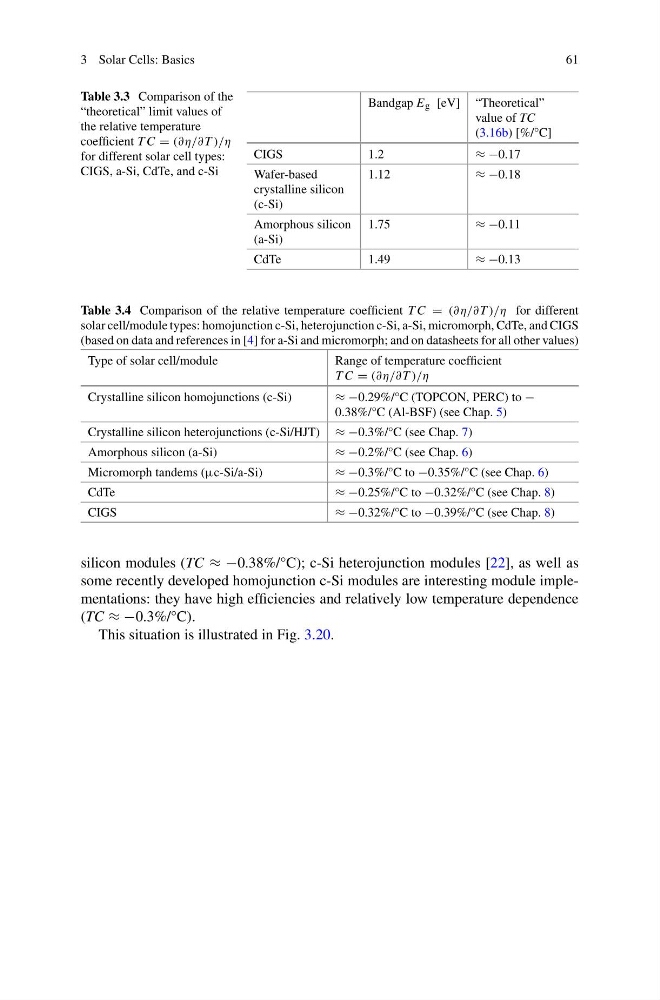
Table 3.3 Comparison of the
“theoretical” limit values of
the relative temperature
coefficient T C = (∂η/∂T )/η
for different solar cell types:
CIGS, a-Si, CdTe, and c-Si
Bandgap E g [eV] “Theoretical”
value of TC
(3.16b) [%/°C]
CIGS
1.2
≈ −0.17
Wafer-based
crystalline silicon
(c-Si)
1.12
≈ −0.18
Amorphous silicon
(a-Si)
1.75
≈ −0.11
CdTe
1.49
≈ −0.13
Table 3.4 Comparison of the relative temperature coefficient T C = (∂η/∂T )/η for different
solar cell/module types: homojunction c-Si, heterojunction c-Si, a-Si, micromorph, CdTe, and CIGS
(based on data and references in [4] for a-Si and micromorph; and on datasheets for all other values)
Type of solar cell/module
Range of temperature coefficient
T C = (∂η/∂T )/η
Crystalline silicon homojunctions (c-Si)
≈ −0.29%/°C (TOPCON, PERC) to −
0.38%/°C (Al-BSF) (see Chap. 5)
Crystalline silicon heterojunctions (c-Si/HJT) ≈ −0.3%/°C (see Chap. 7)
Amorphous silicon (a-Si)
≈ −0.2%/°C (see Chap. 6)
Micromorph tandems (µc-Si/a-Si)
≈ −0.3%/°C to −0.35%/°C (see Chap. 6)
CdTe
≈ −0.25%/°C to −0.32%/°C (see Chap. 8)
CIGS
≈ −0.32%/°C to −0.39%/°C (see Chap. 8)
silicon modules (TC ≈ −0.38%/°C); c-Si heterojunction modules [22], as well as
some recently developed homojunction c-Si modules are interesting module implementations: they have high efficiencies and relatively low temperature dependence
(TC ≈ −0.3%/°C).
This situation is illustrated in Fig. 3.20.
61
Table 3.3 Comparison of the
“theoretical” limit values of
the relative temperature
coefficient T C = (∂η/∂T )/η
for different solar cell types:
CIGS, a-Si, CdTe, and c-Si
Bandgap E g [eV] “Theoretical”
value of TC
(3.16b) [%/°C]
CIGS
1.2
≈ −0.17
Wafer-based
crystalline silicon
(c-Si)
1.12
≈ −0.18
Amorphous silicon
(a-Si)
1.75
≈ −0.11
CdTe
1.49
≈ −0.13
Table 3.4 Comparison of the relative temperature coefficient T C = (∂η/∂T )/η for different
solar cell/module types: homojunction c-Si, heterojunction c-Si, a-Si, micromorph, CdTe, and CIGS
(based on data and references in [4] for a-Si and micromorph; and on datasheets for all other values)
Type of solar cell/module
Range of temperature coefficient
T C = (∂η/∂T )/η
Crystalline silicon homojunctions (c-Si)
≈ −0.29%/°C (TOPCON, PERC) to −
0.38%/°C (Al-BSF) (see Chap. 5)
Crystalline silicon heterojunctions (c-Si/HJT) ≈ −0.3%/°C (see Chap. 7)
Amorphous silicon (a-Si)
≈ −0.2%/°C (see Chap. 6)
Micromorph tandems (µc-Si/a-Si)
≈ −0.3%/°C to −0.35%/°C (see Chap. 6)
CdTe
≈ −0.25%/°C to −0.32%/°C (see Chap. 8)
CIGS
≈ −0.32%/°C to −0.39%/°C (see Chap. 8)
silicon modules (TC ≈ −0.38%/°C); c-Si heterojunction modules [22], as well as
some recently developed homojunction c-Si modules are interesting module implementations: they have high efficiencies and relatively low temperature dependence
(TC ≈ −0.3%/°C).
This situation is illustrated in Fig. 3.20.