

28
A. Funde and A. Shah
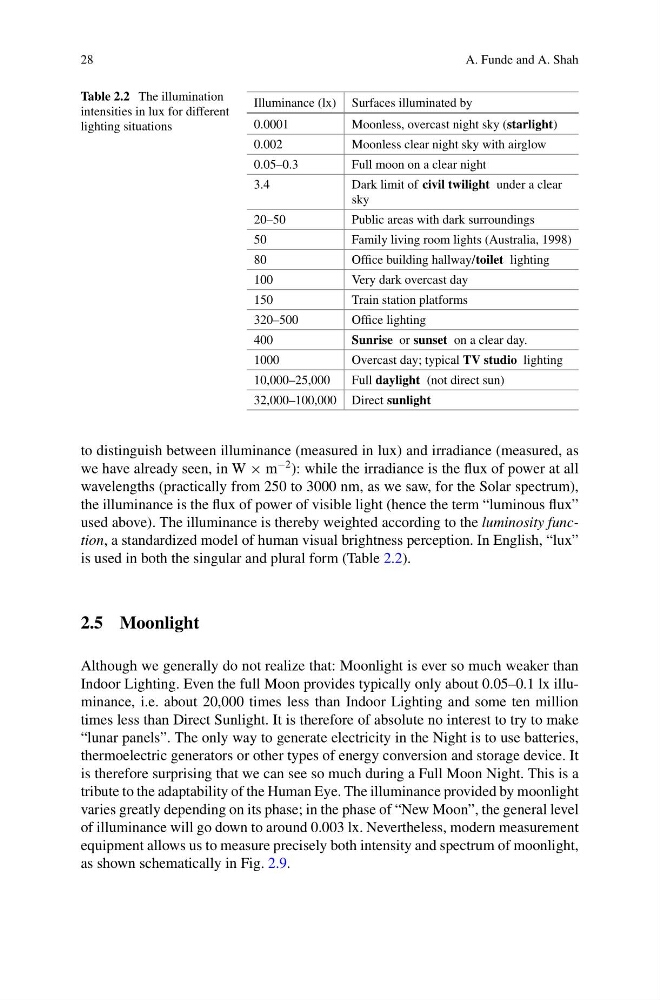
Table 2.2 The illumination
intensities in lux for different
lighting situations
Illuminance (lx) Surfaces illuminated by
0.0001
Moonless, overcast night sky (starlight)
0.002
Moonless clear night sky with airglow
0.05–0.3
Full moon on a clear night
3.4
Dark limit of civil twilight under a clear
sky
20–50
Public areas with dark surroundings
50
Family living room lights (Australia, 1998)
80
Office building hallway/toilet lighting
100
Very dark overcast day
150
Train station platforms
320–500
Office lighting
400
Sunrise or sunset on a clear day.
1000
Overcast day; typical TV studio lighting
10,000–25,000
Full daylight (not direct sun)
32,000–100,000 Direct sunlight
to distinguish between illuminance (measured in lux) and irradiance (measured, as
we have already seen, in W × m
−2 ): while the irradiance is the flux of power at all
wavelengths (practically from 250 to 3000 nm, as we saw, for the Solar spectrum),
the illuminance is the flux of power of visible light (hence the term “luminous flux”
used above). The illuminance is thereby weighted according to the luminosity function, a standardized model of human visual brightness perception. In English, “lux”
is used in both the singular and plural form (Table 2.2).
2.5 Moonlight
Although we generally do not realize that: Moonlight is ever so much weaker than
Indoor Lighting. Even the full Moon provides typically only about 0.05–0.1 lx illuminance, i.e. about 20,000 times less than Indoor Lighting and some ten million
times less than Direct Sunlight. It is therefore of absolute no interest to try to make
“lunar panels”. The only way to generate electricity in the Night is to use batteries,
thermoelectric generators or other types of energy conversion and storage device. It
is therefore surprising that we can see so much during a Full Moon Night. This is a
tribute to the adaptability of the Human Eye. The illuminance provided by moonlight
varies greatly depending on its phase; in the phase of “New Moon”, the general level
of illuminance will go down to around 0.003 lx. Nevertheless, modern measurement
equipment allows us to measure precisely both intensity and spectrum of moonlight,
as shown schematically in Fig. 2.9.
A. Funde and A. Shah
Table 2.2 The illumination
intensities in lux for different
lighting situations
Illuminance (lx) Surfaces illuminated by
0.0001
Moonless, overcast night sky (starlight)
0.002
Moonless clear night sky with airglow
0.05–0.3
Full moon on a clear night
3.4
Dark limit of civil twilight under a clear
sky
20–50
Public areas with dark surroundings
50
Family living room lights (Australia, 1998)
80
Office building hallway/toilet lighting
100
Very dark overcast day
150
Train station platforms
320–500
Office lighting
400
Sunrise or sunset on a clear day.
1000
Overcast day; typical TV studio lighting
10,000–25,000
Full daylight (not direct sun)
32,000–100,000 Direct sunlight
to distinguish between illuminance (measured in lux) and irradiance (measured, as
we have already seen, in W × m
−2 ): while the irradiance is the flux of power at all
wavelengths (practically from 250 to 3000 nm, as we saw, for the Solar spectrum),
the illuminance is the flux of power of visible light (hence the term “luminous flux”
used above). The illuminance is thereby weighted according to the luminosity function, a standardized model of human visual brightness perception. In English, “lux”
is used in both the singular and plural form (Table 2.2).
2.5 Moonlight
Although we generally do not realize that: Moonlight is ever so much weaker than
Indoor Lighting. Even the full Moon provides typically only about 0.05–0.1 lx illuminance, i.e. about 20,000 times less than Indoor Lighting and some ten million
times less than Direct Sunlight. It is therefore of absolute no interest to try to make
“lunar panels”. The only way to generate electricity in the Night is to use batteries,
thermoelectric generators or other types of energy conversion and storage device. It
is therefore surprising that we can see so much during a Full Moon Night. This is a
tribute to the adaptability of the Human Eye. The illuminance provided by moonlight
varies greatly depending on its phase; in the phase of “New Moon”, the general level
of illuminance will go down to around 0.003 lx. Nevertheless, modern measurement
equipment allows us to measure precisely both intensity and spectrum of moonlight,
as shown schematically in Fig. 2.9.