

18
A. Funde and A. Shah
2.1 Interaction of Sunlight and the Earth’s Atmosphere
2.1.1 The Solar Spectrum: Nature of Solar Energy Reaching
the Earth
According to the principles of Physics, every hot body emits radiation to its surroundings. Planck’s Law describes the spectrum
1 of the radiation emitted by a hot surface.
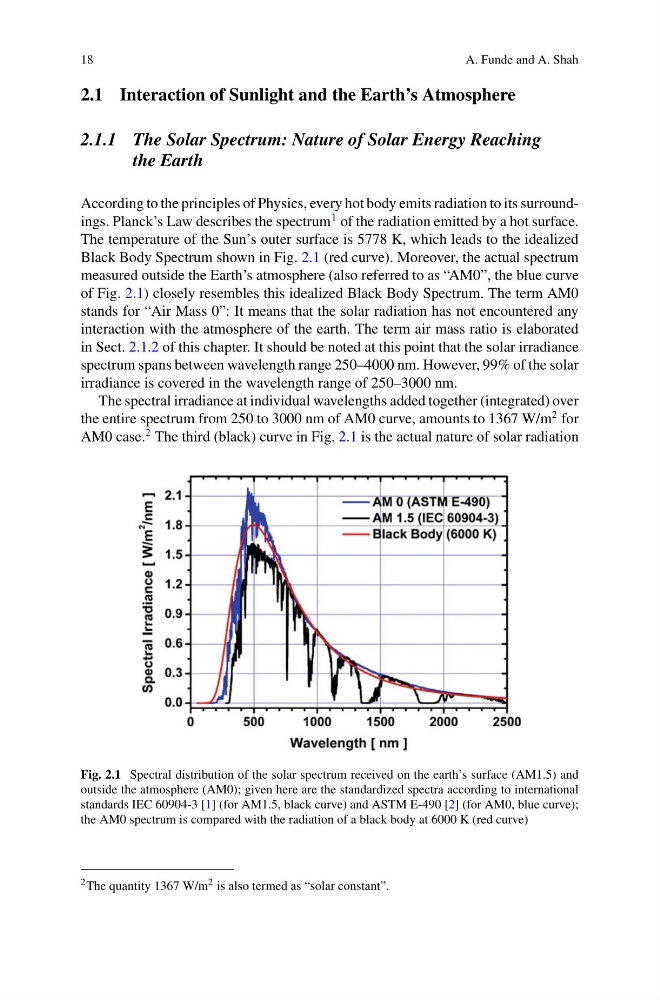
The temperature of the Sun’s outer surface is 5778 K, which leads to the idealized
Black Body Spectrum shown in Fig. 2.1 (red curve). Moreover, the actual spectrum
measured outside the Earth’s atmosphere (also referred to as “AM0”, the blue curve
of Fig. 2.1) closely resembles this idealized Black Body Spectrum. The term AM0
stands for “Air Mass 0”: It means that the solar radiation has not encountered any
interaction with the atmosphere of the earth. The term air mass ratio is elaborated
in Sect. 2.1.2 of this chapter. It should be noted at this point that the solar irradiance
spectrum spans between wavelength range 250–4000 nm. However, 99% of the solar
irradiance is covered in the wavelength range of 250–3000 nm.
The spectral irradiance at individual wavelengths added together (integrated) over
the entire spectrum from 250 to 3000 nm of AM0 curve, amounts to 1367 W/m
2 for
AM0 case.
2 The third (black) curve in Fig. 2.1 is the actual nature of solar radiation
Fig. 2.1 Spectral distribution of the solar spectrum received on the earth’s surface (AM1.5) and
outside the atmosphere (AM0); given here are the standardized spectra according to international
standards IEC 60904-3 [1] (for AM1.5, black curve) and ASTM E-490 [2] (for AM0, blue curve);
the AM0 spectrum is compared with the radiation of a black body at 6000 K (red curve)
2 The quantity 1367 W/m 2 is also termed as “solar constant”.
A. Funde and A. Shah
2.1 Interaction of Sunlight and the Earth’s Atmosphere
2.1.1 The Solar Spectrum: Nature of Solar Energy Reaching
the Earth
According to the principles of Physics, every hot body emits radiation to its surroundings. Planck’s Law describes the spectrum
1 of the radiation emitted by a hot surface.
The temperature of the Sun’s outer surface is 5778 K, which leads to the idealized
Black Body Spectrum shown in Fig. 2.1 (red curve). Moreover, the actual spectrum
measured outside the Earth’s atmosphere (also referred to as “AM0”, the blue curve
of Fig. 2.1) closely resembles this idealized Black Body Spectrum. The term AM0
stands for “Air Mass 0”: It means that the solar radiation has not encountered any
interaction with the atmosphere of the earth. The term air mass ratio is elaborated
in Sect. 2.1.2 of this chapter. It should be noted at this point that the solar irradiance
spectrum spans between wavelength range 250–4000 nm. However, 99% of the solar
irradiance is covered in the wavelength range of 250–3000 nm.
The spectral irradiance at individual wavelengths added together (integrated) over
the entire spectrum from 250 to 3000 nm of AM0 curve, amounts to 1367 W/m
2 for
AM0 case.
2 The third (black) curve in Fig. 2.1 is the actual nature of solar radiation
Fig. 2.1 Spectral distribution of the solar spectrum received on the earth’s surface (AM1.5) and
outside the atmosphere (AM0); given here are the standardized spectra according to international
standards IEC 60904-3 [1] (for AM1.5, black curve) and ASTM E-490 [2] (for AM0, blue curve);
the AM0 spectrum is compared with the radiation of a black body at 6000 K (red curve)
2 The quantity 1367 W/m 2 is also termed as “solar constant”.