

272
M. Pravettoni
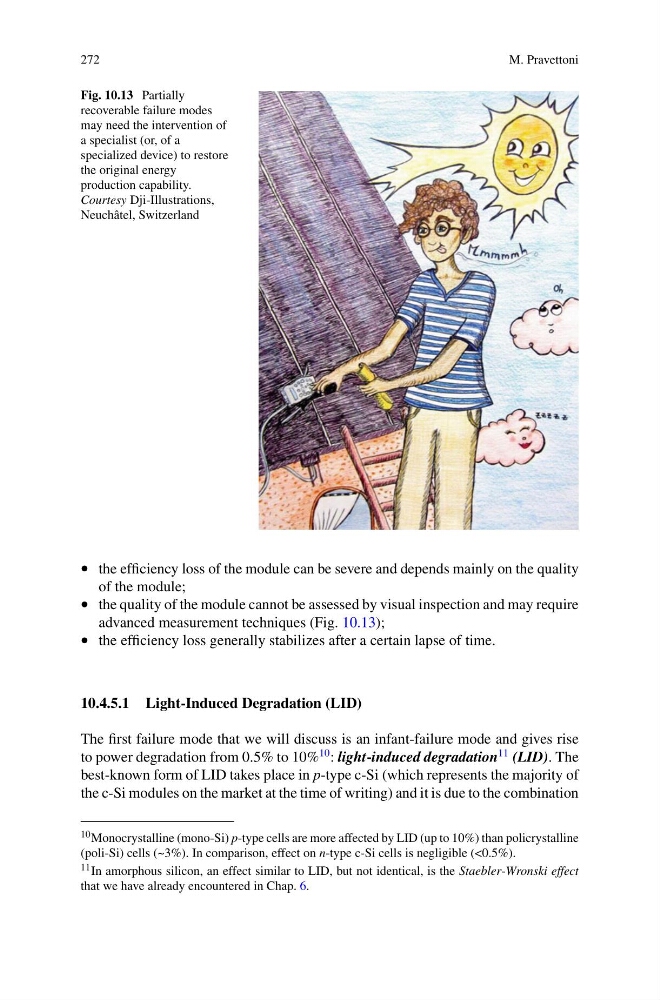
Fig. 10.13 Partially
recoverable failure modes
may need the intervention of
a specialist (or, of a
specialized device) to restore
the original energy
production capability.
Courtesy Dji-Illustrations,
Neuchâtel, Switzerland
• the efficiency loss of the module can be severe and depends mainly on the quality
of the module;
• the quality of the module cannot be assessed by visual inspection and may require
advanced measurement techniques (Fig. 10.13);
• the efficiency loss generally stabilizes after a certain lapse of time.
10.4.5.1 Light-Induced Degradation (LID)
The first failure mode that we will discuss is an infant-failure mode and gives rise
to power degradation from 0.5% to 10%
10 : light-induced degradation
11 (LID). The
best-known form of LID takes place in p-type c-Si (which represents the majority of
the c-Si modules on the market at the time of writing) and it is due to the combination
10 Monocrystalline (mono-Si) p-type cells are more affected by LID (up to 10%) than policrystalline
(poli-Si) cells (~3%). In comparison, effect on n-type c-Si cells is negligible (<0.5%).
11 In amorphous silicon, an effect similar to LID, but not identical, is the Staebler-Wronski effect
that we have already encountered in Chap. 6.
M. Pravettoni
Fig. 10.13 Partially
recoverable failure modes
may need the intervention of
a specialist (or, of a
specialized device) to restore
the original energy
production capability.
Courtesy Dji-Illustrations,
Neuchâtel, Switzerland
• the efficiency loss of the module can be severe and depends mainly on the quality
of the module;
• the quality of the module cannot be assessed by visual inspection and may require
advanced measurement techniques (Fig. 10.13);
• the efficiency loss generally stabilizes after a certain lapse of time.
10.4.5.1 Light-Induced Degradation (LID)
The first failure mode that we will discuss is an infant-failure mode and gives rise
to power degradation from 0.5% to 10%
10 : light-induced degradation
11 (LID). The
best-known form of LID takes place in p-type c-Si (which represents the majority of
the c-Si modules on the market at the time of writing) and it is due to the combination
10 Monocrystalline (mono-Si) p-type cells are more affected by LID (up to 10%) than policrystalline
(poli-Si) cells (~3%). In comparison, effect on n-type c-Si cells is negligible (<0.5%).
11 In amorphous silicon, an effect similar to LID, but not identical, is the Staebler-Wronski effect
that we have already encountered in Chap. 6.