

270
M. Pravettoni
10.4.4.2 High UV Degradation
The second example of unrecoverable failure is high UV degradation, which has
been observed to damage both the encapsulant, the backsheet and unprotected cables,
causing: yellowing of the encapsulant; cracking and brittling of the backsheet; melting or brittling of the cable jacket (resulting in oxidation of the conductors, loss
of insulation, higher resistance and power loss). Power plants exposed to high UV
irradiance and high temperatures such as those in desert locations may require active
cooling of the inverter: cases of inverter overheating have been observed to burn
inverters, leading thus to significant investment losses.
Detection: by visual inspection.
Prevention: by adequate system design.
10.4.4.3 “Snail Trail” Degradation
An unrecoverable failure that is often an infant failure for PV plants is the so-called
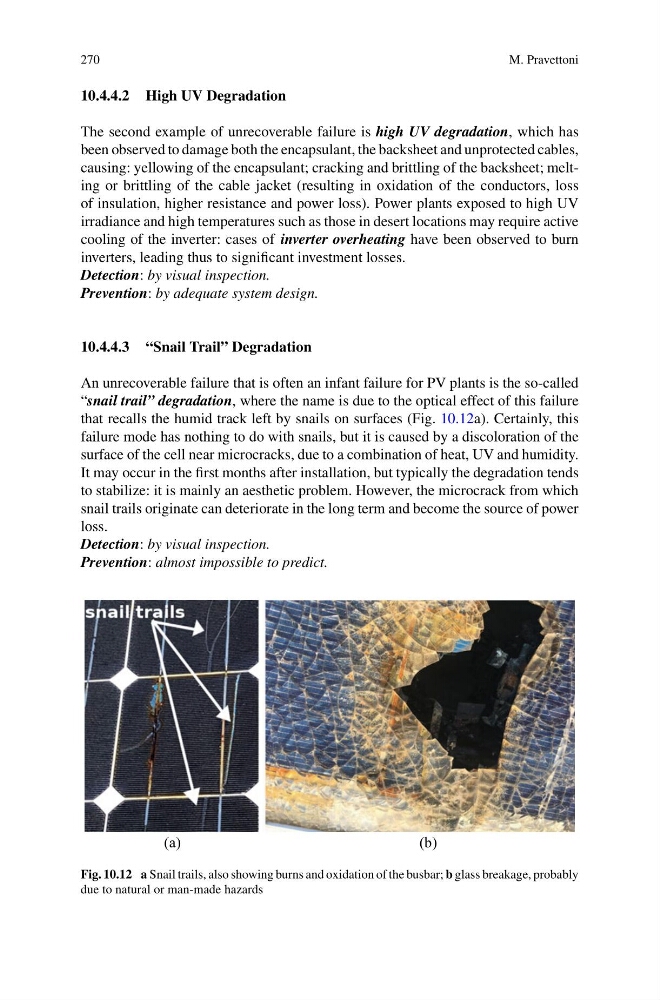
“snail trail” degradation, where the name is due to the optical effect of this failure
that recalls the humid track left by snails on surfaces (Fig. 10.12a). Certainly, this
failure mode has nothing to do with snails, but it is caused by a discoloration of the
surface of the cell near microcracks, due to a combination of heat, UV and humidity.
It may occur in the first months after installation, but typically the degradation tends
to stabilize: it is mainly an aesthetic problem. However, the microcrack from which
snail trails originate can deteriorate in the long term and become the source of power
loss.
Detection: by visual inspection.
Prevention: almost impossible to predict.
(a)
(b)
Fig. 10.12 a Snail trails, also showing burns and oxidation of the busbar; b glass breakage, probably
due to natural or man-made hazards
M. Pravettoni
10.4.4.2 High UV Degradation
The second example of unrecoverable failure is high UV degradation, which has
been observed to damage both the encapsulant, the backsheet and unprotected cables,
causing: yellowing of the encapsulant; cracking and brittling of the backsheet; melting or brittling of the cable jacket (resulting in oxidation of the conductors, loss
of insulation, higher resistance and power loss). Power plants exposed to high UV
irradiance and high temperatures such as those in desert locations may require active
cooling of the inverter: cases of inverter overheating have been observed to burn
inverters, leading thus to significant investment losses.
Detection: by visual inspection.
Prevention: by adequate system design.
10.4.4.3 “Snail Trail” Degradation
An unrecoverable failure that is often an infant failure for PV plants is the so-called
“snail trail” degradation, where the name is due to the optical effect of this failure
that recalls the humid track left by snails on surfaces (Fig. 10.12a). Certainly, this
failure mode has nothing to do with snails, but it is caused by a discoloration of the
surface of the cell near microcracks, due to a combination of heat, UV and humidity.
It may occur in the first months after installation, but typically the degradation tends
to stabilize: it is mainly an aesthetic problem. However, the microcrack from which
snail trails originate can deteriorate in the long term and become the source of power
loss.
Detection: by visual inspection.
Prevention: almost impossible to predict.
(a)
(b)
Fig. 10.12 a Snail trails, also showing burns and oxidation of the busbar; b glass breakage, probably
due to natural or man-made hazards