

268
M. Pravettoni
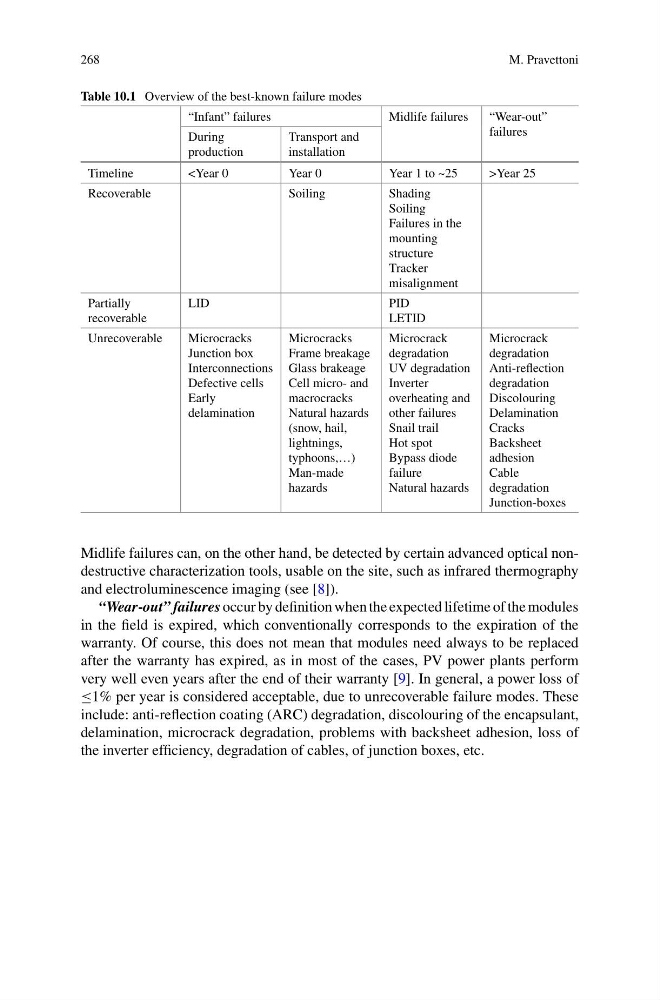
Table 10.1 Overview of the best-known failure modes
“Infant” failures
Midlife failures
“Wear-out”
failures
During
production
Transport and
installation
Timeline
Year 1 to ~25
>Year 25
Recoverable
Soiling
Shading
Soiling
Failures in the
mounting
structure
Tracker
misalignment
Partially
recoverable
LID
PID
LETID
Unrecoverable
Microcracks
Junction box
Interconnections
Defective cells
Early
delamination
Microcracks
Frame breakage
Glass brakeage
Cell micro- and
macrocracks
Natural hazards
(snow, hail,
lightnings,
typhoons,…)
Man-made
hazards
Microcrack
degradation
UV degradation
Inverter
overheating and
other failures
Snail trail
Hot spot
Bypass diode
failure
Natural hazards
Microcrack
degradation
Anti-reflection
degradation
Discolouring
Delamination
Cracks
Backsheet
adhesion
Cable
degradation
Junction-boxes
Midlife failures can, on the other hand, be detected by certain advanced optical nondestructive characterization tools, usable on the site, such as infrared thermography
and electroluminescence imaging (see [8]).
“Wear-out” failures occur by definition when the expected lifetime of the modules
in the field is expired, which conventionally corresponds to the expiration of the
warranty. Of course, this does not mean that modules need always to be replaced
after the warranty has expired, as in most of the cases, PV power plants perform
very well even years after the end of their warranty [9]. In general, a power loss of
≤1% per year is considered acceptable, due to unrecoverable failure modes. These
include: anti-reflection coating (ARC) degradation, discolouring of the encapsulant,
delamination, microcrack degradation, problems with backsheet adhesion, loss of
the inverter efficiency, degradation of cables, of junction boxes, etc.
M. Pravettoni
Table 10.1 Overview of the best-known failure modes
“Infant” failures
Midlife failures
“Wear-out”
failures
During
production
Transport and
installation
Timeline
Year 1 to ~25
>Year 25
Recoverable
Soiling
Shading
Soiling
Failures in the
mounting
structure
Tracker
misalignment
Partially
recoverable
LID
PID
LETID
Unrecoverable
Microcracks
Junction box
Interconnections
Defective cells
Early
delamination
Microcracks
Frame breakage
Glass brakeage
Cell micro- and
macrocracks
Natural hazards
(snow, hail,
lightnings,
typhoons,…)
Man-made
hazards
Microcrack
degradation
UV degradation
Inverter
overheating and
other failures
Snail trail
Hot spot
Bypass diode
failure
Natural hazards
Microcrack
degradation
Anti-reflection
degradation
Discolouring
Delamination
Cracks
Backsheet
adhesion
Cable
degradation
Junction-boxes
Midlife failures can, on the other hand, be detected by certain advanced optical nondestructive characterization tools, usable on the site, such as infrared thermography
and electroluminescence imaging (see [8]).
“Wear-out” failures occur by definition when the expected lifetime of the modules
in the field is expired, which conventionally corresponds to the expiration of the
warranty. Of course, this does not mean that modules need always to be replaced
after the warranty has expired, as in most of the cases, PV power plants perform
very well even years after the end of their warranty [9]. In general, a power loss of
≤1% per year is considered acceptable, due to unrecoverable failure modes. These
include: anti-reflection coating (ARC) degradation, discolouring of the encapsulant,
delamination, microcrack degradation, problems with backsheet adhesion, loss of
the inverter efficiency, degradation of cables, of junction boxes, etc.