

256
M. Pravettoni
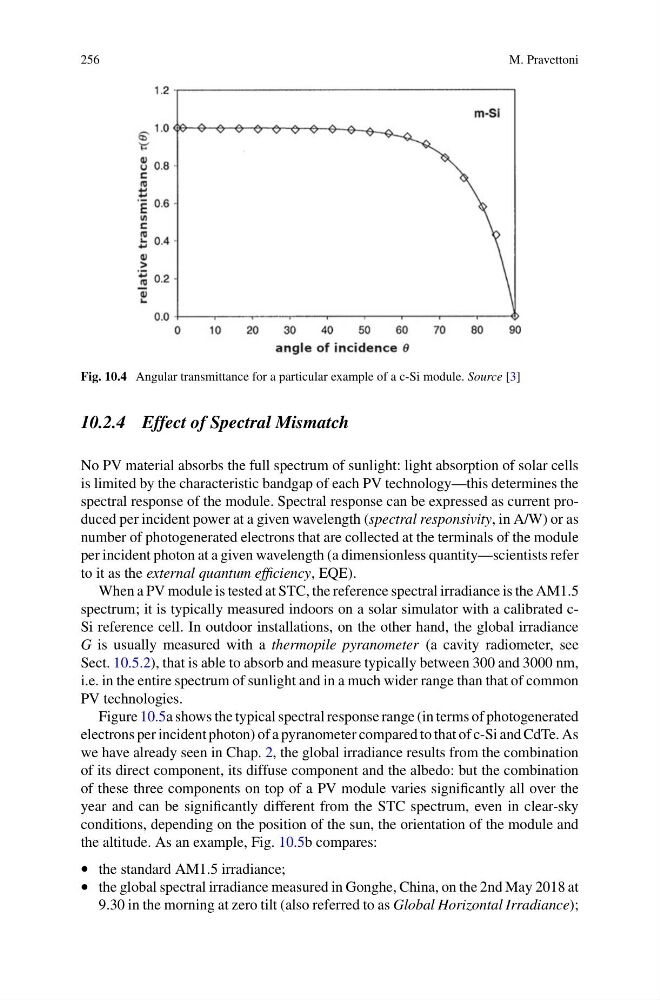
Fig. 10.4 Angular transmittance for a particular example of a c-Si module. Source [3]
10.2.4 Effect of Spectral Mismatch
No PV material absorbs the full spectrum of sunlight: light absorption of solar cells
is limited by the characteristic bandgap of each PV technology—this determines the
spectral response of the module. Spectral response can be expressed as current produced per incident power at a given wavelength (spectral responsivity, in A/W) or as
number of photogenerated electrons that are collected at the terminals of the module
per incident photon at a given wavelength (a dimensionless quantity—scientists refer
to it as the external quantum efficiency, EQE).
When a PV module is tested at STC, the reference spectral irradiance is the AM1.5
spectrum; it is typically measured indoors on a solar simulator with a calibrated cSi reference cell. In outdoor installations, on the other hand, the global irradiance
G is usually measured with a thermopile pyranometer (a cavity radiometer, see
Sect. 10.5.2), that is able to absorb and measure typically between 300 and 3000 nm,
i.e. in the entire spectrum of sunlight and in a much wider range than that of common
PV technologies.
Figure 10.5a shows the typical spectral response range (in terms of photogenerated
electrons per incident photon) of a pyranometer compared to that of c-Si and CdTe. As
we have already seen in Chap. 2, the global irradiance results from the combination
of its direct component, its diffuse component and the albedo: but the combination
of these three components on top of a PV module varies significantly all over the
year and can be significantly different from the STC spectrum, even in clear-sky
conditions, depending on the position of the sun, the orientation of the module and
the altitude. As an example, Fig. 10.5b compares:
• the standard AM1.5 irradiance;
• the global spectral irradiance measured in Gonghe, China, on the 2nd May 2018 at
9.30 in the morning at zero tilt (also referred to as Global Horizontal Irradiance);
M. Pravettoni
Fig. 10.4 Angular transmittance for a particular example of a c-Si module. Source [3]
10.2.4 Effect of Spectral Mismatch
No PV material absorbs the full spectrum of sunlight: light absorption of solar cells
is limited by the characteristic bandgap of each PV technology—this determines the
spectral response of the module. Spectral response can be expressed as current produced per incident power at a given wavelength (spectral responsivity, in A/W) or as
number of photogenerated electrons that are collected at the terminals of the module
per incident photon at a given wavelength (a dimensionless quantity—scientists refer
to it as the external quantum efficiency, EQE).
When a PV module is tested at STC, the reference spectral irradiance is the AM1.5
spectrum; it is typically measured indoors on a solar simulator with a calibrated cSi reference cell. In outdoor installations, on the other hand, the global irradiance
G is usually measured with a thermopile pyranometer (a cavity radiometer, see
Sect. 10.5.2), that is able to absorb and measure typically between 300 and 3000 nm,
i.e. in the entire spectrum of sunlight and in a much wider range than that of common
PV technologies.
Figure 10.5a shows the typical spectral response range (in terms of photogenerated
electrons per incident photon) of a pyranometer compared to that of c-Si and CdTe. As
we have already seen in Chap. 2, the global irradiance results from the combination
of its direct component, its diffuse component and the albedo: but the combination
of these three components on top of a PV module varies significantly all over the
year and can be significantly different from the STC spectrum, even in clear-sky
conditions, depending on the position of the sun, the orientation of the module and
the altitude. As an example, Fig. 10.5b compares:
• the standard AM1.5 irradiance;
• the global spectral irradiance measured in Gonghe, China, on the 2nd May 2018 at
9.30 in the morning at zero tilt (also referred to as Global Horizontal Irradiance);