

236
A. Virtuani
9.2.4 Module Manufacturing Processes
The typical manufacturing line for c-Si modules (sometimes called backend, to differentiate from the frontend where the solar cells are manufactured) is generally composed of the following major processing steps (and of the corresponding equipment),
which are, at present, in most cases fully automated:
1. Pre-stringing: where the glass is unpacked, cleaned in a glass washer and dried.
All other materials (including cells and encapsulants) are prepared and inspected.
2. Stringing: a stringer is used to assemble and connect solar cells in a string. In this
step the ribbons are soldered (or glued) to the busbars of the cell. Proper soldering
and high adhesion of the ribbons is critical in ensuring the long-term performance
of the cells/modules. Electro-luminescence (EL) imaging can be performed to
verify the integrity of the solar cells after the stringing process. In thin-film
manufacturing lines, the interconnection of cells is generally achieved by three
sequential laser or mechanical patterning steps (monolithical interconnection,
see Sect. 9.1.1).
3. Lay-up station: the module sandwich is formed by embedding the interconnected strings into two layers of encapsulants, and into the front and rear
covers.
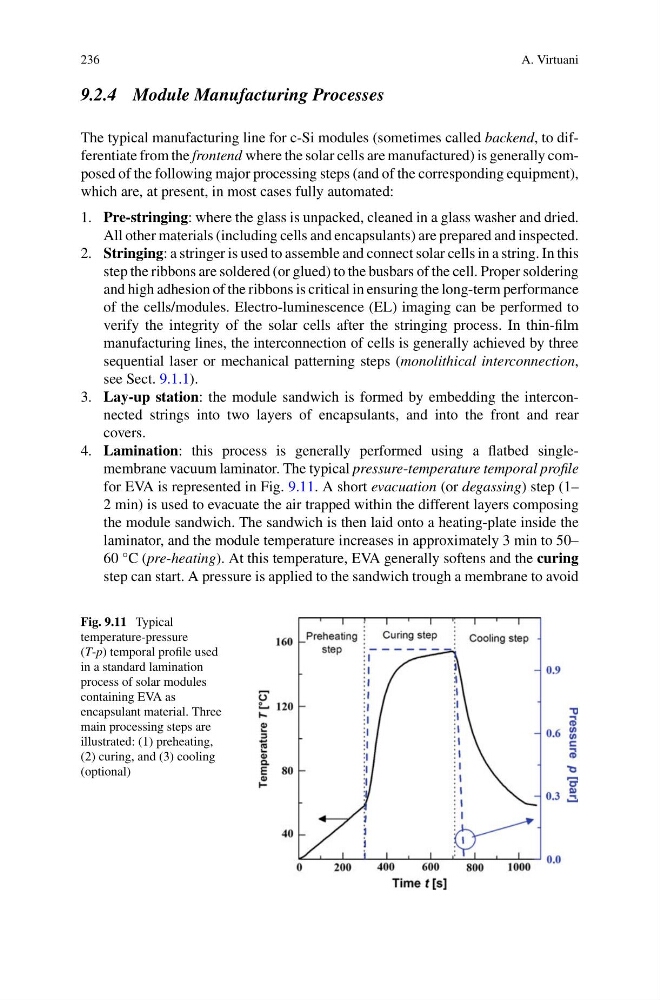
4. Lamination: this process is generally performed using a flatbed singlemembrane vacuum laminator. The typical pressure-temperature temporal profile
for EVA is represented in Fig. 9.11. A short evacuation (or degassing) step (1–
2 min) is used to evacuate the air trapped within the different layers composing
the module sandwich. The sandwich is then laid onto a heating-plate inside the
laminator, and the module temperature increases in approximately 3 min to 50–
60 °C (pre-heating). At this temperature, EVA generally softens and the curing
step can start. A pressure is applied to the sandwich trough a membrane to avoid
Fig. 9.11 Typical
temperature-pressure
(T-p) temporal profile used
in a standard lamination
process of solar modules
containing EVA as
encapsulant material. Three
main processing steps are
illustrated: (1) preheating,
(2) curing, and (3) cooling
(optional)
A. Virtuani
9.2.4 Module Manufacturing Processes
The typical manufacturing line for c-Si modules (sometimes called backend, to differentiate from the frontend where the solar cells are manufactured) is generally composed of the following major processing steps (and of the corresponding equipment),
which are, at present, in most cases fully automated:
1. Pre-stringing: where the glass is unpacked, cleaned in a glass washer and dried.
All other materials (including cells and encapsulants) are prepared and inspected.
2. Stringing: a stringer is used to assemble and connect solar cells in a string. In this
step the ribbons are soldered (or glued) to the busbars of the cell. Proper soldering
and high adhesion of the ribbons is critical in ensuring the long-term performance
of the cells/modules. Electro-luminescence (EL) imaging can be performed to
verify the integrity of the solar cells after the stringing process. In thin-film
manufacturing lines, the interconnection of cells is generally achieved by three
sequential laser or mechanical patterning steps (monolithical interconnection,
see Sect. 9.1.1).
3. Lay-up station: the module sandwich is formed by embedding the interconnected strings into two layers of encapsulants, and into the front and rear
covers.
4. Lamination: this process is generally performed using a flatbed singlemembrane vacuum laminator. The typical pressure-temperature temporal profile
for EVA is represented in Fig. 9.11. A short evacuation (or degassing) step (1–
2 min) is used to evacuate the air trapped within the different layers composing
the module sandwich. The sandwich is then laid onto a heating-plate inside the
laminator, and the module temperature increases in approximately 3 min to 50–
60 °C (pre-heating). At this temperature, EVA generally softens and the curing
step can start. A pressure is applied to the sandwich trough a membrane to avoid
Fig. 9.11 Typical
temperature-pressure
(T-p) temporal profile used
in a standard lamination
process of solar modules
containing EVA as
encapsulant material. Three
main processing steps are
illustrated: (1) preheating,
(2) curing, and (3) cooling
(optional)