

6
C. Ballif
From the 1980’s to the early 1990’s, the most important technological bricks for
the realisation of high performance industrial solar cells were developed. Those were
inspired by microelectronics research in the case of silicon, and related to pure PV
research for amorphous silicon, CIGS, and CdTe. The challenge, was to find a way to
reduce manufacturing costs down by a factor 20–30 to make PV a more competitive
source of electricity.
In the years 2000–2010, a stronger market development was triggered by incentives in several countries. This created a high demand for PV modules, with healthy
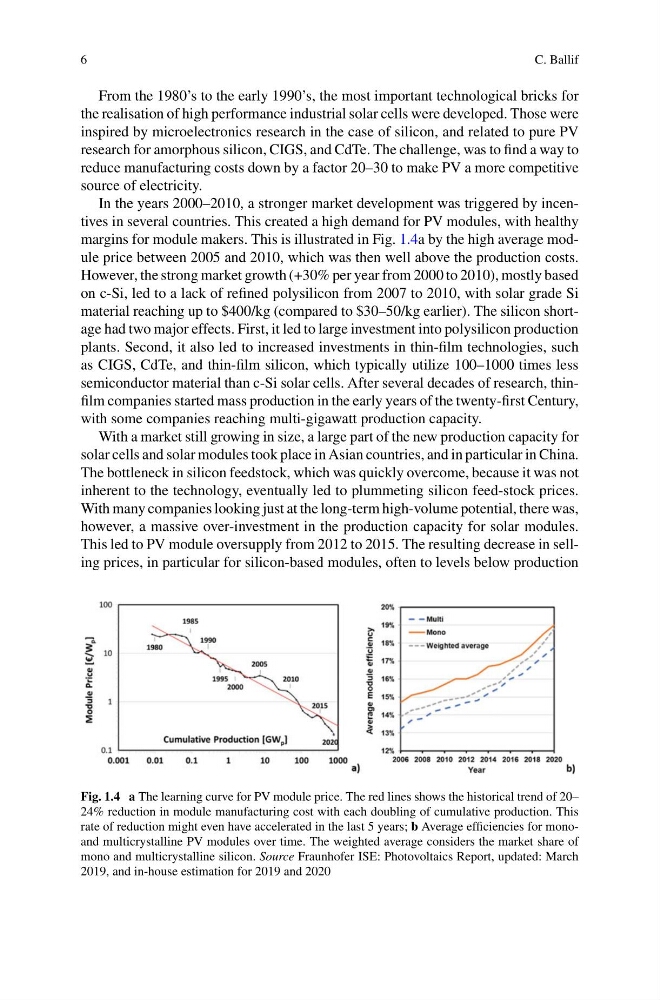
margins for module makers. This is illustrated in Fig. 1.4a by the high average module price between 2005 and 2010, which was then well above the production costs.
However, the strong market growth (+30% per year from 2000 to 2010), mostly based
on c-Si, led to a lack of refined polysilicon from 2007 to 2010, with solar grade Si
material reaching up to $400/kg (compared to $30–50/kg earlier). The silicon shortage had two major effects. First, it led to large investment into polysilicon production
plants. Second, it also led to increased investments in thin-film technologies, such
as CIGS, CdTe, and thin-film silicon, which typically utilize 100–1000 times less
semiconductor material than c-Si solar cells. After several decades of research, thinfilm companies started mass production in the early years of the twenty-first Century,
with some companies reaching multi-gigawatt production capacity.
With a market still growing in size, a large part of the new production capacity for
solar cells and solar modules took place in Asian countries, and in particular in China.
The bottleneck in silicon feedstock, which was quickly overcome, because it was not
inherent to the technology, eventually led to plummeting silicon feed-stock prices.
With many companies looking just at the long-term high-volume potential, there was,
however, a massive over-investment in the production capacity for solar modules.
This led to PV module oversupply from 2012 to 2015. The resulting decrease in selling prices, in particular for silicon-based modules, often to levels below production
Fig. 1.4 a The learning curve for PV module price. The red lines shows the historical trend of 20–
24% reduction in module manufacturing cost with each doubling of cumulative production. This
rate of reduction might even have accelerated in the last 5 years; b Average efficiencies for monoand multicrystalline PV modules over time. The weighted average considers the market share of
mono and multicrystalline silicon. Source Fraunhofer ISE: Photovoltaics Report, updated: March
2019, and in-house estimation for 2019 and 2020
C. Ballif
From the 1980’s to the early 1990’s, the most important technological bricks for
the realisation of high performance industrial solar cells were developed. Those were
inspired by microelectronics research in the case of silicon, and related to pure PV
research for amorphous silicon, CIGS, and CdTe. The challenge, was to find a way to
reduce manufacturing costs down by a factor 20–30 to make PV a more competitive
source of electricity.
In the years 2000–2010, a stronger market development was triggered by incentives in several countries. This created a high demand for PV modules, with healthy
margins for module makers. This is illustrated in Fig. 1.4a by the high average module price between 2005 and 2010, which was then well above the production costs.
However, the strong market growth (+30% per year from 2000 to 2010), mostly based
on c-Si, led to a lack of refined polysilicon from 2007 to 2010, with solar grade Si
material reaching up to $400/kg (compared to $30–50/kg earlier). The silicon shortage had two major effects. First, it led to large investment into polysilicon production
plants. Second, it also led to increased investments in thin-film technologies, such
as CIGS, CdTe, and thin-film silicon, which typically utilize 100–1000 times less
semiconductor material than c-Si solar cells. After several decades of research, thinfilm companies started mass production in the early years of the twenty-first Century,
with some companies reaching multi-gigawatt production capacity.
With a market still growing in size, a large part of the new production capacity for
solar cells and solar modules took place in Asian countries, and in particular in China.
The bottleneck in silicon feedstock, which was quickly overcome, because it was not
inherent to the technology, eventually led to plummeting silicon feed-stock prices.
With many companies looking just at the long-term high-volume potential, there was,
however, a massive over-investment in the production capacity for solar modules.
This led to PV module oversupply from 2012 to 2015. The resulting decrease in selling prices, in particular for silicon-based modules, often to levels below production
Fig. 1.4 a The learning curve for PV module price. The red lines shows the historical trend of 20–
24% reduction in module manufacturing cost with each doubling of cumulative production. This
rate of reduction might even have accelerated in the last 5 years; b Average efficiencies for monoand multicrystalline PV modules over time. The weighted average considers the market share of
mono and multicrystalline silicon. Source Fraunhofer ISE: Photovoltaics Report, updated: March
2019, and in-house estimation for 2019 and 2020