

9 Solar Module Technology
231
9.2.2.4 Other Module Components
Edge seal
In conventional glass/backsheet structures, moisture will diffuse through the permeable backsheet and equilibrate with the external environment in a time frame of
even less than a year [9]. In more solid structures (glass/glass or foils with metal
barriers), water can still diffuse in from the edges, depending on the diffusivity of the
encapsulant and on the specific climatic conditions. A hot and humid climate will
promote the diffusion of water vapour.
For cell materials that are extremely sensitive to moisture (as CIGS, transparent
conductive oxides, etc.), one can prevent the diffusion of moisture into the module
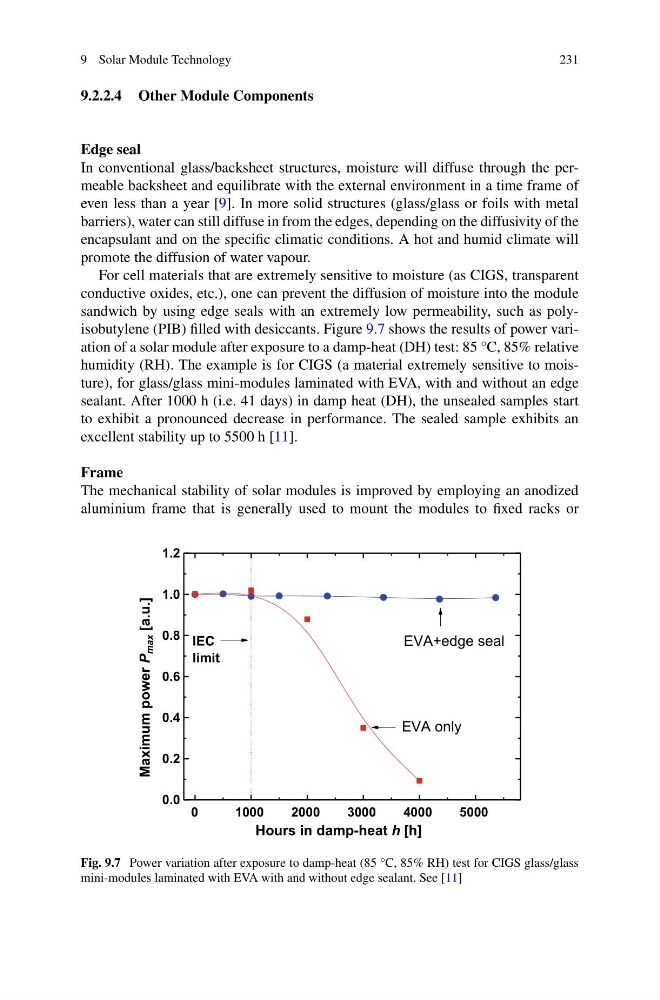
sandwich by using edge seals with an extremely low permeability, such as polyisobutylene (PIB) filled with desiccants. Figure 9.7 shows the results of power variation of a solar module after exposure to a damp-heat (DH) test: 85 °C, 85% relative
humidity (RH). The example is for CIGS (a material extremely sensitive to moisture), for glass/glass mini-modules laminated with EVA, with and without an edge
sealant. After 1000 h (i.e. 41 days) in damp heat (DH), the unsealed samples start
to exhibit a pronounced decrease in performance. The sealed sample exhibits an
excellent stability up to 5500 h [11].
Frame
The mechanical stability of solar modules is improved by employing an anodized
aluminium frame that is generally used to mount the modules to fixed racks or
0
1000
2000
3000
4000
5000
0.0
0.2
0.4
0.6
0.8
1.0
1.2
IEC
limit
EVA+edge seal
Maximum power P
max [a.u.]
Hours in damp-heat h [h]
EVA only
Fig. 9.7 Power variation after exposure to damp-heat (85 °C, 85% RH) test for CIGS glass/glass
mini-modules laminated with EVA with and without edge sealant. See [11]
231
9.2.2.4 Other Module Components
Edge seal
In conventional glass/backsheet structures, moisture will diffuse through the permeable backsheet and equilibrate with the external environment in a time frame of
even less than a year [9]. In more solid structures (glass/glass or foils with metal
barriers), water can still diffuse in from the edges, depending on the diffusivity of the
encapsulant and on the specific climatic conditions. A hot and humid climate will
promote the diffusion of water vapour.
For cell materials that are extremely sensitive to moisture (as CIGS, transparent
conductive oxides, etc.), one can prevent the diffusion of moisture into the module
sandwich by using edge seals with an extremely low permeability, such as polyisobutylene (PIB) filled with desiccants. Figure 9.7 shows the results of power variation of a solar module after exposure to a damp-heat (DH) test: 85 °C, 85% relative
humidity (RH). The example is for CIGS (a material extremely sensitive to moisture), for glass/glass mini-modules laminated with EVA, with and without an edge
sealant. After 1000 h (i.e. 41 days) in damp heat (DH), the unsealed samples start
to exhibit a pronounced decrease in performance. The sealed sample exhibits an
excellent stability up to 5500 h [11].
Frame
The mechanical stability of solar modules is improved by employing an anodized
aluminium frame that is generally used to mount the modules to fixed racks or
0
1000
2000
3000
4000
5000
0.0
0.2
0.4
0.6
0.8
1.0
1.2
IEC
limit
EVA+edge seal
Maximum power P
max [a.u.]
Hours in damp-heat h [h]
EVA only
Fig. 9.7 Power variation after exposure to damp-heat (85 °C, 85% RH) test for CIGS glass/glass
mini-modules laminated with EVA with and without edge sealant. See [11]