

214
A. Romeo
Table 8.1 Temperature
coefficients for different
materials (see Chap. 5 for
explanation of PERC)
Technology/product
series
Manufacturer
Power temperature
coefficient (%/°C)
IBC-crystalline
silicon
Sunpower
−0.29
Multi-PERC
crystalline silicon
Canadian solar −0.37
Mono-PERC
crystalline silicon
Longi solar
−0.38
Bifacial n-type
PERT
Jinko solar
−0.38
CdTe-series 6
First solar
−0.32
CdTe-series 3 black
plus
First solar
−0.29
CdTe-CX3Pro
Calyxo
−0.25
CIGS
Solar frontier
−0.33
CIGS
Avancis
−0.39
CIGS
Nice solar
−0.36
CIGS
Solibro
−0.32
CIGS
Flisom
−0.35
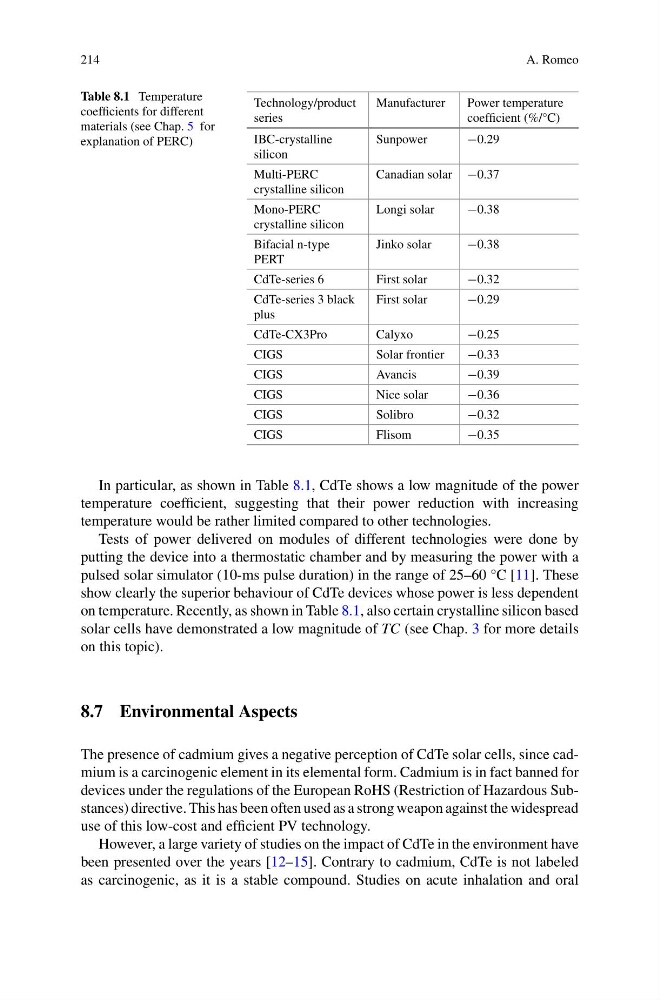
In particular, as shown in Table 8.1, CdTe shows a low magnitude of the power
temperature coefficient, suggesting that their power reduction with increasing
temperature would be rather limited compared to other technologies.
Tests of power delivered on modules of different technologies were done by
putting the device into a thermostatic chamber and by measuring the power with a
pulsed solar simulator (10-ms pulse duration) in the range of 25–60 °C [11]. These
show clearly the superior behaviour of CdTe devices whose power is less dependent
on temperature. Recently, as shown in Table 8.1, also certain crystalline silicon based
solar cells have demonstrated a low magnitude of TC (see Chap. 3 for more details
on this topic).
8.7 Environmental Aspects
The presence of cadmium gives a negative perception of CdTe solar cells, since cadmium is a carcinogenic element in its elemental form. Cadmium is in fact banned for
devices under the regulations of the European RoHS (Restriction of Hazardous Substances) directive. This has been often used as a strong weapon against the widespread
use of this low-cost and efficient PV technology.
However, a large variety of studies on the impact of CdTe in the environment have
been presented over the years [12–15]. Contrary to cadmium, CdTe is not labeled
as carcinogenic, as it is a stable compound. Studies on acute inhalation and oral
A. Romeo
Table 8.1 Temperature
coefficients for different
materials (see Chap. 5 for
explanation of PERC)
Technology/product
series
Manufacturer
Power temperature
coefficient (%/°C)
IBC-crystalline
silicon
Sunpower
−0.29
Multi-PERC
crystalline silicon
Canadian solar −0.37
Mono-PERC
crystalline silicon
Longi solar
−0.38
Bifacial n-type
PERT
Jinko solar
−0.38
CdTe-series 6
First solar
−0.32
CdTe-series 3 black
plus
First solar
−0.29
CdTe-CX3Pro
Calyxo
−0.25
CIGS
Solar frontier
−0.33
CIGS
Avancis
−0.39
CIGS
Nice solar
−0.36
CIGS
Solibro
−0.32
CIGS
Flisom
−0.35
In particular, as shown in Table 8.1, CdTe shows a low magnitude of the power
temperature coefficient, suggesting that their power reduction with increasing
temperature would be rather limited compared to other technologies.
Tests of power delivered on modules of different technologies were done by
putting the device into a thermostatic chamber and by measuring the power with a
pulsed solar simulator (10-ms pulse duration) in the range of 25–60 °C [11]. These
show clearly the superior behaviour of CdTe devices whose power is less dependent
on temperature. Recently, as shown in Table 8.1, also certain crystalline silicon based
solar cells have demonstrated a low magnitude of TC (see Chap. 3 for more details
on this topic).
8.7 Environmental Aspects
The presence of cadmium gives a negative perception of CdTe solar cells, since cadmium is a carcinogenic element in its elemental form. Cadmium is in fact banned for
devices under the regulations of the European RoHS (Restriction of Hazardous Substances) directive. This has been often used as a strong weapon against the widespread
use of this low-cost and efficient PV technology.
However, a large variety of studies on the impact of CdTe in the environment have
been presented over the years [12–15]. Contrary to cadmium, CdTe is not labeled
as carcinogenic, as it is a stable compound. Studies on acute inhalation and oral