

4
C. Ballif
production. The required area, with 20% efficient modules covering half the surface
of the solar power plants (Fig. 1.2a), would be in the range of 340,000 km
2 . This
corresponds to a modest 3% of the area of the Sahara desert, or, alternatively, to 3.4%
of the territory of the USA or China.
1.2 Photovoltaics: A Choice of Technology
There are many possible semiconductors with which to make solar cells, and there
are different ways to process these materials into solar cells. However, the three main
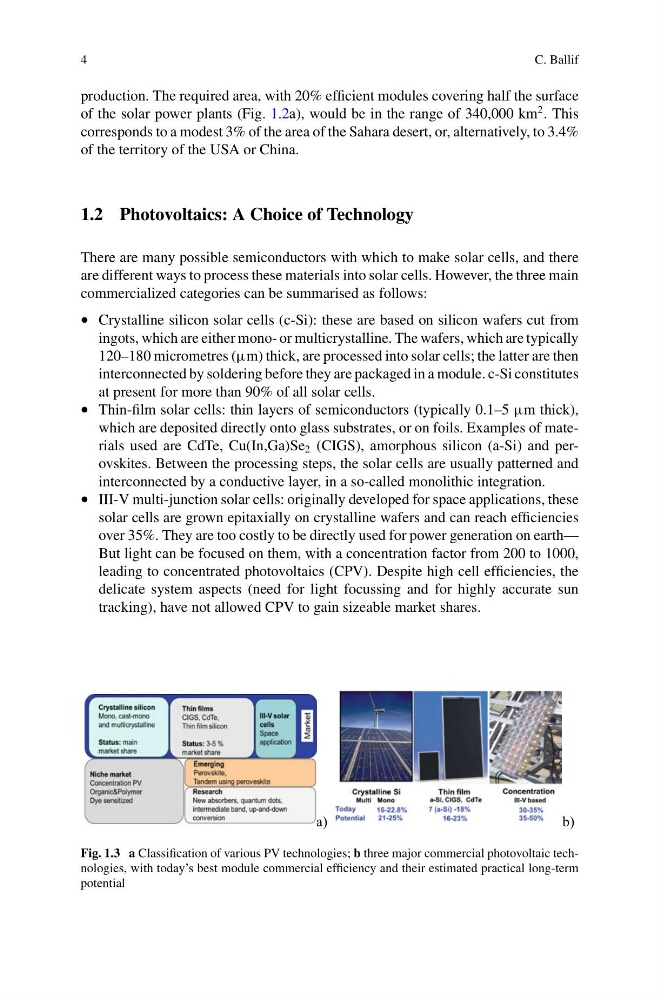
commercialized categories can be summarised as follows:
• Crystalline silicon solar cells (c-Si): these are based on silicon wafers cut from
ingots, which are either mono- or multicrystalline. The wafers, which are typically
120–180 micrometres (µm) thick, are processed into solar cells; the latter are then
interconnected by soldering before they are packaged in a module. c-Si constitutes
at present for more than 90% of all solar cells.
• Thin-film solar cells: thin layers of semiconductors (typically 0.1–5 µm thick),
which are deposited directly onto glass substrates, or on foils. Examples of materials used are CdTe, Cu(In,Ga)Se 2 (CIGS), amorphous silicon (a-Si) and perovskites. Between the processing steps, the solar cells are usually patterned and
interconnected by a conductive layer, in a so-called monolithic integration.
• III-V multi-junction solar cells: originally developed for space applications, these
solar cells are grown epitaxially on crystalline wafers and can reach efficiencies
over 35%. They are too costly to be directly used for power generation on earth—
But light can be focused on them, with a concentration factor from 200 to 1000,
leading to concentrated photovoltaics (CPV). Despite high cell efficiencies, the
delicate system aspects (need for light focussing and for highly accurate sun
tracking), have not allowed CPV to gain sizeable market shares.
a)
b)
Fig. 1.3 a Classification of various PV technologies; b three major commercial photovoltaic technologies, with today’s best module commercial efficiency and their estimated practical long-term
potential
C. Ballif
production. The required area, with 20% efficient modules covering half the surface
of the solar power plants (Fig. 1.2a), would be in the range of 340,000 km
2 . This
corresponds to a modest 3% of the area of the Sahara desert, or, alternatively, to 3.4%
of the territory of the USA or China.
1.2 Photovoltaics: A Choice of Technology
There are many possible semiconductors with which to make solar cells, and there
are different ways to process these materials into solar cells. However, the three main
commercialized categories can be summarised as follows:
• Crystalline silicon solar cells (c-Si): these are based on silicon wafers cut from
ingots, which are either mono- or multicrystalline. The wafers, which are typically
120–180 micrometres (µm) thick, are processed into solar cells; the latter are then
interconnected by soldering before they are packaged in a module. c-Si constitutes
at present for more than 90% of all solar cells.
• Thin-film solar cells: thin layers of semiconductors (typically 0.1–5 µm thick),
which are deposited directly onto glass substrates, or on foils. Examples of materials used are CdTe, Cu(In,Ga)Se 2 (CIGS), amorphous silicon (a-Si) and perovskites. Between the processing steps, the solar cells are usually patterned and
interconnected by a conductive layer, in a so-called monolithic integration.
• III-V multi-junction solar cells: originally developed for space applications, these
solar cells are grown epitaxially on crystalline wafers and can reach efficiencies
over 35%. They are too costly to be directly used for power generation on earth—
But light can be focused on them, with a concentration factor from 200 to 1000,
leading to concentrated photovoltaics (CPV). Despite high cell efficiencies, the
delicate system aspects (need for light focussing and for highly accurate sun
tracking), have not allowed CPV to gain sizeable market shares.
a)
b)
Fig. 1.3 a Classification of various PV technologies; b three major commercial photovoltaic technologies, with today’s best module commercial efficiency and their estimated practical long-term
potential