

6 Amorphous Silicon Solar Cells
153
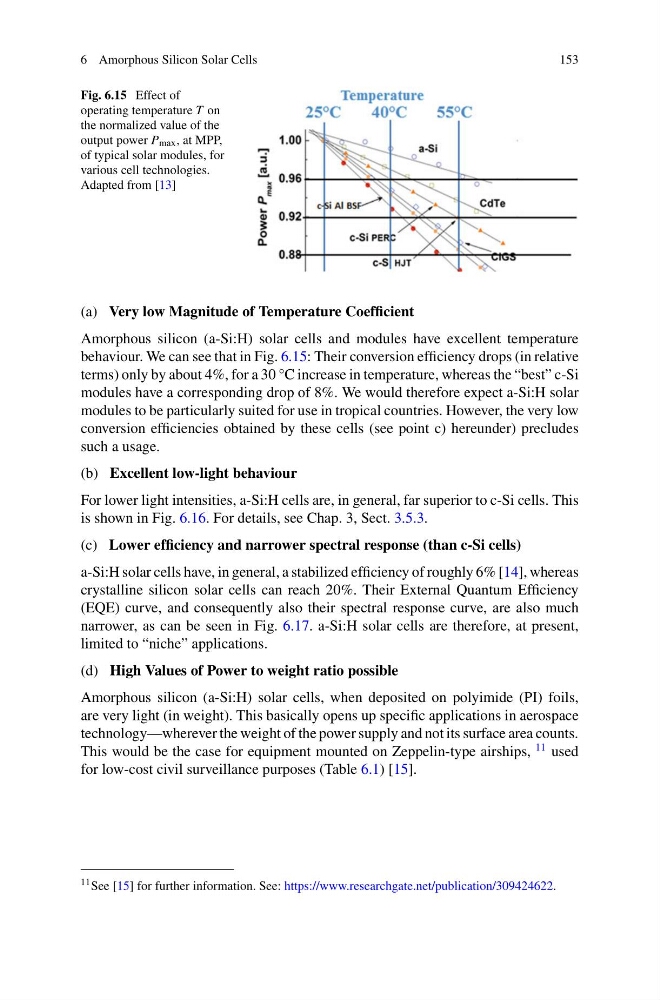
Fig. 6.15 Effect of
operating temperature T on
the normalized value of the
output power P max , at MPP,
of typical solar modules, for
various cell technologies.
Adapted from [13]
(a) Very low Magnitude of Temperature Coefficient
Amorphous silicon (a-Si:H) solar cells and modules have excellent temperature
behaviour. We can see that in Fig. 6.15: Their conversion efficiency drops (in relative
terms) only by about 4%, for a 30 °C increase in temperature, whereas the “best” c-Si
modules have a corresponding drop of 8%. We would therefore expect a-Si:H solar
modules to be particularly suited for use in tropical countries. However, the very low
conversion efficiencies obtained by these cells (see point c) hereunder) precludes
such a usage.
(b) Excellent low-light behaviour
For lower light intensities, a-Si:H cells are, in general, far superior to c-Si cells. This
is shown in Fig. 6.16. For details, see Chap. 3, Sect. 3.5.3.
(c) Lower efficiency and narrower spectral response (than c-Si cells)
a-Si:H solar cells have, in general, a stabilized efficiency of roughly 6% [14], whereas
crystalline silicon solar cells can reach 20%. Their External Quantum Efficiency
(EQE) curve, and consequently also their spectral response curve, are also much
narrower, as can be seen in Fig. 6.17. a-Si:H solar cells are therefore, at present,
limited to “niche” applications.
(d) High Values of Power to weight ratio possible
Amorphous silicon (a-Si:H) solar cells, when deposited on polyimide (PI) foils,
are very light (in weight). This basically opens up specific applications in aerospace
technology—wherever the weight of the power supply and not its surface area counts.
This would be the case for equipment mounted on Zeppelin-type airships,
11 used
for low-cost civil surveillance purposes (Table 6.1) [15].
11 See [15] for further information. See: https://www.researchgate.net/publication/309424622.
153
Fig. 6.15 Effect of
operating temperature T on
the normalized value of the
output power P max , at MPP,
of typical solar modules, for
various cell technologies.
Adapted from [13]
(a) Very low Magnitude of Temperature Coefficient
Amorphous silicon (a-Si:H) solar cells and modules have excellent temperature
behaviour. We can see that in Fig. 6.15: Their conversion efficiency drops (in relative
terms) only by about 4%, for a 30 °C increase in temperature, whereas the “best” c-Si
modules have a corresponding drop of 8%. We would therefore expect a-Si:H solar
modules to be particularly suited for use in tropical countries. However, the very low
conversion efficiencies obtained by these cells (see point c) hereunder) precludes
such a usage.
(b) Excellent low-light behaviour
For lower light intensities, a-Si:H cells are, in general, far superior to c-Si cells. This
is shown in Fig. 6.16. For details, see Chap. 3, Sect. 3.5.3.
(c) Lower efficiency and narrower spectral response (than c-Si cells)
a-Si:H solar cells have, in general, a stabilized efficiency of roughly 6% [14], whereas
crystalline silicon solar cells can reach 20%. Their External Quantum Efficiency
(EQE) curve, and consequently also their spectral response curve, are also much
narrower, as can be seen in Fig. 6.17. a-Si:H solar cells are therefore, at present,
limited to “niche” applications.
(d) High Values of Power to weight ratio possible
Amorphous silicon (a-Si:H) solar cells, when deposited on polyimide (PI) foils,
are very light (in weight). This basically opens up specific applications in aerospace
technology—wherever the weight of the power supply and not its surface area counts.
This would be the case for equipment mounted on Zeppelin-type airships,
11 used
for low-cost civil surveillance purposes (Table 6.1) [15].
11 See [15] for further information. See: https://www.researchgate.net/publication/309424622.