

6 Amorphous Silicon Solar Cells
151
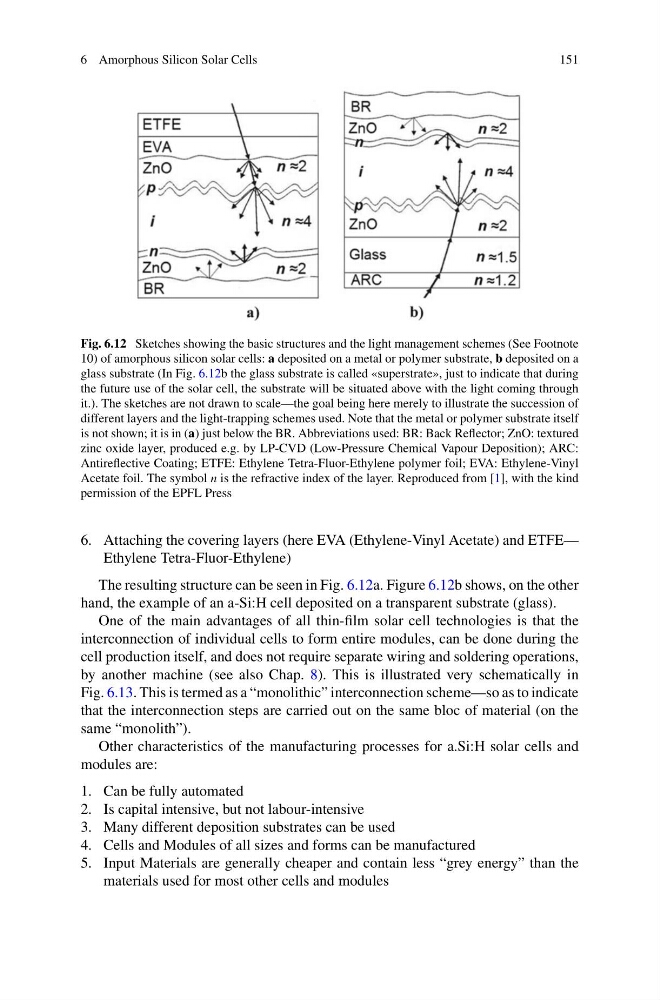
Fig. 6.12 Sketches showing the basic structures and the light management schemes (See Footnote
10) of amorphous silicon solar cells: a deposited on a metal or polymer substrate, b deposited on a
glass substrate (In Fig. 6.12b the glass substrate is called «superstrate», just to indicate that during
the future use of the solar cell, the substrate will be situated above with the light coming through
it.). The sketches are not drawn to scale—the goal being here merely to illustrate the succession of
different layers and the light-trapping schemes used. Note that the metal or polymer substrate itself
is not shown; it is in (a) just below the BR. Abbreviations used: BR: Back Reflector; ZnO: textured
zinc oxide layer, produced e.g. by LP-CVD (Low-Pressure Chemical Vapour Deposition); ARC:
Antireflective Coating; ETFE: Ethylene Tetra-Fluor-Ethylene polymer foil; EVA: Ethylene-Vinyl
Acetate foil. The symbol n is the refractive index of the layer. Reproduced from [1], with the kind
permission of the EPFL Press
6. Attaching the covering layers (here EVA (Ethylene-Vinyl Acetate) and ETFE—
Ethylene Tetra-Fluor-Ethylene)
The resulting structure can be seen in Fig. 6.12a. Figure 6.12b shows, on the other
hand, the example of an a-Si:H cell deposited on a transparent substrate (glass).
One of the main advantages of all thin-film solar cell technologies is that the
interconnection of individual cells to form entire modules, can be done during the
cell production itself, and does not require separate wiring and soldering operations,
by another machine (see also Chap. 8). This is illustrated very schematically in
Fig. 6.13. This is termed as a “monolithic” interconnection scheme—so as to indicate
that the interconnection steps are carried out on the same bloc of material (on the
same “monolith”).
Other characteristics of the manufacturing processes for a.Si:H solar cells and
modules are:
1. Can be fully automated
2. Is capital intensive, but not labour-intensive
3. Many different deposition substrates can be used
4. Cells and Modules of all sizes and forms can be manufactured
5. Input Materials are generally cheaper and contain less “grey energy” than the
materials used for most other cells and modules
151
Fig. 6.12 Sketches showing the basic structures and the light management schemes (See Footnote
10) of amorphous silicon solar cells: a deposited on a metal or polymer substrate, b deposited on a
glass substrate (In Fig. 6.12b the glass substrate is called «superstrate», just to indicate that during
the future use of the solar cell, the substrate will be situated above with the light coming through
it.). The sketches are not drawn to scale—the goal being here merely to illustrate the succession of
different layers and the light-trapping schemes used. Note that the metal or polymer substrate itself
is not shown; it is in (a) just below the BR. Abbreviations used: BR: Back Reflector; ZnO: textured
zinc oxide layer, produced e.g. by LP-CVD (Low-Pressure Chemical Vapour Deposition); ARC:
Antireflective Coating; ETFE: Ethylene Tetra-Fluor-Ethylene polymer foil; EVA: Ethylene-Vinyl
Acetate foil. The symbol n is the refractive index of the layer. Reproduced from [1], with the kind
permission of the EPFL Press
6. Attaching the covering layers (here EVA (Ethylene-Vinyl Acetate) and ETFE—
Ethylene Tetra-Fluor-Ethylene)
The resulting structure can be seen in Fig. 6.12a. Figure 6.12b shows, on the other
hand, the example of an a-Si:H cell deposited on a transparent substrate (glass).
One of the main advantages of all thin-film solar cell technologies is that the
interconnection of individual cells to form entire modules, can be done during the
cell production itself, and does not require separate wiring and soldering operations,
by another machine (see also Chap. 8). This is illustrated very schematically in
Fig. 6.13. This is termed as a “monolithic” interconnection scheme—so as to indicate
that the interconnection steps are carried out on the same bloc of material (on the
same “monolith”).
Other characteristics of the manufacturing processes for a.Si:H solar cells and
modules are:
1. Can be fully automated
2. Is capital intensive, but not labour-intensive
3. Many different deposition substrates can be used
4. Cells and Modules of all sizes and forms can be manufactured
5. Input Materials are generally cheaper and contain less “grey energy” than the
materials used for most other cells and modules